
 Sankalp
R Vision Pvt. Ltd manufactures aluminium roll-on pilfer-proof (ROPP) closures at MIDC Malegaon, Sinnar, Nashik, Maharashtra. There are two products, Aqua Cap for packaged drinking water and Bev Cap for beverages, both made in 28/15 mm with a TPE liner and rated to 8 bar. This page collects the questions bottlers, brand owners and procurement teams ask before they order, grouped by what they are actually trying to decide. The full range is on Products, and anything not answered here can go to R Vision directly. After each group of questions, a short table points to the page that covers each subject in full. The company’s registered details are on the R Vision company profile.
Frequently asked questions about the products
R Vision makes two closures. Both are 28/15 mm. The difference is what the tamper ring does after the bottle is opened. Full specifications sit on the Aqua Cap and Bev Cap product pages.
What closures does R Vision manufacture?
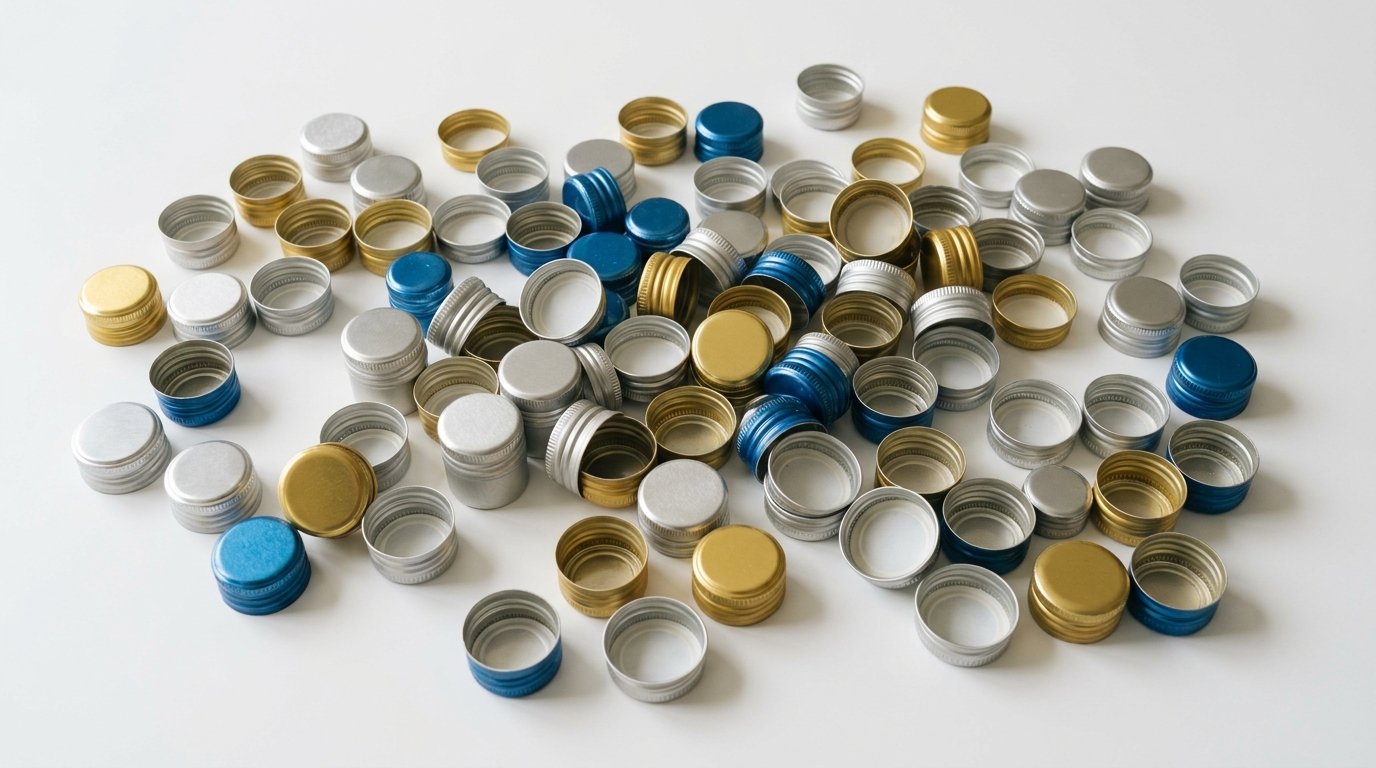
R Vision manufactures two aluminium roll-on pilfer-proof closures. Aqua Cap is the tamper-evident closure for packaged drinking water, built with a three-part break-system ring that separates visibly on first opening. Bev Cap is the beverage closure, built with a PVC-free TPE liner and a pilfer-proof ring that stays attached after opening so the bottle reseals. Both are made in 28/15 mm.
What does ROPP stand for?
ROPP stands for roll-on pilfer-proof. The cap is supplied as a plain aluminium shell with no thread formed in it. During capping, rollers on the capping head press the aluminium against the bottle neck and form the thread onto the neck profile at that moment. The pilfer-proof part refers to the lower band, which breaks when the bottle is first opened.
What is the difference between Aqua Cap and Bev Cap?
The tamper ring behaves differently. Aqua Cap uses a three-part break-system ring that separates visibly on first opening, which is the right answer for packaged drinking water, where the buyer needs a clear signal at the shelf. Bev Cap keeps its pilfer-proof ring attached to the closure after opening, so the bottle reseals for a drink consumed over time. Bev Cap also specifies a PVC-free TPE liner and comes in Round Ring, Two Slit and Five Slit variants.
What size are R Vision’s caps?
Both closures are 28/15 mm. That is the only size R Vision manufactures. Other ROPP diameters exist across the wider market, but they are not R Vision products, so a bottle neck has to be matched to 28/15 mm before ordering.
What does 28/15 mm mean?
In ROPP notation the first number is the neck diameter in millimetres and the second is the cap height in millimetres. So 28/15 is a cap for a 28 mm neck, standing 15 mm tall. This differs from GPI neck finish codes such as 38-400, where the second number is a coded thread style rather than a measurement.
Is a ROPP cap the same as a pilfer-proof cap?
In practice yes, for aluminium closures of this type. Pilfer-proof describes the lower band that breaks on first opening. Roll-on describes how the thread is formed during capping. A roll-on pilfer-proof closure does both, which is why the two terms are used interchangeably in the Indian packaging trade.
What products are these closures used on?
Packaged drinking water, carbonated soft drinks, juices, and flavoured or functional beverages. Both closures suit hot fill, cold fill and carbonated products. Aqua Cap is specified mainly by water bottlers, and Bev Cap by beverage bottlers who need the bottle to reseal.
What type of plastic is the Bev Cap?
Bev Cap is mainly aluminium, not plastic. The cap body is an aluminium shell, the tamper ring is PE (polyethylene), and the liner that seals against the bottle is TPE (thermoplastic elastomer), specified PVC-free. Those two, the PE ring and the TPE liner, are the only plastics in the closure.
Is the PP cap and ROPP cap same?
In Indian trade use, usually yes: PP in “PP cap” normally stands for pilfer-proof, so a PP cap and a ROPP cap name the same aluminium roll-on closure. PP also stands for polypropylene, the plastic many moulded screw caps are made from, so confirm which one a quotation means.
What is the ROPP cap full form in pharma?
The same as in every other industry: roll-on pilfer-proof. In pharmaceutical packaging ROPP caps close syrup and liquid bottles, usually in smaller diameters than beverage caps, and “PP cap” is often used there as shorthand for the pilfer-proof cap.
What is a ROPP cap with wad?
Wad is an older trade word for the liner, the disc inside the top of the cap that seals against the bottle rim. A ROPP cap with wad is simply a lined roll-on pilfer-proof cap. Wads were once cork or pulp board with a facing; current closures mostly use polymer liners such as EPE, PE or TPE.
What is a CSD bottle closure?
CSD stands for carbonated soft drink, so a CSD closure is one built to hold carbonation pressure for the life of the pack. It needs a pressure rating, a liner or seal that keeps CO2 in, and a match to a carbonated neck finish, such as PCO 1881 on PET or an MCA finish on glass.
Are ROPP caps used in liquor bottles?
Yes. Aluminium ROPP caps are common on Indian liquor bottles, usually in larger diameters with taller skirts than water or soft drink caps, and sometimes combined with anti-refill fittings. R Vision does not make liquor closures; its 28/15 mm closures are for water and beverages.
What are the names of soft drink bottle cap types?
Four types cover most soft drinks: plastic screw caps on PET finishes such as PCO 1881, aluminium ROPP caps on glass and roll-on PET necks, crown caps on glass bottles opened with an opener, and sports or flip-top caps on some flavoured and sports drinks.
Is a beer crown cap made of aluminium or tinplate?
A standard crown cap is steel, usually tinplate or tin-free steel, with a sealing compound inside. Aluminium is used for roll-on closures rather than for mainstream crown caps. A crown is crimped onto a glass bottle and does not reseal, which is the main practical difference from a ROPP cap.
Where the product and terms questions are covered in full
Each of the subjects above has a page of its own, and the table sends each question there.
| Question | Covered in full |
|---|---|
| Aqua Cap against Bev Cap | Aqua Cap and Bev Cap compared |
| What ROPP stands for | ROPP cap full form |
| PP cap, ROPP cap and screw cap, including pharma usage | PP cap, ROPP cap and screw cap: which term means what |
| CSD closures | What is a CSD closure |
| Juices and hot-filled drinks | Closures for juices and RTD beverages |
| Liquor closures | Liquor bottle caps in India |
| Crown caps against ROPP caps | Crown cap vs ROPP cap |
| Every cap type by name | Types of bottle caps |
| Questions specific to Bev Cap | Bev Cap FAQ |
Frequently asked questions about sizes, weight and neck finishes
Buyers ask for a size and mean a neck. These answers keep the two apart.
What are the standard ROPP closure sizes?
Across the industry, ROPP closures are commonly made in 18, 20, 22, 25, 28, 30, 31.5 and 38 mm diameters, each in a range of heights set by the depth of the neck finish. 28 mm is the main size for water and soft drinks, and larger diameters serve spirits and wide-neck food bottles. R Vision makes 28/15 mm only.
What is the weight of a 28 mm ROPP cap?
It depends on the aluminium gauge, the skirt height and the liner, so no single figure holds across suppliers. The reliable method is to weigh a counted sample, such as 100 caps from one lot, and divide. The same weighing gives pieces per kilogram, which is what turns a per-kilogram figure into a per-thousand one.
What are the ROPP 28 neck finish standard sizes?
A 28 mm ROPP closure seats on the 28 mm MCA glass finishes, which CETIE publishes as data sheets: MCA 1, MCA 3, MCA 7.5 R for returnable glass and the 7.5 RF universal finish for pressurised liquids. MCA II appears in supplier listings. A PET bottle takes a roll-on closure only if its preform carries a finish drawn for one.
Is a 18mm ROPP finish the same as a 18-350 finish?
No. An 18 mm ROPP finish is a neck for an aluminium cap whose thread is formed on the bottle during capping, while 18-350 is a code for a finish with a moulded thread that takes a threaded cap. The diameter matches, but the thread and the closure type do not, so one cap will not fit both.
What does 38/400 mean for cap dimensions?
38 is the outside diameter of the bottle neck in millimetres. 400 is the finish style, a code describing a shallow finish with about one turn of thread, not a measurement. A 38-400 cap fits a 38-400 neck; it will not seat correctly on a 38-410, which has the same diameter and a taller thread.
How to measure bottle cap size at home?
Measure the outside diameter of the bottle neck across the thread, in millimetres, with a vernier caliper, and match it to the nearest standard size. For a ROPP cap, also measure from the top of the neck down to just below the locking ring for the height. A ruler gets close, but only a caliper separates neighbouring sizes.
Where the size and neck finish questions are covered in full
Sizes, weights and finishes each have a reference page, listed here against the question.
| Question | Covered in full |
|---|---|
| The full standard ROPP size range | ROPP cap size chart |
| Cap weight, gauge and pieces per kilogram | ROPP cap weight, gauge and pieces per kilogram |
| 28 mm MCA and other roll-on glass finishes | Glass bottle neck finishes for ROPP caps |
| Indian Standards for glass neck finishes | Neck finish standards on Indian glass bottles |
| Whether a GPI or SPI finish is a ROPP finish | GPI and SPI neck finishes, and how they differ from a ROPP finish |
| Reading a code such as 38-400 | What does 38-400 cap size mean |
| What the second number in 28/15 means | Long skirt vs short skirt ROPP caps |
| Measuring a cap or a neck | How to measure bottle cap size |
| Cap sizes on Indian water packs | Water bottle cap sizes used in India |
| Neck finishes on Indian PET water bottles | Neck formats on Indian packaged water bottles |
Frequently asked questions about ordering
Every order is quoted against volume, colour and decoration, so there is no shelf price. What drives the number is set out in ROPP cap price in India.
What is the minimum order quantity?
Minimum order is 50,000 caps for plain silver, 200,000 caps for plain colours and 300,000 caps for litho printing. The same tiers apply to both Aqua Cap and Bev Cap.
Why are there three different minimum order quantities?
The tiers track setup work rather than the cap itself. A plain silver run needs no colour or plate preparation, so it carries the lowest floor. A colour run adds a coating pass and the setup that goes with it. Litho printing needs printing plates cut for your specific artwork, which is the largest fixed cost and therefore the highest minimum.
What is the lead time?
Lead time is 4 to 6 weeks from a confirmed order. On litho-printed orders, artwork approval sits ahead of that window, because the plates cannot be cut until the design is signed off, so allow additional time if artwork is not final.
How much do ROPP caps cost?
There is no list price. Aluminium closures are quoted per order against the volume, the colour or decoration specified, and the finish. A plain silver run at the 50,000 minimum prices differently from a litho-printed run at 300,000. Send your volume and decoration requirement to get a figure for your line.
Can I get samples before ordering?
Yes. Ask for samples in plain silver first, since that avoids the artwork and plate stage entirely and gets caps onto your capping head fastest. For Bev Cap, request all three ring variants in the same sample set, because the choice between Round Ring, Two Slit and Five Slit is best made on your own line.
What information is needed to prepare a quotation?
The bottle neck specification, the fill type and whether the product is carbonated, the annual or per-order volume, and the decoration you want on the top and side of the cap. If a colour is being matched to existing brand packaging, say so at enquiry stage rather than after the first run.
How are caps packed and shipped?
Caps are packed in PE bags, and the bags are packed into export-grade corrugated cartons made from recycled or virgin kraft paper. Cartons carry the manufacturing date, which is what shelf life and stock rotation are measured against.
What is the shelf life of an unused cap, and how should cartons be stored?
Shelf life is two years from the manufacturing date printed on the carton. Cartons should be held in a clean environment with the temperature maintained between 5 and 30 degrees centigrade. Rotate stock against the carton date rather than the delivery date.
Where the ordering questions are covered in full
Minimums, lead time, cost and packing are each worked through on a page of their own.
| Question | Covered in full |
|---|---|
| Why minimums step with decoration | What MOQ means for bottle caps |
| Buying in bulk, from enquiry to delivery | Bulk ROPP cap orders |
| What sits inside a cap quote | What drives the cost of a ROPP cap |
| Printed, embossed and foiled caps | Custom printed and embossed bottle caps |
| The specification to quote against | ROPP cap specification sheet |
| Carton counts, storage and shelf life | Packing, carton counts and storage for aluminium closures |
| Where the caps are made, and transit times | Inside our Nashik plant |
Frequently asked questions about compatibility and machinery
A ROPP closure is only as good as the fit between cap, neck and capping head. The components involved are laid out in parts of a ROPP cap.
Will these caps run on our existing capping line?
Yes, if the line is a standard roll-on capping line and the bottle neck is 28/15 mm. Both closures are designed for standard roll-on application machinery and need no line conversion. What does need attention is the head setting, since roller pressure and thread profile have to be dialled in for the specific neck.
Do ROPP caps need a special capping head?
They need a roll-on head, which is different from the chuck head used for pre-threaded plastic screw caps. A roll-on head carries thread rollers and a pilfer roller that form the thread and tuck the pilfer band under the neck bead. Any line already running aluminium ROPP closures already has this.
How do I check that my bottle neck matches a 28/15 mm cap?
Measure the outside diameter of the neck across the thread area; for a 28/15 mm closure that should be 28 mm. Then confirm the neck profile against the bottle supplier’s technical drawing rather than by eye, because two necks of the same diameter can carry different bead and thread geometry. Ask the bottle supplier for the drawing if you do not have it.
Can the same closure be used on glass and PET bottles?
Closure finish options include MCA I/II/III, MCA 7.5 R, MCA 7.5 RF and PET BPF, so both bottle types are covered by the range. Which finish is correct depends on the neck specification of the bottle in question, so confirm the finish at enquiry stage rather than assuming one carries across from another bottle.
What causes capping defects on a ROPP line?
The common causes are mechanical rather than material: roller pressure set too high or too low, a worn or mis-set capping head, misalignment between the head and the bottle neck, and inconsistent neck geometry from the bottle supplier. Symptoms show up as loose caps, stripped threads, crooked application, or a pilfer band that fails to tuck properly under the bead.
What is the difference between a ROPP cap and a plastic screw cap?
A plastic screw cap is moulded with its thread already formed and is screwed onto a matching bottle thread. A ROPP cap arrives unthreaded and the thread is created on the line at the moment of capping. That is why ROPP gives an exact fit to the individual neck, and why the closure cannot simply be moved between different neck profiles without resetting the head.
How does a ROPP cap head work?
The head lowers onto the plain aluminium shell and a pressure block presses it down, compressing the liner onto the bottle rim. Thread rollers then run around the skirt and press the aluminium into the bottle’s thread, and pilfer rollers tuck the lower band under the neck’s locking ring. The cycle repeats on every bottle.
What is removal torque a measure of?
Removal torque measures the twisting force needed to open a closed container. On a screw cap it is read after a set dwell, because it falls as the liner relaxes. On a ROPP cap, opening is recorded as separate events: slip torque to start movement, bridge torque to break the tamper band, and over torque to strip the thread.
Can a soft drink bottle withstand 8 bar pressure?
The 8 bar figure on a closure is the closure’s rating, not the bottle’s. Whether a bottle holds a given pressure depends on its design, weight and material, and carbonated bottles are designed and tested by the bottle or preform maker for the carbonation they carry. Ask that supplier for the bottle’s pressure test results at your storage temperature.
Are these closures suitable for hot fill?
Yes. Both Aqua Cap and Bev Cap are specified for hot fill, cold fill and carbonated products. The TPE liner is what carries this, since it has to hold a seal as the headspace cools and contracts after a hot fill.
Where the compatibility and machinery questions are covered in full
Settings, torque, testing and faults each have a detailed page.
| Question | Covered in full |
|---|---|
| Head settings and roller positions | ROPP capping machine guide |
| Slip, bridge, over and removal torque | Cap torque specifications |
| Leak, torque, band break and drop testing | Testing a ROPP closure |
| Faults and their causes | Capping defects |
| Leaking caps | Why water bottle caps leak |
| What 8 bar means, and CO2 volumes | What is an 8 bar pressure rating |
| Checking an incoming batch | Cap dimension tolerances and QC sampling |
Frequently asked questions about materials and safety
The liner is the only part of the closure in contact with the product, which makes it the component food-safety questions land on.
What are R Vision’s closures made of?
The cap body is aluminium, the tamper ring is PE (polyethylene), and the liner is TPE (thermoplastic elastomer). On Bev Cap the TPE liner is specified PVC-free.
What is a cap liner and why does it matter?
The liner, sometimes called a wad, is the soft disc inside the top of the cap that presses against the bottle rim and forms the seal. It matters for two reasons at once. It determines whether the bottle actually seals, and because it is the only cap component touching the product, its material governs what can transfer into the contents.
What is a TPE liner?
TPE stands for thermoplastic elastomer. It is a liner material that is soft enough to seal against a bottle rim without needing plasticisers added to make it pliable, which is the property that distinguishes it from a PVC compound. Both R Vision closures use a TPE liner.
Is the liner PVC-free?
Bev Cap is specified with a PVC-free TPE liner. PVC is rigid on its own and has to be softened with plasticisers before it will seal, and those plasticisers are what raise migration concerns for food and beverage contact. TPE does not need them.
What standards do R Vision’s closures follow?
Both closures are made adhering to USFDA and EU standards for food-contact materials. Packaged drinking water sold in India is separately governed by FSSAI rules and made to the BIS standard IS 14543, which covers the water and its packaging rather than the closure component on its own.
Are aluminium caps recyclable?
Aluminium is recyclable and is one of the most widely recovered packaging materials. On a ROPP closure the cap body is aluminium and the tamper ring is polyethylene, so the two components are different material streams. Practical recovery therefore depends on the collection and sorting system the closure ends up in, not on the material alone.
Why choose aluminium over a plastic closure?
Three things usually decide it. Aluminium takes litho printing, embossing and hot foiling in a way a moulded plastic cap does not, so it reads as a different product class on the shelf. The roll-on process forms the thread onto each individual neck, which gives a tight fit. And an aluminium closure with a TPE liner holds pressure well, which is what an 8 bar rating reflects.
What is the difference between an EPE liner and a PE liner?
EPE is expanded polyethylene, a foamed liner that compresses easily and seals against slightly uneven rims. PE here means solid polyethylene, a firmer liner with a harder seal face. Both are polyethylene and both are PVC-free. The choice follows the rim finish, the product and the pressure the pack has to hold.
What is a PVC lined cap?
A cap whose liner is a PVC compound. PVC is rigid on its own, so it is softened with plasticisers before it will seal, and those plasticisers are the migration concern that has moved beverage brands toward PVC-free liners such as TPE. PVC compounds are still found on some metal closures.
What does a BPA-NI, PVC-free cap liner mean?
BPA-NI means bisphenol A non-intent: the coating or compound is made without intentionally added BPA. PVC-free means the liner contains no polyvinyl chloride. Together they describe a closure whose internal coating and sealing liner avoid both chemistries. Both are formulation claims, so ask the supplier for a written declaration supporting them.
Are aluminium caps food grade?
Aluminium caps are made for food contact with a coating on the inside and a compliant liner, which is the part that touches the product. Food-grade is judged by what migrates into the product under test, so the evidence to ask for is a food-contact declaration and a liner migration report rather than a general statement about the metal.
What are the ROPP cap production stages?
In general terms: aluminium is coated and decorated with colour or litho print, blanked and drawn into a shell with a knurled skirt and the tamper band detail, lined, inspected and packed. The thread is not made at the factory. It is formed on the bottle neck by the capping head during filling.
What does IS 14543 stand for?
IS 14543 is the Indian Standard for packaged drinking water other than natural mineral water, published by the Bureau of Indian Standards. IS means Indian Standard and 14543 is its number. Packaged natural mineral water has a separate standard, IS 13428, and BIS certification against either has been voluntary since 17 October 2024.
Where the materials and standards questions are covered in full
Liners, food-contact rules and water standards are covered in depth on these pages.
| Question | Covered in full |
|---|---|
| EPE, PE, PVC and pulp liners side by side | EPE, PE, PVC and pulp liners compared |
| PVC against PVC-free liners | PVC vs PVC-free cap liners |
| Food-contact rules for aluminium and liners | Food-grade aluminium and liner safety standards |
| Documents to ask a cap supplier for | Quality certificates to ask your cap supplier for |
| How caps are made | How ROPP caps are made |
| IS 14543 and IS 13428 | IS 14543 explained |
| The BIS licence route for a water brand | BIS certification for a water brand |
| Recycling aluminium caps | Are aluminium caps recyclable |
Frequently asked questions about tamper evidence
Both closures are tamper evident. Neither is tamper proof, and the difference is worth being precise about. The mechanism on the water closure is set out in the three-part tamper break system.
What is a tamper-evident cap?
A tamper-evident cap is one that shows, permanently and visibly, that a container has been opened. It does not prevent opening. On a ROPP closure the evidence is the pilfer band: intact means the bottle has not been opened since it left the plant, broken means it has.
What is the difference between tamper evident and tamper proof?
Tamper evident means an opening leaves a visible, irreversible mark. Tamper proof would mean the container cannot be opened at all without specialised tools, which is not a claim any consumer beverage closure can make. R Vision’s closures are tamper evident, and the value is in the visibility of the evidence rather than in resistance to opening.
What does pilfer-proof mean on a bottle cap?
It refers to the lower band of the closure, the pilfer band, which is tucked under the bead of the bottle neck during capping. Twisting the cap open forces that band to break away from the cap body. Because the break is permanent, casual pilfering or refilling of a bottle cannot be hidden.
How does the three-part break system on Aqua Cap work?
The pilfer ring is scored into three connected sections. When the bottle is first twisted open, those sections give way and the ring breaks apart visibly, leaving the cap free to lift. Because the break is distributed across three sections, the result is unmistakable and cannot be pushed back together.
Does the tamper ring stay on the bottle after opening?
It depends on the closure. On Aqua Cap the three-part ring separates on first opening. On Bev Cap the pilfer-proof ring breaks but stays attached to the closure, which is what allows the bottle to be resealed while the broken ring still shows it was opened.
Can a broken tamper ring be reassembled?
No. Once the pilfer band has broken it cannot be pushed back together, re-fused or disguised. That irreversibility is the entire mechanism: it is what lets a distributor or a consumer judge a sealed bottle without opening it.
How can a buyer tell a bottle has been opened before purchase?
By looking at the band below the cap. On an unopened bottle it is continuous and sits flush under the neck bead. Once opened, it has visibly separated, and on a water closure with a three-part break ring the separation is obvious at arm’s length.
Are a pilfer-proof ring and a tamper-evident ring the same?
On an aluminium ROPP cap, in practice yes: the pilfer-proof ring is the tamper-evident band. It breaks away when the bottle is first opened and cannot be put back, and that break is the evidence. Pilfer-proof is the older trade term; tamper-evident is the more accurate one, because the ring shows an opening rather than preventing it.
What is the difference between tamper-resistant and tamper-evident?
Tamper-evident packaging shows, visibly and permanently, that it has been opened. Tamper-resistant packaging makes opening harder, for example with a child-resistant cap or an extra seal, without necessarily leaving a mark. A pack can be both. An aluminium ROPP closure is tamper-evident.
What does it mean if a water bottle is missing its tamper-evident ring?
Treat the bottle as possibly opened. On a sealed bottle the band sits intact just below the cap; if it has separated or is missing, the seal may have been broken since filling. A band is occasionally damaged on the capping line, but a buyer cannot tell that from tampering, so do not drink from it and return it to the seller.
What does a yellow cap on a water bottle mean?
Usually nothing regulated. Cap colour on packaged water in India is a brand choice, often used to mark a variant such as mineral, flavoured or a particular pack within one brand’s range, and it differs from brand to brand. Read the label, not the cap, to know what is in the bottle.
Where the tamper evidence questions are covered in full
The tamper vocabulary is settled on one page, and the failure modes on another.
| Question | Covered in full |
|---|---|
| Tamper evident, tamper resistant and tamper proof | Tamper evident vs tamper proof |
| What a tamper-evident cap is | What is a tamper-evident cap |
| What pilfer means in packaging | Pilfer meaning in packaging |
| Why bands break early or do not break | Why tamper bands fail |
| Rings that stay attached for resealing | Resealable tamper-evident caps |
| Water bottle cap colours | What water bottle cap colours mean |
Related guides
- Aqua Cap product page for the packaged drinking water closure specification
- Bev Cap product page for the beverage closure specification
- Aqua Cap FAQ for questions specific to the water closure
- Contact R Vision to request samples or a quotation, or call +91 72620 02754
Sources
- Food Safety and Standards Authority of India, the regulator for packaged drinking water and beverages sold in India
- Bureau of Indian Standards, which publishes IS 14543 for packaged drinking water
- CETIE finish data sheets (GME), for the 28 mm MCA glass finishes
- United States Food and Drug Administration, for USFDA food-contact material expectations
- Food contact materials, European Commission, for the EU food-contact framework