
 Sankalp
ROPP cap sizes are written as diameter by height in millimetres, for example 28/15 mm: a 28 mm shell with a 15 mm skirt. The standard range runs from 18 mm to 70 mm in diameter, with 28 mm the working size for Indian packaged drinking water and soft drinks and 30 mm to 31.5 mm common on spirits. The diameter is set by the bottle’s neck finish and the height by the depth of that finish, so always confirm against a physical sample or the finish drawing.
How to read a ROPP size (diameter by height)
A ROPP size is two millimetre figures: the shell diameter first, the skirt height second. An aluminium ROPP closure starts as a plain shell and is threaded onto the bottle during capping, so it does not carry pre-formed threads the way a moulded plastic cap does. What a ROPP cap is covers the format itself, and the parts of a ROPP cap labels the skirt and band.
- Diameter: the nominal diameter of the shell in millimetres. This must match the bottle’s neck finish.
- Height (or skirt length): how far the cap skirt runs down the neck, again in millimetres.
So a size quoted as 28/15 mm, or 28 mm by 15 mm, means a 28 mm shell with a 15 mm skirt. Get the diameter right first. The height then follows the length of the threaded neck and the position of the locking ring the pilfer band tucks under. What the second number changes in practice is compared in long skirt vs short skirt ROPP caps.
Standard ROPP cap size chart
The table lists the standard aluminium ROPP diameters, the neck finish each seats on, typical skirt heights and the products that use them in India. R Vision manufactures one size, 28/15 mm. Every other row is industry reference, not an R Vision product.
| Diameter | Neck finish it seats on | Typical skirt height | Common application in India | Made by R Vision |
|---|---|---|---|---|
| 18 mm | Small pharma and essence finishes, not listed in IS 7511 (Part 4) | 15 mm to 24 mm | Pharma syrups, small tincture and essence bottles | No, reference |
| 20 mm | Small pharma finishes, not listed in IS 7511 (Part 4) | 15 mm to 24 mm | Pharma syrups, small edible-oil and flavouring bottles | No, reference |
| 22 mm | IS 7511 (Part 4) standard finish | 18 mm to 30 mm | Liquor miniatures, syrups, speciality bottles | No, reference |
| 25 mm | IS 7511 (Part 4) standard finish | 17 mm to 30 mm | 180 ml and 250 ml liquor bottles, some pharma and food bottles | No, reference |
| 28 mm | IS 7511 (Part 4) standard finish; MCA family on glass; PET BPF on PET | 15 mm to 24 mm | Packaged drinking water, carbonated soft drinks, juices; 375 ml to 750 ml liquor | Yes: 28/15 mm, Aqua Cap and Bev Cap |
| 30 mm | IS 7511 (Part 4) extra deep finish | 18 mm to 60 mm | Liquor and spirits with tall pilfer-proof skirts | No, reference |
| 31.5 mm | IS 7511 (Part 4) standard or deep finish | 24 mm to 60 mm | Indian made foreign liquor, premium and export bottles, glass bottles for free flowing liquids | No, reference |
| 38 mm | IS 7511 (Part 4) shallow finish; CETIE GME 401 on glass | 18 mm to 33 mm | Edible oils, wide-neck food and beverage bottles | No, reference |
| 46 mm | IS 7511 (Part 4) shallow finish | Set by the finish drawing | Wide-mouth food bottles and jars | No, reference |
| 53 mm | IS 7511 (Part 4) standard finish | Set by the finish drawing | Wide-mouth jars | No, reference |
| 70 mm | IS 7511 (Part 4) standard finish | Set by the finish drawing | Large wide-mouth jars | No, reference |
Heights vary widely within a single diameter because the same neck diameter can carry a short or a long skirt. Spirits bottles often use tall skirts for a fuller pilfer-proof band, while water and soft-drink bottles usually use shorter ones. Use the diameter to shortlist, then match the height to your actual bottle. The 28 mm line carries most of the volume in India and has a page of its own, 28mm ROPP caps; the spirits diameter is covered in 30mm ROPP caps.
Which ROPP size suits which product
The product decides the bottle, and the bottle’s finish decides the cap, so each product category settles on a small number of diameters. The finish diameters for liquor bottles are fixed by IS 1662, and glass bottles for free flowing liquids by IS 11984; the rest is common practice.
| Product category | Usual ROPP diameter | Skirt | What sets it |
|---|---|---|---|
| Packaged drinking water, 250 ml to 2 litre bottles | 28 mm | Short, around 15 mm | The 28 mm neck most Indian water bottles are made on |
| Glass water bottles for hotels and premium retail | 28 mm | Short | A 28 mm ROPP glass finish |
| Carbonated soft drinks | 28 mm | Short | Same 28 mm family; the liner and pressure rating do the work |
| Juices and hot-filled drinks | 28 mm | Short | Same 28 mm family, with a liner suited to hot fill |
| Liquor, 375 ml to 750 ml | 28 mm | Short to medium | IS 1662 sets a 28,0 mm finish for these capacities |
| Liquor, 180 ml and 250 ml | 25 mm, or 28 mm by agreement | Short to medium | IS 1662 |
| Indian made foreign liquor, 750 ml | 31.5 mm or 30 mm | Long | IS 1662 allows a 31,5 mm standard or deep finish, or a 30,0 mm extra deep finish |
| Glass bottles for free flowing liquids | 28 mm or 31.5 mm | Standard depth | IS 11984 |
| Pharma syrups and small liquids | 18 mm to 25 mm | Short | Small bottle necks |
| Edible oils and wide-neck food | 38 mm | Short for the diameter | Shallow finish |
| Wide-mouth jars | 46 mm to 70 mm | Set per jar | Shallow or standard finish on a wide mouth |
R Vision’s 28/15 mm closures fit the first four rows. For the rest, the table is there so a bottler can see where its own bottle sits. Water pack formats that do not take a ROPP cap at all, such as cups and 20 litre jars, are listed in water bottle cap sizes used in India, and the PET neck formats on water bottles in neck formats on Indian packaged water bottles. Spirits bottlers working from a BVS drawing will find that finish in BVS and spirits neck finishes, and the wider segment in liquor bottle caps in India.
ROPP cap specification: what a full specification states
A ROPP cap specification states the size, the aluminium gauge, the liner, the tamper band, the pressure rating and the neck finish, with the tolerance on each dimension agreed against the bottle’s finish drawing. The table lists each line, what typical industry practice looks like, and where R Vision’s closure sits.
| Specification line | What it controls | Typical industry practice | R Vision 28/15 mm |
|---|---|---|---|
| Diameter | Fit on the neck finish | From the size chart above | 28 mm |
| Skirt height | Thread length and pilfer band | From the size chart above | 15 mm |
| Shell gauge | Forming under the rollers, band strength | Most often around 0.20 to 0.23 mm; larger and taller shells sit toward the upper end | Aluminium shell |
| Cap weight | Pieces per kilogram, freight, cost per thousand | Follows diameter, height and gauge; confirm by weighing a counted sample | Weigh a counted sample |
| Dimensional tolerance | Whether every cap in the lot seats | Agreed per neck finish drawing rather than published as a blanket figure | Agreed against your finish drawing |
| Liner | Seal against the rim | PVC-based compound, PE or EPE foam, or TPE | TPE; PVC-free on Bev Cap |
| Tamper band | Proof of first opening | Scored band held by bridges | Three-part break-system ring (Aqua Cap); retained ring in Round Ring, Two Slit or Five Slit (Bev Cap) |
| Pressure rating | Carbonated and hot-filled products | Set by liner and finish | Up to 8 bar |
| Neck finish | Thread profile the shell is rolled against | IS 7511 (Part 4), CETIE MCA family, PET roll-on finishes | MCA I/II/III, MCA 7.5 R, MCA 7.5 RF, PET BPF |
| Decoration | Shelf appearance | Plain, lacquered colour, litho printed, embossed | Top: plain, litho printed, embossed (Aqua Cap) or hot foiled (Bev Cap); side: plain or litho printed |
Two lines have pages of their own. Gauge, cap weight and pieces per kilogram are worked through in ROPP cap weight and gauge, and the tolerance on each dimension, with the sampling plan used to check a lot, in cap dimension tolerances and QC sampling. R Vision’s two closures are written out in full, one table per closure, on the ROPP cap specification sheet. For carbonated products, what an 8 bar pressure rating means explains the pressure figure.
How to measure a bottle’s neck diameter and required cap height
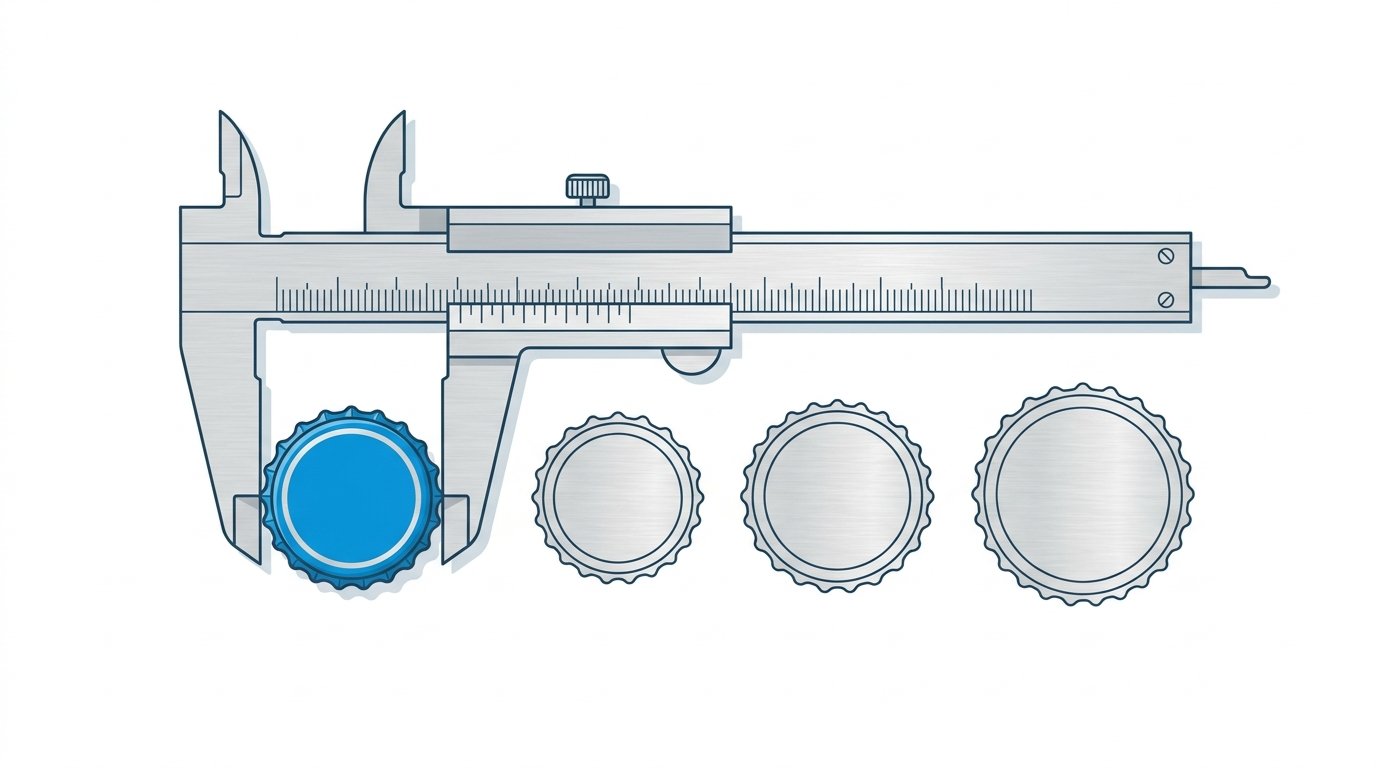
Measure the neck’s outer diameter across the threads and the depth from the rim to the locking ring with a caliper, then read the size off the chart above. How to measure bottle cap size takes each reading in order and shows what it maps to.
How the neck finish determines the size
The neck finish is the shaped, threaded top of the bottle: its diameter, thread profile, thread pitch, rim and overall height. A ROPP shell is formed onto that finish during capping, a step set out in what ROPP capping involves, so the finish, not the cap, drives the size. If the neck diameter is 28 mm, you need a 28 mm shell; a 30 mm shell will not seal correctly on it.
Glass and PET bottles are made to defined neck-finish standards, and different bottle makers may use slightly different finishes at the same nominal diameter. So two 28 mm bottles are not automatically interchangeable. The Indian and European finish systems are laid out in neck finish standards on Indian glass bottles and glass bottle neck finishes for ROPP caps. Threaded plastic-closure codes such as 38-400 are a separate system, decoded in neck finish codes and cap sizes, and whether one of those finishes can take a ROPP cap is answered in GPI and SPI neck finishes vs a ROPP finish. Treat the neck finish as the single source of truth and match the closure to it, rather than assuming a nominal size guarantees a fit.
How to specify a size when ordering
When you request ROPP closures, give the supplier enough detail to match your exact neck finish:
- State the diameter and target height in millimetres, for example 28/15 mm.
- Name the segment and product so the seal and liner suit the contents (water, carbonated drink, spirit, or syrup); bottle cap liner materials sets out which liner suits which fill.
- Share the bottle’s neck-finish drawing or standard reference if you have one.
- Send a physical bottle sample wherever possible. A sample removes ambiguity that a drawing alone can leave.
- For carbonated products, flag the pressure requirement so the closure and liner are rated for it.
Confirming against a sample or drawing before a full production run is the most reliable way to avoid leakers, poor thread pickup, or pilfer bands that sit at the wrong height. A short approval step up front is cheaper than reworking a filled batch. For 28/15 mm closures, R Vision’s minimum orders are 50,000 caps in plain silver, 200,000 in plain colours and 300,000 litho printed, with a lead time of 4 to 6 weeks; how a first order runs from sample to delivery is set out in bulk ROPP cap orders, and the range itself on ROPP caps.
Frequently asked questions
How is a ROPP cap size measured?
A ROPP cap size is expressed as diameter by height in millimetres, such as 28/15 mm. The diameter is the nominal diameter of the aluminium shell and must match the bottle’s neck finish. The height is the skirt length running down the neck. Diameter is fixed by the bottle; height depends on the depth of the finish.
What are the standard ROPP cap sizes?
The standard aluminium ROPP diameters are 18, 20, 22, 25, 28, 30, 31.5, 38, 46, 53 and 70 mm. Smaller diameters suit pharma syrups and miniatures, 28 mm is used for water, soft drinks and many liquor bottles, 30 mm and 31.5 mm are frequent on spirits, and 38 mm and above suit wide-neck food bottles and jars.
Which ROPP cap size is used for packaged drinking water?
Packaged drinking water bottles in India commonly use a 28 mm diameter ROPP closure with a short skirt, such as 28/15 mm, and a tamper-evident band. Because water bottle finishes vary between suppliers, verify the diameter and height against your actual bottle before ordering rather than assuming a nominal 28 mm size will fit.
What does a ROPP cap specification include?
Diameter and skirt height, aluminium gauge, cap weight, liner material, tamper band design, pressure rating, the neck finish it is made for, decoration, and the tolerance on each dimension. Tolerances are agreed against the bottle’s finish drawing rather than published as a single figure, because a roll-on cap is matched to a specific finish.
Are ROPP caps of the same diameter interchangeable between bottles?
Not always. Two bottles quoted at the same nominal diameter, such as 28 mm, can still have slightly different neck finishes depending on the bottle maker. Thread profile, rim and tolerances all affect fit. Treat the neck finish as the deciding factor and check a closure against your specific bottle before committing to a production quantity.
Do ROPP caps come with pre-formed threads?
No. A ROPP closure starts as a plain aluminium shell without threads. The threads and the pilfer-proof band are formed onto the shell during capping, when rollers press the metal against the bottle’s neck finish. This is why matching the shell diameter to the neck finish matters so much: the finish, not the cap, shapes the final thread.
Sources
- Bureau of Indian Standards, IS 7511 (Part 4): 1986, Roll-on Threads Pilferproof, for the finish types and nominal sizes from 22 mm to 70 mm.
- Bureau of Indian Standards, IS 1662: 1974, Glass Liquor Bottles, for finish diameters by capacity and the IMFL clause.
- Bureau of Indian Standards, IS 11984: 1986, Glass Bottles for Free Flowing Liquids, for the 28 mm and 31.5 mm ROPP finish requirement.
- CETIE, Finish data sheets (GME), for the MCA glass finishes and GME 401.
R Vision Pvt. Ltd manufactures 28/15 mm aluminium ROPP closures from Nashik, Maharashtra: the Aqua Cap for packaged drinking water and the Bev Cap for beverages. To match a closure to your bottle, send the finish drawing or a sample through contact us. More sizing and closure guides sit in the learn library.