
 Sankalp
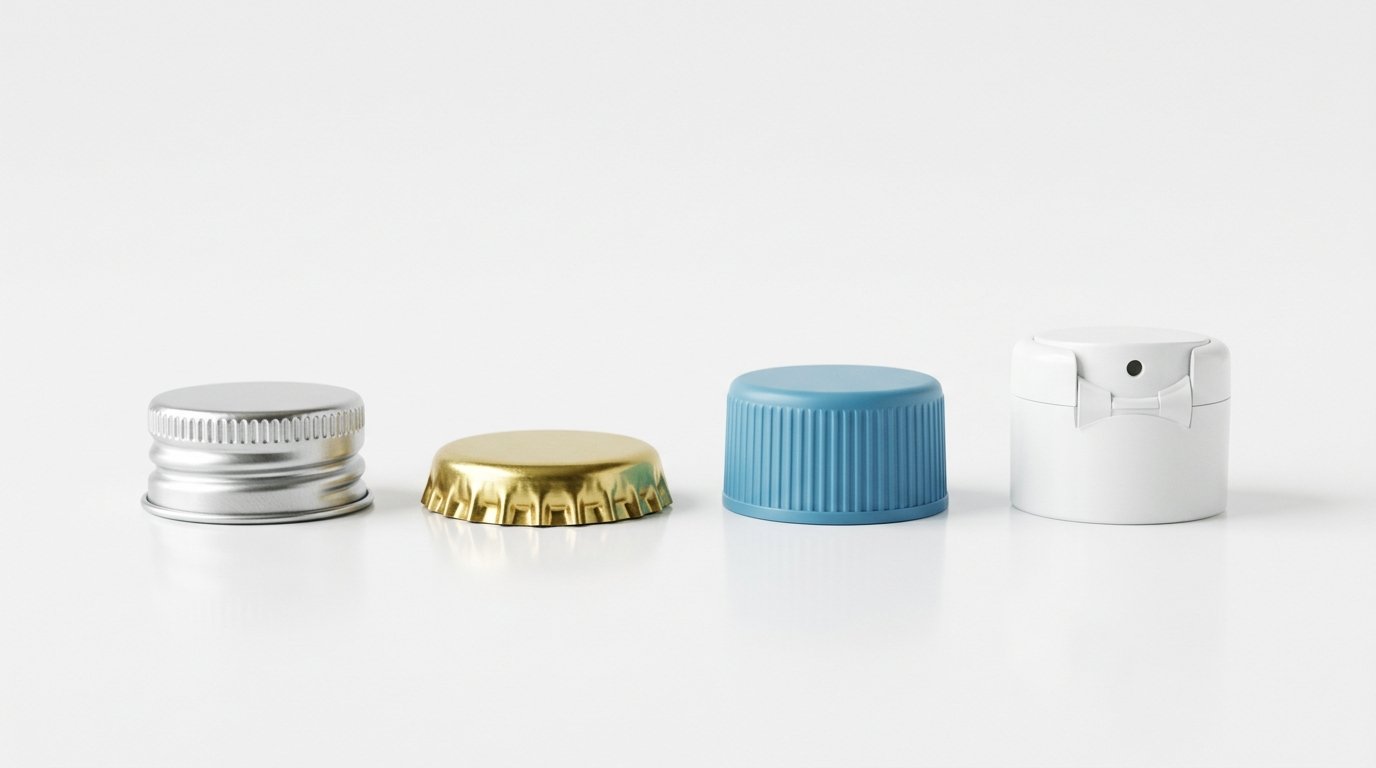
There are ten main types of bottle caps: aluminium ROPP (roll-on pilfer-proof) caps, crown caps, plastic screw caps, snap-on caps, sports and flip-top caps, child-resistant closures, lug or vacuum caps, corks and stoppers, long-skirt aluminium wine closures, and crimped vial seals. Each is made from a different material, suits a different product, and needs its own neck finish on the bottle, which is the detail that decides whether a cap can be used at all. The table below gives one row per type, and each row links to the page that covers it in full.
All ten types in one table
The neck finish column matters most when changing closure, because a cap only fits the finish it was made for. Swapping cap type almost always means changing the bottle or preform as well.
| Cap type | Material | Main applications | Neck finish it needs | Tamper evidence | Covered in full |
|---|---|---|---|---|---|
| ROPP cap | Aluminium shell with a liner | Packaged drinking water, carbonated drinks, spirits, edible oil, pharma syrups | A roll-on finish: the MCA family on glass, PET BPF on PET, IS 7511 (Part 4) roll-on pilferproof finishes in India | Yes, a ring that breaks on first opening | What is a ROPP cap |
| Crown cap | Tinplate or tin-free steel with a liner compound | Glass beer, soft drinks, soda water | A 26 mm crown finish, 26 H 126 or 26 H 180 | Yes, the crown bends on removal | Crown cap vs ROPP cap |
| Plastic screw cap | Polypropylene or HDPE | PET water, carbonated drinks, juices, sauces | A threaded PET finish: PCO 1810, PCO 1881, 26/22, 29/25 or 30/25 | Yes, a break-off band | ROPP cap vs screw cap |
| Snap-on or press-on cap | LDPE or polypropylene | Milk and dairy drinks, fresh juice | A plain bead on the neck, no thread | Only with a foil membrane or pull tab | What is a closure in packaging |
| Sports, dispensing or flip-top cap | Polypropylene with a valve or hinge | Sports water, sauces, edible oil, personal care | A threaded or snap finish matched to the fitment | Only with an added seal or shrink band | Types of water bottle caps |
| Child-resistant closure | Polypropylene, often two-piece | Pharma, agrochemicals, household cleaners | A threaded finish matched to the child-resistant design | Often paired with an induction seal | Tamper evident vs tamper resistant |
| Lug or vacuum cap | Tinplate with a sealing compound | Jams, pickles, honey | A lug finish on a wide-mouth glass jar | Yes, a vacuum button that pops up | What is a closure in packaging |
| Cork or stopper | Natural or synthetic cork, glass, rubber | Wine, some spirits, laboratory bottles | A plain bore finish the stopper is pushed into | Only with a capsule or sleeve over it | Liquor bottle caps in India |
| Long-skirt aluminium wine closure | Aluminium with a liner | Wine, premium spirits, olive oil | A tall roll-on finish, such as the BVS finish used for wine | Yes, a break band | BVS and spirits neck finishes |
| Crimped vial seal | Aluminium, often with a plastic flip-off button | Injection vials | A vial neck with a rubber stopper, crimped rather than threaded | Yes, the button or tear strip | PP cap vs ROPP cap |
Sizing is a separate question from type, covered in the ROPP cap size chart for aluminium closures.
ROPP (aluminium roll-on pilfer-proof) caps
A ROPP cap starts as a plain aluminium shell. On the filling line, a capping head presses the metal against the bottle, rollers form the thread directly on the neck, and a second set of rollers tucks the lower ring under the bead so it separates when the cap is first turned. Because the thread is formed on the bottle itself, the fit is tight and the broken ring gives clear tamper evidence. ROPP cap full form explains the name.
- Typical material: aluminium, often coloured or printed, with an inner liner.
- Common use: packaged drinking water, edible oil, spirits and liquor, syrups and pharmaceutical bottles.
- Neck finish: a finish drawn for roll-on closures. On glass that is the MCA family, each published by CETIE as a numbered data sheet; the Indian equivalent is IS 7511 (Part 4), set out in glass bottle neck finish standards in India. The finish depth sets the skirt length, as explained in long skirt vs short skirt ROPP caps.
- Tamper-evident: yes, through a ring that breaks away on first opening.
ROPP caps are the standard closure for Indian liquor and a common one on premium water. R Vision manufactures aluminium ROPP closures of this type, including the Aqua Cap for packaged drinking water, which uses a three-part break ring so a consumer can see at a glance whether the seal is intact. How that differs from a commodity closure is set out in Aqua Cap vs ordinary ROPP caps. Water and soft drinks run mostly on the 28 mm finish, while spirits more often use the wider one covered in 30mm ROPP caps.
Crown caps
The crown cap is the crimped metal cap on a glass beer or soda bottle. Its fluted skirt is pressed round the bead on a crown finish to hold pressure. Opening it needs a bottle opener, and once removed it does not reseal. Crown cap vs ROPP cap compares the two on pressure, resealing, cost and dimensions, and aluminium vs steel bottle caps compares the metals behind them.
- Typical material: tinplate or tin-free steel with a food-safe liner compound.
- Common use: glass-bottled carbonated soft drinks, beer and soda water.
- Neck finish: a 26 mm crown finish on glass.
- Tamper-evident: yes, because removal bends the crown and it cannot be refitted cleanly.
Plastic screw caps
Plastic screw caps thread onto a moulded bottle neck and are the standard closure on PET bottles. They carry a tamper band that breaks off and stays on the neck ring after the first opening. Carbonated lines use the 28 mm PCO 1810 finish or the lighter PCO 1881, and still water sits mostly on three-start finishes such as 29/25 and 30/25; the formats and the standards behind them are in neck formats on Indian packaged water bottles. ROPP cap vs screw cap weighs the two threaded formats against each other, and aluminium vs plastic bottle caps the two materials.
- Typical material: polypropylene (PP) or high-density polyethylene (HDPE).
- Common use: PET bottles for water, carbonated drinks, juices and sauces.
- Tamper-evident: yes, via a break-away lower band.
Snap-on and press-on caps
A snap-on cap is pushed straight down onto the bottle rather than threaded. It clicks over a bead on the neck and seals by friction and shape, which allows very fast, low-force capping on dairy and juice lines.
- Typical material: LDPE or PP, sometimes with a foil membrane underneath.
- Common use: milk and dairy drinks, fresh juices and some cosmetic bottles.
- Tamper-evident: only when combined with an inner foil seal or a visible pull tab.
Sports, dispensing and flip-top caps
These closures let a user drink or dispense without removing the cap. Sports caps have a pull or push nozzle for water and energy drinks; flip-top caps hinge open for sauces, shampoos and edible oils; dispensing caps meter out a set amount.
- Typical material: PP, usually with a silicone or plastic valve.
- Common use: sports and flavoured water, ketchup and sauces, personal-care bottles.
- Tamper-evident: usually needs an added inner seal or shrink band, as the hinge alone shows nothing.
Child-resistant closures
Child-resistant caps need a deliberate action, such as push-and-turn or squeeze-and-turn, so young children cannot easily open them. They are tamper resistant rather than tamper evident, which is why they are so often paired with a seal.
- Typical material: PP, often a two-piece design.
- Common use: pharmaceutical syrups and tablets, agrochemicals and household cleaning products.
- Tamper-evident: often paired with an inner induction seal for full tamper evidence.
Lug and vacuum caps for jars
Lug caps are metal closures for wide-mouth glass jars. Small lugs inside the skirt grip matching threads on the jar, and the cap holds a vacuum that keeps the product fresh. A raised button on the lid pops when the vacuum breaks, showing the jar has been opened.
- Typical material: tinplate steel with a sealing compound in the rim.
- Common use: jams, pickles, honey and other preserved foods.
- Tamper-evident: yes, through the vacuum button.
Corks, stoppers and long-skirt wine closures
Wine and some spirits use either a natural or synthetic cork pushed into the neck, or a long-skirt aluminium closure rolled onto a tall finish. Cork lets a very small amount of air reach the wine over time, while an aluminium closure gives a consistent seal and is easy to close again.
- Typical material: natural cork, synthetic polymer, or aluminium.
- Common use: wine, premium spirits and olive oil.
- Tamper-evident: aluminium closures use a break band; corks rely on an outer capsule or shrink sleeve.
Crimped vial seals
Injection vials are closed with a rubber stopper held down by an aluminium seal crimped round the neck, often with a plastic flip-off button over the centre. There is no thread and nothing rolled, so these are a separate family from the roll-on caps used on syrup bottles, even though pharma buyers meet both.
- Typical material: aluminium, with a plastic button on flip-off designs.
- Common use: injectable medicines in glass vials.
- Tamper-evident: yes, the button or tear strip cannot be replaced once removed.
Which bottle caps are tamper-evident
Some cap types show first opening on their own, and some need a second component to do it. The difference matters for water, beverages and anything consumed straight from the pack.
| Cap type | Tamper evidence built in? | What provides it |
|---|---|---|
| ROPP cap | Yes | Break ring formed at capping |
| Crown cap | Yes | Crown bent on removal |
| Plastic screw cap | Yes | Break-off band |
| Lug or vacuum cap | Yes | Vacuum button |
| Long-skirt aluminium wine closure | Yes | Break band |
| Crimped vial seal | Yes | Flip-off button or tear strip |
| Snap-on cap | No | Needs a foil membrane or pull tab |
| Sports or flip-top cap | No | Needs an inner seal or shrink band |
| Child-resistant closure | No, it is tamper resistant | Usually an induction seal |
| Cork or stopper | No | A capsule or sleeve over the neck |
A built-in ring still has to break properly to mean anything. It can part in the carton or fail to part at all, and why tamper bands fail covers both.
Where aluminium ROPP caps fit
For most Indian water and beverage brands, the practical choice comes down to plastic screw caps or aluminium ROPP caps. Aluminium ROPP closures give a metal finish, a seal formed on the neck and a clear pilfer-proof ring, which is why they are standard on liquor and common on premium packaged drinking water. For carbonated beverages, the closure has to hold internal pressure without leaking; R Vision’s Bev Cap is built for this, keeping its tamper-evident ring attached for resealing, using a PVC-free liner, and rated to 8 bar carbonation pressure.
Once ROPP is settled, the remaining question is usually sourcing, which imported vs Indian ROPP caps and bottle cap manufacturing in India take on between them.
Frequently asked questions
What are the different types of bottle caps?
The ten main types are aluminium ROPP caps, crown caps, plastic screw caps, snap-on caps, sports and flip-top caps, child-resistant closures, lug or vacuum caps, corks and stoppers, long-skirt aluminium wine closures, and crimped vial seals. They differ in material, in the products they suit, and in the neck finish the bottle needs.
What is the most common bottle cap in India?
On PET water and soft drink bottles, the plastic screw cap with a break-away tamper band is the most widespread. On liquor, and on premium and glass-bottled water, the aluminium ROPP cap is the common closure, valued for its tamper-evident ring and metal finish. The bottle material and the product decide which.
What does ROPP stand for?
ROPP stands for Roll-On Pilfer-Proof. A plain aluminium shell is rolled onto the bottle so its thread forms against the neck, and a lower ring is tucked under the neck bead. That ring breaks on first opening, giving the pilfer-proof, tamper-evident feature the closure is named for.
Does every cap type fit every bottle?
No. Each cap type needs its own neck finish, so a roll-on cap needs a roll-on finish, a plastic screw cap needs a threaded finish moulded to match, and a crown needs a crown finish. Changing cap type almost always means changing the bottle or preform too.
Which cap is best for carbonated drinks?
Carbonated drinks need a closure that holds internal pressure without leaking. Plastic screw caps on PCO finishes, crown caps on glass, and pressure-rated aluminium ROPP caps all do this. R Vision’s Bev Cap, for example, is rated to 8 bar and keeps its tamper-evident ring attached so the bottle can be resealed.
Are aluminium bottle caps recyclable?
Yes. Aluminium can be reprocessed repeatedly without losing quality, which makes aluminium ROPP closures a practical choice for brands watching their packaging footprint. Steel crown and lug caps are recyclable too, and plastic caps are recyclable where local facilities accept the specific resin.
R Vision Pvt. Ltd manufactures aluminium ROPP closures, the Aqua Cap and Bev Cap, both 28/15 mm, at its plant in Sinnar, Nashik. Every closure guide on this site is indexed in the learn library.