
 Sankalp
IS 14543 is the Bureau of Indian Standards (BIS) specification for packaged drinking water other than natural mineral water, and it is the standard packaged drinking water is tested against in India. It sets microbiological, physical, chemical, toxic-substance, radioactive and pesticide limits for the water, and packing and labelling requirements for the pack. The edition BIS certification cites is IS 14543:2016, the second revision, which has been amended since. Natural mineral water has its own standard, IS 13428. BIS certification against either is voluntary since FSSAI notified the omission of the compulsory clauses on 17 October 2024; an FSSAI licence is still mandatory.
IS 14543 at a glance
The standard is short, and each clause maps to something a bottler has to do.
| Clause | What it covers | What it means for a bottler |
|---|---|---|
| 1 Scope | Requirements, sampling and test methods for packaged drinking water other than natural mineral water | If you sell treated water in a sealed pack, this is your standard |
| 3 Terminology | Defines packaged drinking water as water, other than natural mineral water, offered or sold in packaged form by whatever name | A different brand name on the label does not move the product out of scope |
| 4 Hygienic conditions | Source water collected, processed and packaged under the hygienic practices in the annexes, with a checklist for processing units | Plant hygiene is part of the standard, not an extra |
| 5.1 General requirements | Permitted sources (surface, civic supply, underground or sea water after desalination) and permitted treatments, followed by disinfection; filled in sealed containers | Your treatment train has to sit inside the permitted list |
| 5.2 Microbiological | Organisms that must be absent in the stated sample volume, including E. coli, coliform bacteria, faecal streptococci, Staphylococcus aureus, Pseudomonas aeruginosa, yeast and mould, Salmonella, Shigella and Vibrio, plus an aerobic count limit | The monthly testing regime is built on these parameters |
| 5.3 Physical and chemical | Clear water with no sediment or extraneous matter, meeting tables for organoleptic and physical parameters, undesirable substances, toxic substances and radioactive residues | Source water analysis has to cover every table, not just TDS and pH |
| 5.4 Pesticide residues | Individual and total pesticide residue limits, tested by a recognised laboratory | The pesticide report in the FSSAI application answers this clause |
| 6 Packing | Clean, hygienic, tamperproof containers of food-grade materials, with plastic containers to IS 15410 and migration limits to pass | Container and closure are inside the standard, as set out below |
| 7 Marking | Label particulars, labelling prohibitions and use of the Standard Mark | Product name, processor, batch, dates, net quantity and storage directions on every label |
| 9 Sampling | How samples are drawn and conformity is judged | The basis for lot acceptance in surveillance |
Clause numbers follow the 2016 text as amended. Always read the amended copy before relying on a clause.
Which standard is packaged drinking water tested against?
Packaged drinking water in India is tested against IS 14543. It applies to drinking water that has been treated and sealed in bottles, jars or pouches for sale, as distinct from natural mineral water, which is tested against IS 13428. Under FSSAI’s Scheme of Testing in force from 1 January 2026, a bottler tests monthly against the specified parameters whether or not it holds a BIS licence.
Which revision of IS 14543 is current?
The edition cited in BIS certification material is IS 14543:2016, published as the second revision; the standard was first published in 1998. The 2004 edition that still appears in older test reports and in searches has been superseded. IS 14543:2016 has itself been amended several times, and Amendment No. 8 of September 2022 replaced the packing clause entirely. Because amendments keep arriving, check the current amendment list for IS 14543 on the BIS standards portal before quoting a clause in a specification or a test report.
The same applies to IS 13428, where the edition in use is IS 13428:2005, also a second revision, with amendments since.
IS 14543 versus IS 13428
These two standards are often confused because both cover bottled water. The key difference is the source and what may be done to the water.
| Point | IS 14543 | IS 13428 |
|---|---|---|
| Product | Packaged drinking water, other than natural mineral water | Packaged natural mineral water |
| Source | Surface water, civic supply, underground water, sea water after desalination, or another consistent source | Water obtained directly from natural or drilled underground sources, within protected perimeters |
| Treatment | A permitted list including filtration, reverse osmosis, demineralisation, remineralisation and disinfection | Limited to treatments the standard permits, such as separating unstable constituents like iron, manganese, sulphur or arsenic compounds |
| Composition | Must meet the limits; composition may be adjusted by treatment | Characterised by its mineral salts and trace elements, with a stable composition |
| Carbonation | Not classified by carbonation | Five classes: naturally carbonated, non-carbonated, decarbonated, fortified with carbon dioxide from the source, and carbonated |
| Pack wording | Filled in sealed containers | Filled into hermetically sealed containers |
| Edition cited by BIS | IS 14543:2016, second revision | IS 13428:2005, second revision |
| BIS certification | Voluntary since 17 October 2024 | Voluntary since 17 October 2024 |
The carbonation classes matter at the closure. A natural mineral water sold carbonated needs a closure rated to hold pressure, while still packaged drinking water does not, though many brands choose a pressure-rated closure so one cap covers both.
Why BIS certification matters
BIS certification for packaged drinking water used to be compulsory, and it is not any longer. On 17 October 2024, FSSAI gazette-notified the omission of sub-regulation 2.3.14, clauses 17 and 18, of the Food Safety and Standards (Prohibition and Restriction on Sales) Regulations, 2011. Those were the clauses that made BIS certification mandatory for packaged drinking water and packaged mineral water, so food business operators no longer require BIS certification to sell these products.
What has not changed is the standard. IS 14543 remains the Indian standard for packaged drinking water and the specification the product is judged against, and an FSSAI licence remains mandatory. Certification against the standard is now a voluntary quality signal, and many brands continue to hold a BIS licence for two reasons:
- Consumer trust. The ISI mark signals to buyers that the water has been made to a defined national standard and is subject to BIS oversight.
- Accountability. A BIS licence ties a product to a licensed manufacturer and to ongoing surveillance, so quality can be traced and enforced.
Oversight tightened on the food-safety side in the meantime. An FSSAI order of 29 November 2024 reclassified packaged drinking water and mineral water as a high-risk food category, bringing annual third-party audit and stricter inspection. A further FSSAI order of 17 December 2025 introduced a Scheme of Testing, in force from 1 January 2026, requiring monthly testing against the specified parameters, source-water testing, record keeping including batch-wise consumption of added minerals, hygiene controls, and immediate corrective action plus retesting on any microbiological non-compliance.
The licence route, in short
A bottler holds an FSSAI licence, State or Central depending on capacity and the number of states it operates in, and runs the Scheme of Testing. If it also wants the ISI mark, it applies to BIS in Form-V under Scheme-I of Schedule-II of the Conformity Assessment Regulations, 2018, naming IS 14543 or IS 13428, followed by a factory visit, laboratory testing and surveillance. The full process, with a route table by type of plant, is in BIS certification for a water brand, and the parallel requirements for flavoured and carbonated lines are in FSSAI packaging rules for bottled beverages.
What IS 14543 requires of the container
The packing clause, as replaced by Amendment No. 8 in 2022, asks for clean, hygienic and tamperproof containers, bottles or pouches made of food-grade materials compatible with the water.
| Requirement | What the clause says | What it means in practice |
|---|---|---|
| Condition | Clean, hygienic and tamperproof | Containers arrive and are filled clean, and the pack shows interference |
| Materials | Food-grade plastic, paper and paper board, glass, or metal and metal alloys that may contain plastic as a component | PET, glass, cartons and cans are all within scope |
| Plastic containers | To conform to IS 15410; polyethylene pouches to IS 15609 | Buy containers made to the container standard, not just food-grade resin |
| Glass | Reference to IS 11984, glass bottles for free flowing liquids | Glass bottles for water point to the glass bottle standard |
| Cartons | Paper-based multilayer cartons to IS 17753 | Carton-packed water has its own standard |
| Migration | Plastic packaging materials to pass overall, colour and specific migration limits for toxic substances as laid down in IS 15410 | Ask for migration evidence on every plastic component, the cap liner included |
The container standard reaches the cap directly. IS 15410, for plastic containers of packaged drinking water and natural mineral water, requires containers to be provided with suitable closures of metal or plastics that are pilfer-proof in character. Neck finishes in use on Indian water bottles are set out in neck formats on Indian packaged water bottles.
What IS 14543 requires of the closure
IS 14543 has no clause headed “closure”. The closure is caught by three requirements that apply to the pack as a whole.
| Standard wording | What the closure has to do | How to evidence it |
|---|---|---|
| Filled in sealed containers | Seal the container through storage and transport without leaking or admitting contamination | Leak and seal test results on your own bottle |
| Tamperproof containers | Show clearly whether the pack has been opened | A tamper band that breaks visibly on first opening |
| Food-grade materials, with migration limits for plastics | The liner and any internal coating must not transfer substances into the water | A food-contact declaration and a liner migration test report |
On the wording: no closure can literally be tamper proof, and in practice the requirement is met with tamper evidence, a band that breaks visibly on first opening. The difference between the terms is set out in tamper evident vs tamper proof.
For a packaged drinking water bottle, that points to a few closure needs:
- Food-grade sealing. The liner that seals against the bottle rim must be a food-grade material, so it does not affect the water. Brands often specify PVC-free liners.
- A reliable, hygienic seal. The closure must keep the water protected through storage and transport without leaking or admitting contamination.
- Tamper evidence. A closure that visibly breaks on first opening supports the protected, verifiable pack the standard expects, and it discourages refilling used bottles.
- Documents. A food-contact declaration and a liner migration report from the closure supplier, requested before the first order.
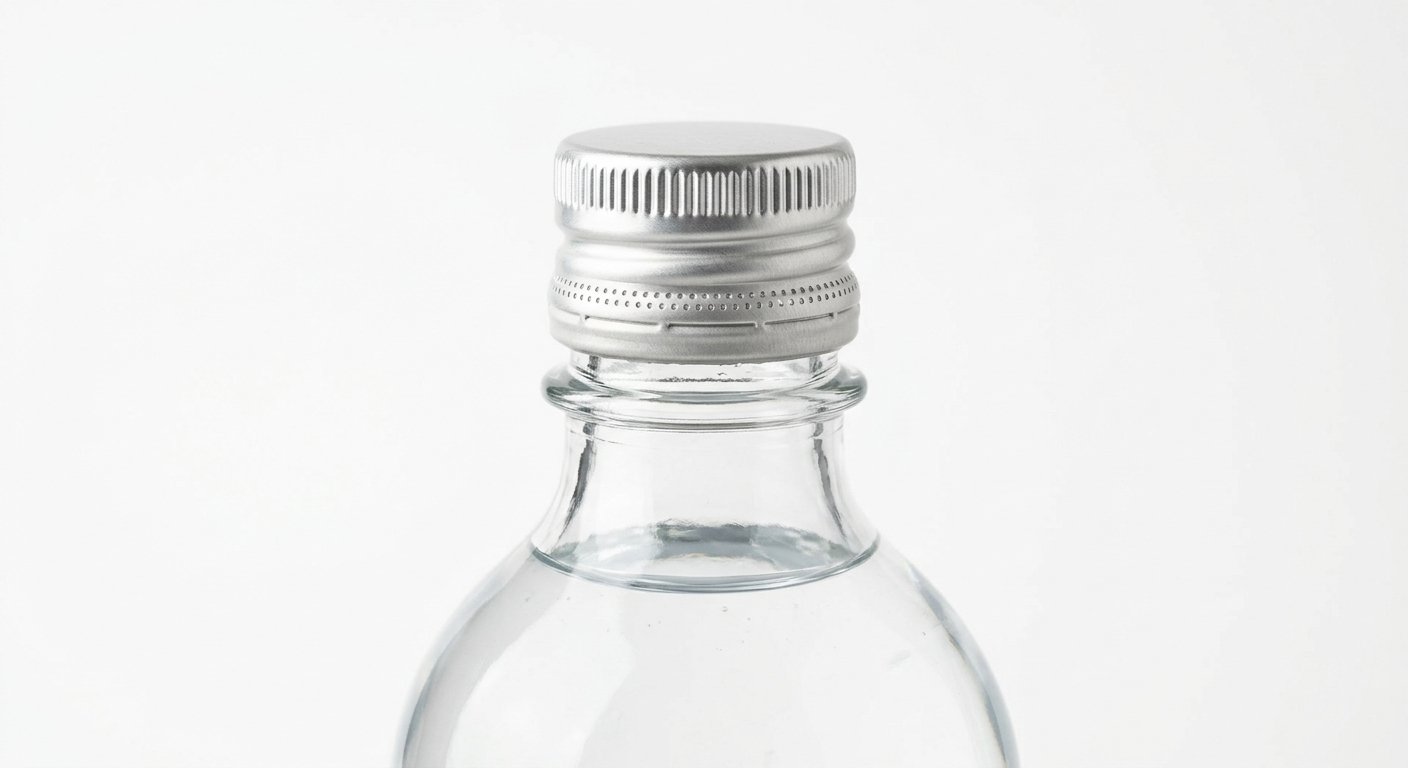
An aluminium ROPP (Roll-On Pilfer-Proof) closure fits these needs well: aluminium is inert and taint-free, the liner can be food-grade and PVC-free, and the integral pilfer band gives clear tamper evidence on first opening. That is why aluminium ROPP dominates the closure choice for packaged drinking water, with the practical comparison against plastic, sports and jar closures set out in types of water bottle caps. R Vision’s Aqua Cap is a 28/15 mm aluminium ROPP closure for packaged drinking water with a TPE liner and a three-part break-system ring, rated to 8 bar and adhering to USFDA and EU standards.
Frequently asked questions
What does IS 14543 stand for?
IS stands for Indian Standard, and 14543 is the number the Bureau of Indian Standards gave the specification for packaged drinking water other than packaged natural mineral water. The edition cited in BIS certification is IS 14543:2016, the second revision, which has been amended since, so the full reference on a document usually carries the year.
Is BIS certification mandatory for packaged drinking water in India?
No, not since 17 October 2024. On that date FSSAI notified the omission of the clauses in the Food Safety and Standards (Prohibition and Restriction on Sales) Regulations, 2011 that made BIS certification compulsory for packaged drinking water and packaged mineral water. An FSSAI licence is still mandatory and IS 14543 is still the applicable standard. BIS certification remains available as a voluntary quality signal.
What is the difference between IS 14543 and IS 13428?
IS 14543 covers packaged drinking water: water from surface, civic, underground or desalinated sea sources, treated by permitted processes and sealed for sale. IS 13428 covers packaged natural mineral water: water from a natural or drilled underground source with a stable mineral composition, with treatment limited to what the standard allows, and classified by carbonation. Neither now carries compulsory BIS certification.
Is IS 14543:2004 still valid?
No. The 2004 edition was superseded by IS 14543:2016, the second revision, which has since been amended several times, including a full replacement of the packing clause in September 2022. Check the current amendment list on the BIS standards portal before quoting the standard in a test report or a supply specification.
Does packaged drinking water need FSSAI as well as BIS?
An FSSAI licence is mandatory. A BIS licence is not, because the clauses that required BIS certification for packaged drinking water were omitted on 17 October 2024, though many brands still hold one by choice. Where a brand holds both, the two operate together, one covering the product standard and mark, the other covering food-business licensing and safety.
How does the bottle cap relate to IS 14543?
IS 14543 has no separate closure clause, but the pack must be sealed, tamperproof and made of food-grade materials that pass migration limits. The closure delivers the seal and the tamper evidence, and its liner is a food-contact material, so a food-grade liner, a reliable seal and a band that breaks visibly on first opening all support compliance.
Sources
- IS 14543: 2016, packaged drinking water (other than packaged natural mineral water), with Amendments 3 to 8, Bureau of Indian Standards, for the scope, requirements, packing and marking clauses.
- IS 13428: 2005, packaged natural mineral water, Bureau of Indian Standards, for the definitions, carbonation classes and packing clause.
- IS 15410: 2003, containers for packaging of natural mineral water and packaged drinking water, Bureau of Indian Standards, for the pilfer-proof closure requirement.
- BIS standards portal, for the current edition and amendment status of each standard.
- FSSAI, for the omission notified on 17 October 2024, the order of 29 November 2024 and the Scheme of Testing order of 17 December 2025.
On the sourcing side, choosing caps for a water brand works through order quantities, neck fit and finish, parts of a ROPP cap shows how a compliant seal is built into a closure, and the rest of the closure library is on Learn.