
 R Vision Technical Team
A sparkling water or soda bottle needs a cap that holds carbonation pressure, keeps the gas in for the shelf life and shows whether the bottle has been opened. Soda water is among the most heavily carbonated drinks sold, at around 4 to 4.5 volumes of CO2, so its cap carries roughly 3.5 bar at 20 °C and about 6.5 bar in a 40 °C godown. R Vision Closures makes two aluminium roll-on pilfer-proof (ROPP) caps for it, Aqua Cap and Bev Cap, both 28/15 mm with a TPE liner and both rated to 8 bar.
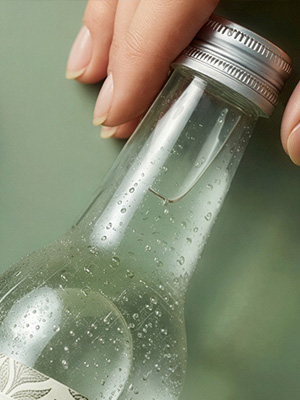
What the pressure in a sparkling water bottle asks of the cap
Carbonated water is still water with carbon dioxide dissolved into it under pressure. Once the bottle is sealed, that gas pushes outward on the bottle wall and the closure, and the push grows as the bottle warms. A cap that holds a chilled bottle comfortably can weep gas from the same bottle left in a closed truck in May, and the buyer opens it flat.
Bottlers specify carbonation in volumes of CO2, one volume being one litre of gas dissolved in one litre of water. Soda water and club soda sit at the top of the range. Lightly sparkling waters are carbonated lower, at a level each brand sets for its own taste. The pressure that results depends on the carbonation and the temperature together:
| Pack temperature | Where the bottle is | Soda water at about 4 volumes |
|---|---|---|
| 5 °C | Chilled, close to filling conditions | About 2 bar |
| 20 °C | An air-conditioned shop | About 3.5 bar |
| 30 °C | An Indian ambient warehouse for much of the year | About 5 bar |
| 40 °C | An uncooled godown or a closed truck in summer | About 6.5 bar |
These are approximate gauge pressures worked out from how much CO2 water holds at each temperature, the same basis as the full table in closures for carbonated soft drinks. Treat the table as a ceiling rather than a measurement; for your own product, read the pressure off a carbonation chart at the hottest temperature the bottle will see.
Why the 8 bar rating is the figure that matters
A pressure rating is the internal pressure a closure is built to withstand without deforming or releasing. Both R Vision closures are rated to 8 bar, which sits above what a fully carbonated soda water reaches through Indian storage, including a summer warehouse. The rating is a working margin, not a limit the product runs against. How the figure is defined, and what it does and does not promise, is in what an 8 bar pressure rating means.
The rating is only half the job. A cap can hold its shape at 8 bar and still lose gas slowly through a liner that has taken a set or a seal that never formed properly. That slow loss is the commoner failure on sparkling water, and it is covered in how closures prevent carbonation loss.
How the liner and the tamper ring behave on a carbonated fill
On a still fill the liner seals against a bottle that is not pushing back. On a carbonated fill the liner is loaded for the whole shelf life, and the load is highest when heat is also ageing it. The liner has to stay resilient against the rim rather than simply start soft. Both R Vision closures use a TPE (thermoplastic elastomer) liner; on Bev Cap it is specified PVC-free, which is set out in PVC-free liner bottle caps.
The tamper ring has a harder job on a pressurised bottle too. It has to stay intact through filling, conveying and a bumpy road, then break cleanly the first time the cap turns, while the thread still holds the cap long enough for the gas to vent past the liner. That sequence is why a ROPP cap opens with a hiss before it lifts.
| Stage | What the cap does on a sparkling bottle |
|---|---|
| Capping | The head presses the shell onto the liner, rolls the thread into the glass or PET neck and tucks the ring under the locking bead |
| Storage | The liner stays compressed on the rim against rising pressure as the bottle warms |
| First turn | The tamper ring breaks, and the seal lifts while the thread still holds |
| Venting | Gas escapes past the liner before the cap leaves the thread |
| Reclosing | The cap threads back on, so the remaining fizz is held between pours |
A soda bottle that is poured over an evening needs that last line. A crown cap holds the pressure but cannot reseal, which is the main split set out in crown cap vs ROPP cap.
Glass and PET necks for sparkling water
The neck decides the cap. A ROPP cap needs a neck drawn for a roll-on closure: a thread the rollers can form the aluminium into and a bead below it for the tamper ring to tuck under.
| Bottle | Neck | Cap that fits | R Vision cap? |
|---|---|---|---|
| Glass soda or sparkling water bottle, hotels and bars | 28 mm MCA roll-on finish | Aluminium ROPP, 28/15 mm | Yes, Aqua Cap or Bev Cap |
| Glass bottle with a crown finish | Crown finish | Crown cap | No |
| PET sparkling water, retail | PCO 1810 or PCO 1881 | Moulded pressure-rated plastic closure | No |
| PET bottle drawn for a roll-on cap | PET or BPF finish | Aluminium ROPP, 28/15 mm | Yes, Aqua Cap or Bev Cap |
Both closures are made for the MCA I/II/III, MCA 7.5 R, MCA 7.5 RF, PET and BPF finishes, as the product pages list them. The glass finishes are mapped to their published data sheets in glass bottle neck finishes for ROPP caps, and the PET finishes on Indian water lines, with the CETIE and ISBT data sheets behind them, in neck formats on Indian packaged water bottles. Two necks quoted at a nominal 28 mm can be cut to different drawings, so send the bottle or preform drawing to the closure maker rather than a diameter.
Aqua Cap or Bev Cap for sparkling water
Both closures hold a sparkling fill. The choice comes from what else the brand sells and how the bottle is used.
| Aqua Cap | Bev Cap | |
|---|---|---|
| Made for | Packaged drinking water | Beverages, carbonated and still |
| Best fit for sparkling | A water brand adding a sparkling variant to a still range | Soda water, club soda and mixers sold alongside soft drinks |
| Tamper ring | Three-part break-system ring that separates visibly on first opening | Pilfer-proof ring that breaks and stays with the cap or the neck |
| Ring variants | Three-part break system | Round Ring, Two Slit, Five Slit |
| Liner | TPE | TPE, PVC-free |
| Pressure rating | Up to 8 bar | Up to 8 bar |
| Top decoration | Plain, litho printed, embossed | Plain, litho printed, hot foiled |
| Size | 28/15 mm | 28/15 mm |
For a water brand, Aqua Cap lets the sparkling bottle carry the same closure as the still range, so one specification, one capping setup and one supplier serve both. For a soda or mixer line run beside soft drinks, Bev Cap keeps one closure across the carbonated range, and its retained ring leaves no loose band on a bar counter. The three-part break system and resealable tamper-evident caps explain each ring, and Aqua Cap and Bev Cap compared sets out the rest of the differences.

Order terms and line checks
Both closures run on standard roll-on application machinery and suit hot fill, cold fill and carbonated products. Caps are packed in PE bags inside export-grade corrugated cartons, stored between 5 and 30 °C, with a shelf life of two years from the manufacturing date.
| Order type | Minimum order |
|---|---|
| Plain silver | 50,000 |
| Plain colours | 200,000 |
| Litho printed | 300,000 |
Lead time is 4 to 6 weeks. Before a first run, test filled bottles after a warm storage cycle as well as fresh off the capper, and check the ring breaks cleanly on packs opened warm. ROPP closure testing covers the leak and pull-up tests, and bulk ROPP cap orders covers the order from enquiry to despatch.
Frequently asked questions
What kind of cap does sparkling water need?
Sparkling water needs a pressure-rated closure with a resilient liner and a tamper ring that holds through transport and breaks on first opening. On glass and on PET bottles drawn for a roll-on cap, that is an aluminium ROPP cap. Standard PET sparkling water bottles carry a moulded plastic closure on a PCO finish.
How much pressure is in a bottle of soda water?
Soda water at about 4 volumes of CO2 is roughly 3.5 bar above atmospheric at 20 °C, about 5 bar at 30 °C and about 6.5 bar at 40 °C. The pressure rises with temperature while the carbonation stays the same, which is why the cap is rated above the hottest storage the bottle will see.
Can a still water cap be used on sparkling water?
Only if it is rated for pressure. A cap built only for still water may leak gas or lift under load. Aqua Cap is rated to 8 bar, so a water brand can run still and sparkling water on the same closure.
Is Aqua Cap or Bev Cap better for soda water?
Both are rated to 8 bar and fit the same 28/15 mm necks. Aqua Cap suits a water brand adding a sparkling variant to a still range. Bev Cap suits soda water and mixers sold alongside soft drinks, with a PVC-free liner and a ring that stays with the cap after opening.
Do aluminium caps reseal a sparkling water bottle?
Yes. The thread rolled onto the neck at capping takes the cap back after opening, so the bottle can be closed between pours and holds its remaining carbonation better than an open bottle. A crown cap cannot be refitted.
What is the minimum order for sparkling water caps?
For both R Vision closures the minimum is 50,000 caps in plain silver, 200,000 in plain colours and 300,000 litho printed, with a lead time of 4 to 6 weeks.
Sources
- CETIE finish data sheets, for the glass and PET neck finishes
- ISBT Threadspecs, for PCO 1810 and PCO 1881
- Food Safety and Standards Authority of India, for carbonated water and its packaging
For the full specification, see the Aqua Cap and Bev Cap product pages, or contact R Vision on +91 72620 02754.