
 Sankalp
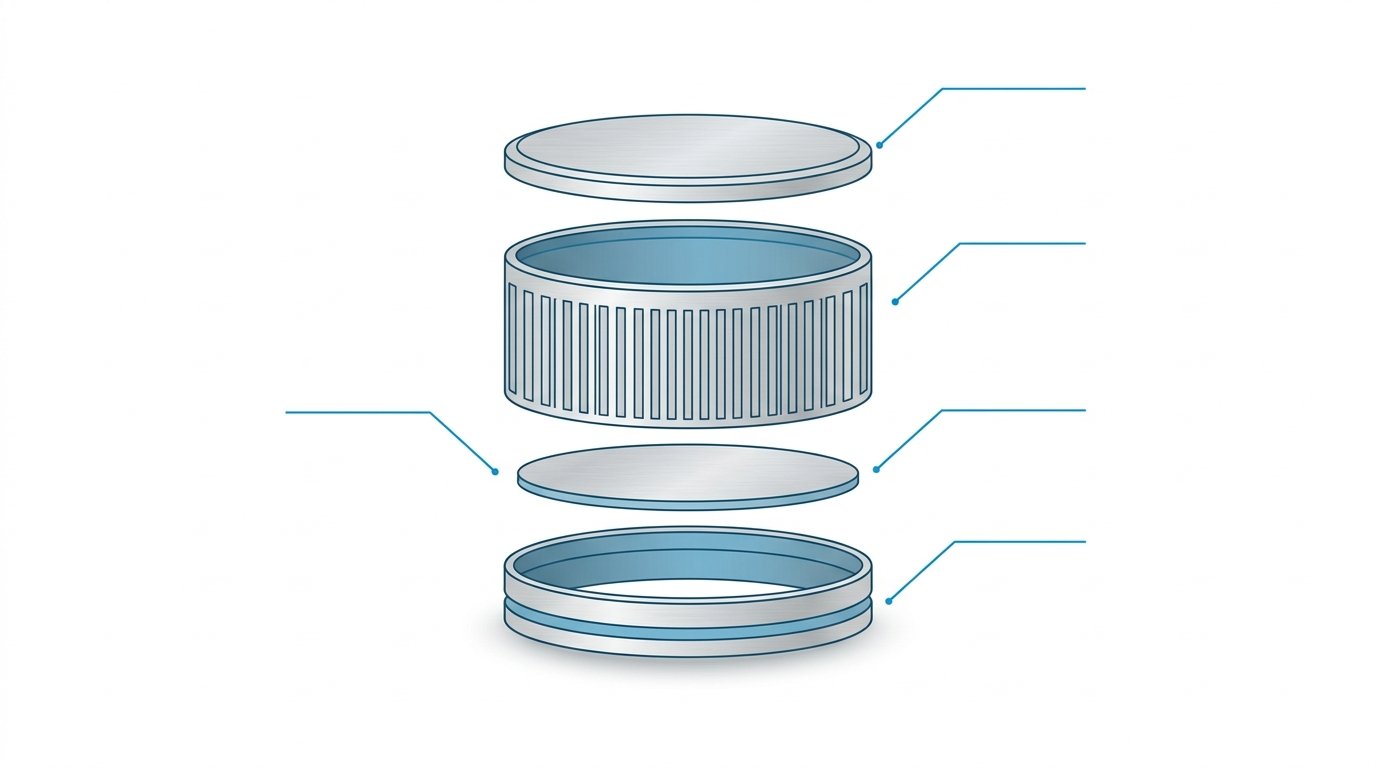
A ROPP (Roll-On Pilfer-Proof) cap has a small set of working parts: the aluminium shell (top panel plus skirt), the wad or liner inside, the knurls on the skirt, the thread area, and the pilfer-proof band held by a locking ring. Each part does one job. For the closure as a whole, start with what a ROPP cap is.
The aluminium shell (body)
The shell is the main aluminium piece, formed from a single flat disc into a shallow cup with a closed top and an open bottom. It arrives at the filling line as a plain, thread-free blank; the threads and tamper band are shaped later, during capping. How ROPP caps are made follows the shell from aluminium coil to finished blank. The shell gives the cap its structure and its printable outer surface for branding.
The top panel
The top panel is the flat, closed disc at the crown of the cap. It sits directly over the mouth of the bottle and carries the downward pressing force during capping. Any embossing, printing, or centre logo lives here, and the panel holds the liner in place against the neck below.
The wad or liner (the seal)
The liner, sometimes called the wad, is the soft disc bonded to the underside of the top panel. It is the actual sealing element: when the cap is tightened, the liner presses flat against the top rim (the sealing surface) of the bottle neck and closes the gap that would otherwise let liquid or gas escape. Traditional liners often use a PVC-based compound. PVC-free liners are now widely specified, especially for water and food-grade beverages, because they seal reliably without PVC; the two are set against each other in PVC vs PVC-free cap liners. What a cap liner is covers the sealing disc in full. The liner is matched to the product, since still water, oils, spirits, and carbonated drinks each place different demands on the seal.
The knurls
Knurls are the fine vertical ridges, or flutes, running down the outside of the skirt. They do two jobs. They give the consumer grip so the cap can be twisted off by hand, and they give the capping machine’s chuck something to hold and align, so the cap sits square before the threads are rolled. The number and depth of knurls is a design choice; finer knurls tend to read as a premium finish.
The thread area
Unlike a pre-moulded plastic cap, a ROPP cap has no threads when it leaves the factory. During capping, rollers press the soft aluminium skirt inward against the thread profile already on the bottle neck, forming threads that exactly match that neck. This “roll-on” step is where the format gets its name, and because the thread is created in place, the fit is tight to that specific neck finish. The forming step is set out in what ROPP capping involves, and matching a shell diameter to a neck starts with the ROPP cap size chart.
The pilfer-proof band (tamper-evident band)
The pilfer-proof band is the lower ring of the skirt, joined to the body above it by a row of small aluminium bridges left between short perforations or slits. During capping, a roller tucks the bottom edge of this band under a locking ring: the bead of glass or plastic that sits below the threads on the neck. Once tucked, the band cannot ride back up over that ring. When the consumer first unscrews the cap, the body lifts but the band is trapped, so the bridges snap. A broken or dropped band is the visible sign that the closure has been opened. Some designs let the band break away completely; others keep it attached below the cap so it stays on the neck. Both are forms of pilfer-proof closure, and the word itself is unpacked in pilfer meaning in packaging. The roller that tucks the band is step four of the ROPP capping process.
The skirt
The skirt is the cylindrical wall of the cap that hangs down from the top panel and surrounds the bottle neck. It carries the knurls on the outside and receives the rolled threads and the tucked band on the inside. In short, the skirt is the working length of the cap between the crown and the tamper band.
Parts at a glance
| Part | Function |
|---|---|
| Aluminium shell (body) | The main formed piece; gives structure and the printable outer surface. |
| Top panel | Flat crown over the bottle mouth; takes capping pressure and holds the liner. |
| Wad / liner | Soft disc that seals against the neck rim; PVC or PVC-free options. |
| Knurls | Vertical ridges on the skirt for hand grip and machine alignment. |
| Thread area | Formed onto the neck during capping, not pre-cut. |
| Pilfer-proof band | Lower ring held by bridges; tucks under the locking ring to show tampering. |
| Skirt | Cylindrical wall carrying the knurls, threads, and band. |
Related guides
Frequently Asked Questions
Are the threads on a ROPP cap made in the factory?
No. A ROPP cap ships as a smooth, thread-free aluminium shell. The threads are formed at the filling line, when rollers press the soft skirt against the thread profile already on the bottle neck. This is why the cap fits that specific neck so closely and why the format is called “roll-on”.
What does the pilfer-proof band actually do?
It shows whether a bottle has been opened. The band is joined to the cap by thin bridges and tucked under a locking ring on the neck. The first time the cap is unscrewed, those bridges break. A snapped or dropped band tells the buyer the seal is no longer intact, which is the point of a tamper-evident closure.
What is the difference between PVC and PVC-free liners?
Both act as the seal pressed against the bottle rim. PVC-based liner compounds are long established and low cost. PVC-free liners do the same sealing job without PVC, which many water and beverage brands now prefer for food-safety and material reasons. The correct liner depends on the product being packed, such as water, oil, spirits, or a carbonated drink.
Can a ROPP cap be resealed after opening?
Yes. Because the threads are formed to match the neck, the cap can be screwed back on and reseals reasonably well for still products. The tamper evidence is one-time, though: once the band has broken on first opening, it stays broken even after you retighten the cap.
R Vision Pvt. Ltd manufactures specialised aluminium ROPP closures, including PVC-free liner options on its Bev Cap and a TPE liner on the Aqua Cap, from MIDC Malegaon, Sinnar, in Nashik, Maharashtra. The full set of closure explainers is listed on the learn page.