
 Sankalp
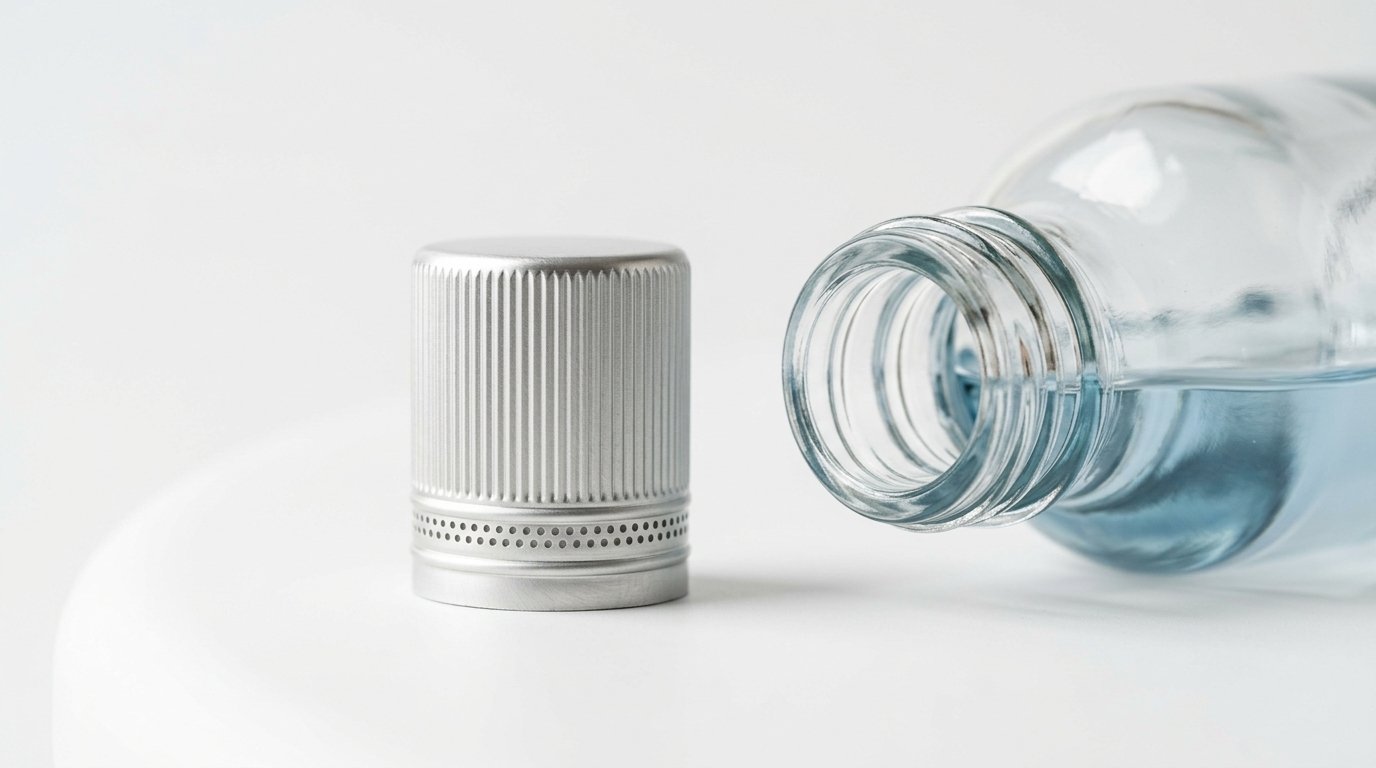
A ROPP cap is an aluminium bottle closure that reaches the filling line as a plain, unthreaded shell with a liner inside. The capping head rolls the thread into the shell against the bottle neck and tucks the lower band under the neck’s locking ring, so the band breaks the first time the bottle is opened. ROPP caps are sized as diameter by skirt height in millimetres, and 28/15 mm is the common size for Indian packaged drinking water and beverages.
ROPP cap specification at a glance
A ROPP cap is specified by its diameter, its skirt height, the thickness of the aluminium and the liner material. Pressure rating, tamper band and neck finish follow from those. The ranges below are industry reference; the right-hand column is the size R Vision manufactures.
| Specification | What it sets | Typical industry range | R Vision 28/15 mm |
|---|---|---|---|
| Diameter | Which neck finish the shell fits | 18 mm to 70 mm across the standard range | 28 mm |
| Skirt height | Thread length and tamper band material | About 15 mm on water and soft drink caps, up to around 60 mm on tall spirits caps | 15 mm |
| Shell gauge | How cleanly the shell forms under the rollers | Most often around 0.20 to 0.23 mm; wider and taller shells sit toward the upper end | Aluminium shell |
| Liner | The seal against the bottle rim | PVC-based compound, PE or EPE foam wad, or TPE, matched to the product | TPE (thermoplastic elastomer) |
| Tamper band | Proof of first opening | Scored band held by bridges, tucked under the neck’s locking ring | Three-part break-system ring (Aqua Cap) or retained ring (Bev Cap) |
| Pressure rating | Whether a carbonated product stays sealed | Depends on liner and finish; still products need little | Up to 8 bar |
| Neck finish | The thread profile the shell is rolled against | Roll-on pilferproof finishes to IS 7511 (Part 4) or the CETIE MCA family | MCA I/II/III, MCA 7.5 R, MCA 7.5 RF, PET BPF |
Gauge and cap weight are worked through size by size in ROPP cap weight and gauge. Two bottles quoted at the same nominal diameter can still be cut to different finish drawings, so the drawing is what a closure is matched to.
ROPP full form
ROPP stands for Roll-On Pilfer-Proof: the thread is rolled on at capping, and the band shows whether anyone has pilfered from the bottle. The ROPP cap full form takes each word apart, and pilfer meaning in packaging explains the middle term on its own.
How a ROPP cap is made and applied
A ROPP cap is made as a blank in the factory and finished on the bottle. The shell is drawn, coated, lined and scored at the closure plant, a sequence covered in how ROPP caps are made. It arrives at the filling line as a smooth cylinder with a top panel, a sealing liner inside, and no threads yet.
During capping, a pressure block pushes the shell down onto the bottle so the liner compresses against the rim. Thread rollers then press the soft aluminium against the glass or PET finish, forming a thread that matches the thread already moulded into that neck. A separate roller tucks the bottom edge of the shell under the locking ring, forming the pilfer band. Because the thread is shaped to each bottle, the fit is close, and a well set capping head repeats the same seal across a production run. The rollers, the pressure block and the order they act in are set out in what ROPP capping involves and in the ROPP capping machine guide.
That sequence is also why a ROPP cap does not have an application torque in the way a screw cap does. The seal is set by top load and roller pressure, and the torque a buyer measures is the removal torque, which cap torque specifications explains.
| Capping stage | What happens to the cap | What goes wrong if it is set badly |
|---|---|---|
| Top load | Liner is compressed against the rim | Too little and the pack leaks; too much and the liner is cut |
| Thread rolling | Skirt is formed into the neck’s thread | Shallow thread backs off; deep rolling tears the shell |
| Pilfer rolling | Band is tucked under the locking ring | Band rides up, or bridges crack before opening |
Most faults blamed on a cap start at one of those three settings. Why water bottle caps leak traces the leak to its cause, and why tamper bands fail separates band faults made in the cap from those made at the capping head.
Aluminium construction
ROPP closures are made from aluminium because the metal is soft enough to be rolled cold into threads yet strong enough to hold a seal. Aluminium resists corrosion, does not impart taste or odour to the contents, and can be printed, lacquered or embossed for branding. It is also light and widely recycled, which matters for bottlers managing packaging weight and waste.
The inside of the shell is lacquered, and the liner is the only part that touches the product. What a food-contact closure has to evidence under Indian and EU rules is set out in food-grade aluminium and liner standards.
The tamper-evident pilfer band
The pilfer band is the lower skirt of the cap, joined to the main body by a ring of small bridges. When the cap is twisted open for the first time, those bridges snap and the band either drops against the bottle shoulder or, in resealable designs, stays attached. Either way, a broken band is visible proof of first opening. For packaged water, spirits and pharma products, that visible assurance is what the buyer is paying for. The band and the bridges that hold it are two of the parts of a ROPP cap, and the format belongs to the wider family of pilfer-proof caps.
The liner and its sealing role
The thread holds the cap on, but the liner seals the bottle. It is a disc or wad seated inside the top panel, and what a cap liner does is worth reading before you specify one. Under top load, the liner compresses against the rim of the bottle finish and blocks the path for leaks, gas loss and outside air.
Liner choice depends on the contents:
- Older liners used PVC compounds, which seal well but need plasticisers, and those raise food-contact concerns.
- PVC-free liners such as TPE are now widely specified for water, beverages and pharmaceutical products.
- Carbonated drinks need a liner that holds internal pressure without leaking gas, so the liner material and thickness are matched to the product.
The materials are compared line by line in EPE, PE, PVC and pulp liners compared.
ROPP cap sizes
ROPP sizes are written as diameter by skirt height in millimetres, so 28/15 mm is a 28 mm shell with a 15 mm skirt, and the bottle’s neck finish decides both numbers. The full standard range is on the ROPP cap size chart, and how to measure bottle cap size shows how to read your own bottle.
Typical applications
ROPP closures suit any product that needs a tamper-evident seal on a bottle with a roll-on finish. In packaging language a cap of this kind is one form of closure, and it sits alongside the other formats in types of bottle caps. Common uses in the Indian market include:
| Application | Why ROPP suits it |
|---|---|
| Packaged drinking water | Visible tamper evidence and a taint-free seal for products under IS 14543 and FSSAI rules |
| Carbonated soft drinks | A pressure-rated liner holds carbonation and prevents leaks |
| Liquor and spirits | Strong tamper evidence plus a printed finish for branding |
| Pharma syrups and tonics | A hygienic seal with clear evidence of any prior opening |
| Edible oils and other liquids | Reliable resealing and leak resistance for repeat use |
A water brand’s licence route under IS 14543, and where the closure fits into it, is set out in BIS certification for a water brand.
Advantages over pre-threaded and plastic closures
ROPP closures compete mainly with pre-threaded metal caps and moulded plastic screw caps. Each pairing has its own read-out: ROPP cap vs screw cap and aluminium vs plastic bottle caps. The differences that matter to a bottler are set out below.
| Factor | ROPP (roll-on aluminium) | Pre-threaded / plastic caps |
|---|---|---|
| Fit to the bottle | Threads formed onto each bottle, so the seal is close and repeatable | Fixed thread that must be manufactured to close tolerances |
| Tamper evidence | Integral pilfer band breaks on first opening | Present, but bands vary in reliability |
| Material and taste | Aluminium is inert and taint-free | Plastic can affect taste or scent in sensitive products |
| Branding | Printed, embossed and lacquered finishes | Limited on many stock plastic caps |
| Recyclability | Aluminium is widely recycled | Depends on plastic type and local recovery |
The trade-off is that ROPP capping needs correctly set rollers and bottles with consistent finishes, so process control on the filling line matters more than with a simple pre-threaded cap.
Choosing a ROPP cap manufacturer in India
When you source ROPP closures, look at more than price per piece. Check that the supplier can match the exact bottle finish you use, since a mismatch causes leaks and thread damage. Ask about liner options, especially PVC-free liners for water and pharma. Confirm consistency across large batches, printing capability if you need branding, and the documents the supplier can hand over, which quality certificates to ask your cap supplier for lists. A manufacturer close to your bottling location can also shorten lead times, and the landed-cost arithmetic behind that is worked through in imported vs Indian ROPP caps.
Which R Vision closure suits which product
R Vision manufactures two aluminium ROPP closures, both 28/15 mm with a TPE liner, rated to 8 bar and adhering to USFDA and EU standards. Aqua Cap is built for packaged drinking water and Bev Cap for beverages. The choice turns on the tamper system and whether the drink is finished in one go.
| Your product | R Vision closure | Why |
|---|---|---|
| Still packaged drinking water, premium or niche brand | Aqua Cap | Three-part break-system ring shows opening at a glance |
| Sparkling water | Aqua Cap | Rated to 8 bar and suited to carbonated products |
| Carbonated soft drink | Bev Cap | Rated to 8 bar, PVC-free TPE liner |
| Juice or hot-filled drink | Bev Cap | Suits hot fill; ring stays attached so the bottle reseals |
| Any drink consumed over time | Bev Cap | Reseals while the broken ring stays visible |
| Spirits on a 30 mm or 31.5 mm finish, or pharma on 18 mm to 20 mm | Not made by R Vision | R Vision manufactures 28/15 mm only |
The two are set side by side in Aqua Cap and Bev Cap compared. Minimum orders are 50,000 caps in plain silver, 200,000 in plain colours and 300,000 litho printed, with a lead time of 4 to 6 weeks. How a first order runs is covered in bulk ROPP cap orders, and why the tiers step with decoration in what MOQ means for bottle caps. To request samples, send a bottle or its finish drawing through contact us.
Frequently asked questions
What does ROPP stand for?
ROPP stands for Roll-On Pilfer-Proof. “Roll-on” describes how the aluminium shell has its thread rolled onto the bottle neck during capping. “Pilfer-proof” describes the tamper-evident lower band that breaks the first time the cap is opened, showing that the bottle has been opened since it was sealed.
What size is a standard ROPP cap?
ROPP caps are sized as diameter by skirt height in millimetres. The standard range runs from about 18 mm to 70 mm in diameter, with 28 mm the common size for packaged drinking water and soft drinks in India, usually with a short skirt such as 15 mm. Spirits bottles often use 30 mm or 31.5 mm with a much taller skirt.
What are ROPP caps made of?
A ROPP cap is an aluminium shell, typically around 0.20 to 0.23 mm thick, lacquered inside and often printed outside, with a liner seated in the top panel. The liner may be a PVC compound, a PE or EPE foam wad, or a PVC-free material such as TPE. Some designs add a plastic tamper ring.
Are ROPP caps reusable?
Once a ROPP cap is opened, the pilfer band has broken, so the tamper evidence is spent and cannot be restored. Some resealable designs keep the band attached at the neck so the cap can be screwed back on to protect the remaining contents. The seal still works for storage, but the first-opening evidence is one-time only.
Do ROPP caps work on carbonated drinks?
Yes. ROPP closures are used on carbonated soft drinks when fitted with a liner and specified to a pressure rating that holds internal carbonation without leaking. The liner material and thickness are matched to the level of carbonation so the seal keeps gas in and outside air out over the product’s shelf life.
Are ROPP caps suitable for packaged drinking water?
Yes. ROPP closures are widely used for packaged drinking water because the aluminium is taint-free and the pilfer band gives clear tamper evidence, which supports consumer trust and the Indian requirements under IS 14543 and FSSAI rules. PVC-free liners are commonly specified for water to keep the food-contact surface free of plasticisers.
Sources
- Bureau of Indian Standards, IS 7511 (Part 4): 1986, Roll-on Threads Pilferproof, for the roll-on pilferproof neck finish series.
- Bureau of Indian Standards, product manual for packaged drinking water, IS 14543.
- Food Safety and Standards Authority of India, regulator for packaged water and beverages.
- CETIE, Finish data sheets (GME), for the MCA glass finish family.
R Vision Pvt. Ltd manufactures aluminium ROPP closures at MIDC Malegaon, Sinnar, Nashik, Maharashtra. This guide is also available in Hindi as ROPP cap kya hai, and every closure guide on this site is indexed in the learn library.