
 Sankalp
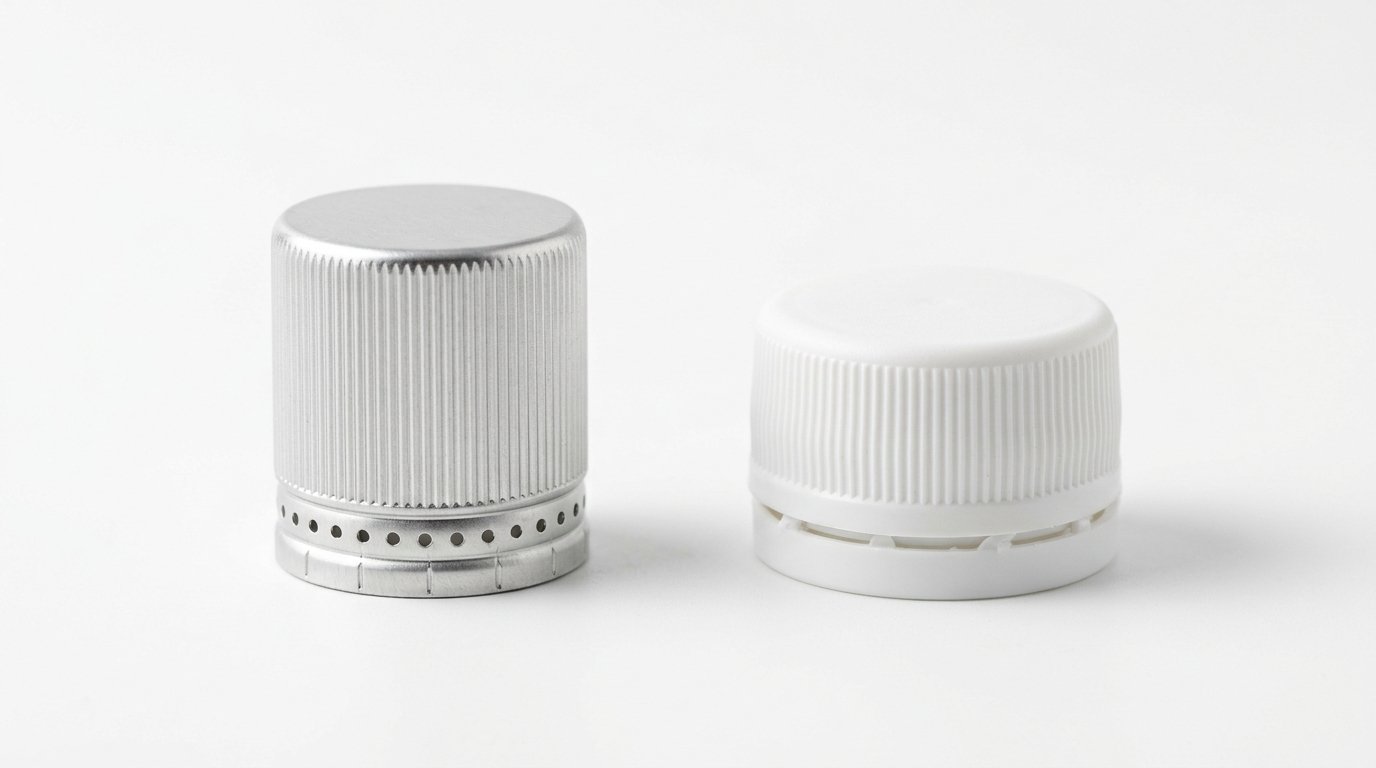
A ROPP cap arrives as a smooth aluminium shell and gets its thread rolled onto the bottle neck by the capping head, so the seal is formed to that bottle. A screw cap, usually moulded polypropylene or HDPE, arrives with its thread already in place and is torqued down onto a neck moulded to match. That one difference decides the rest: the neck finish each needs, the capping head, how tamper evidence is built, and where each sits on cost. Both reseal by hand.
Side-by-side comparison
The table covers the points a bottler weighs when choosing between the two. Neither closure wins every row, which is why both are common on Indian water and beverage lines.
| Factor | ROPP cap (aluminium) | Screw cap (plastic) |
|---|---|---|
| How it is applied | A roll-on head presses the shell down, rollers form the thread and tuck the ring | A torque capper turns the pre-threaded cap down to a set torque |
| Thread | Formed on the bottle during capping | Moulded into the cap in advance |
| Neck finish needed | A roll-on finish, such as the MCA family on glass or PET BPF on PET | A threaded finish such as PCO 1810, PCO 1881, 29/25 or a GPI code |
| How it is ordered | Diameter and height, such as 28/15 mm | The finish code the cap is moulded to |
| Seal fit | Formed to the individual neck | Depends on the cap mould and the neck mould matching within tolerance |
| Tamper evidence | Integral ring that breaks on first opening | Moulded band that breaks off, or a tethered band, where fitted |
| Resealable | Yes | Yes |
| Pressure | Handles carbonated and hot-filled products on a suitable finish | Depends on the design; carbonated closures are a specific type |
| Line speed | High, with more to set per head: thread and skirt rollers as well as head load | High and simple to set; most high-speed PET water and soft drink lines run screw caps |
| Unit cost | Higher per piece: aluminium, liner, often decoration | Usually lower per piece at volume |
| Look | Metallic, can be coloured, litho printed and embossed | Moulded plastic, coloured, with limited print |
| Material | Aluminium, widely recyclable | Plastic, recyclable where the resin is collected |
How each one is applied
A ROPP cap is not screwed on at all. The capping head lowers onto the shell and presses the top down so the liner compresses on the rim. With that load held, thread rollers press the aluminium into the glass or PET thread below, and skirt rollers tuck the lower edge of the ring under the bead on the neck. The thread is created in place, so it matches that bottle rather than a mould average. The full mechanism is explained in what is a ROPP cap?
A screw cap is injection moulded with its thread finished, ships ready to use, and is applied by turning it down to a set application torque. The seal comes from a liner or a moulded sealing lip pressing on the rim. Because the thread is already made, what the line controls is torque, and what it checks afterwards is removal torque. On a ROPP line the controls are head load and roller pressure instead, which is why torque figures quoted for screw caps do not transfer; cap torque specifications explains what to set and measure on each. Types of bottle caps places both formats among the other closure types.
The neck finish each needs
The two closures do not fit the same neck, so the bottle decides the closure long before the capping head does. A ROPP cap needs a finish drawn for roll-on closures, which gives the rollers a thread profile to form against and a bead for the ring to lock under. A screw cap needs a finish with a thread moulded to match its own.
On PET water and soft drink bottles in India, the common screw finishes are PCO 1810 and PCO 1881 for carbonated lines and the three-start 29/25 and 30/25 finishes for still water. None of them takes an aluminium roll-on cap. The finishes are set out with their published standards in neck formats on Indian packaged water bottles. A bottle designed for a ROPP cap is specified by diameter and height, such as 28/15 mm, because the shell’s size is what has to match.
Tamper evidence and resealing
Both reseal by hand, and both can show first opening, but the evidence is built differently. On a ROPP cap the ring is part of the closure and is formed onto the bottle in the same stroke as the thread, so every cap applied correctly has it. On a plastic screw cap the tamper band is moulded as part of the cap and linked by bridges that snap on opening, and some designs now keep the band and the cap tethered to the neck.
Line speed and cost
Both closures run on high-speed rotary cappers, and neither is slow. The difference is in setting up and holding the line. A torque capper has one main variable per head. A roll-on head has several, head load and the position and pressure of two sets of rollers, so changeovers and maintenance take more skill.
On unit cost, a plastic screw cap is usually cheaper per piece at volume, and an aluminium ROPP cap costs more because of the metal, the liner and decoration. The piece price is not the whole comparison: a line already fitted with roll-on heads, or a brand that sells on a metal closure, prices the choice differently. What moves the price of a ROPP cap is broken down in what drives ROPP cap cost, and if sourcing is part of the decision, read imported vs Indian ROPP caps before assuming metal is the expensive option.
Which one suits your line
Choose a ROPP cap when the pack has to look premium, when you fill carbonated or hot products on glass or on a PET finish drawn for roll-on closures, or when a visibly broken ring is central to how the brand shows its seal. Aluminium is taint-free and recyclable, which matters for water and beverages; the material comparison in full is aluminium vs plastic bottle caps. A metal top can also carry litho print or embossing, as set out in custom printed and embossed bottle caps.
R Vision’s Aqua Cap and Bev Cap are both 28/15 mm aluminium ROPP closures rated to 8 bar, so one closure family covers still, hot fill and carbonated lines. Both run on standard roll-on application machinery.
Choose a plastic screw cap when the fill is still, the bottle is on a PCO or three-start PET finish, the budget is tight and the line already runs torque cappers. The trade-off is a moulded plastic look and a seal that relies on two moulds matching rather than being formed to each bottle.
Is a PP cap the same as a ROPP cap?
In the aluminium closure trade “PP cap” usually means pilfer-proof cap, which is a ROPP cap by a shorter name, while in plastics a PP cap is a polypropylene screw cap. Which one a quote means, and how the term is used in pharma, is settled in PP cap vs ROPP cap.
A note on tamper evidence in India
For packaged drinking water sold under an FSSAI licence and judged against BIS standard IS 14543, visible tamper evidence is what tells a buyer the seal is intact. A ROPP ring that breaks cleanly on the first turn is easy for a consumer to read at the point of sale, which is one reason aluminium ROPP closures are common on premium Indian water and beverage bottles.
Frequently asked questions
Is a ROPP cap the same as a screw cap?
No. Both are threaded and both reseal, but a ROPP cap starts as a plain aluminium shell and has its thread rolled onto the bottle during capping, while a screw cap is moulded with its thread already in place and is turned down onto a matching neck by a torque capper.
Can a screw cap go on a ROPP bottle neck?
Not as a rule. A ROPP finish is drawn for a roll-on closure, and a screw cap is moulded to fit a specific threaded finish such as PCO 1881 or 29/25. The closure has to match the finish on the bottle drawing, so change the bottle and the closure together.
Are ROPP caps reusable?
The cap can be screwed back on to close the bottle again, but the pilfer ring stays broken once opened. That is the point of it: the ring shows the bottle has been opened before, even after the cap is back on.
Which is better for carbonated drinks?
Both can be, on the right finish. Aluminium ROPP closures handle pressure well and are commonly rated for carbonated fills; R Vision’s closures are rated to 8 bar. Plastic screw caps for carbonated drinks are a specific design made for PCO or similar carbonated finishes.
Do ROPP and screw caps need different machinery?
Yes. ROPP caps need a roll-on capping head with thread rollers, skirt rollers and a pressure block for the top seal. Screw caps run on a torque capper that turns a pre-threaded cap down to a set torque.
Which costs less, a ROPP cap or a screw cap?
A plastic screw cap is usually cheaper per piece at volume, because an aluminium ROPP cap carries the cost of the metal, the liner and often decoration. The full comparison also includes the capping heads a line already has and whether the brand sells on a metal closure.
More comparison guides are collected in the learn library. To match a closure to your bottle and fill, see the Aqua Cap and Bev Cap pages or contact R Vision.