
 R Vision Technical Team
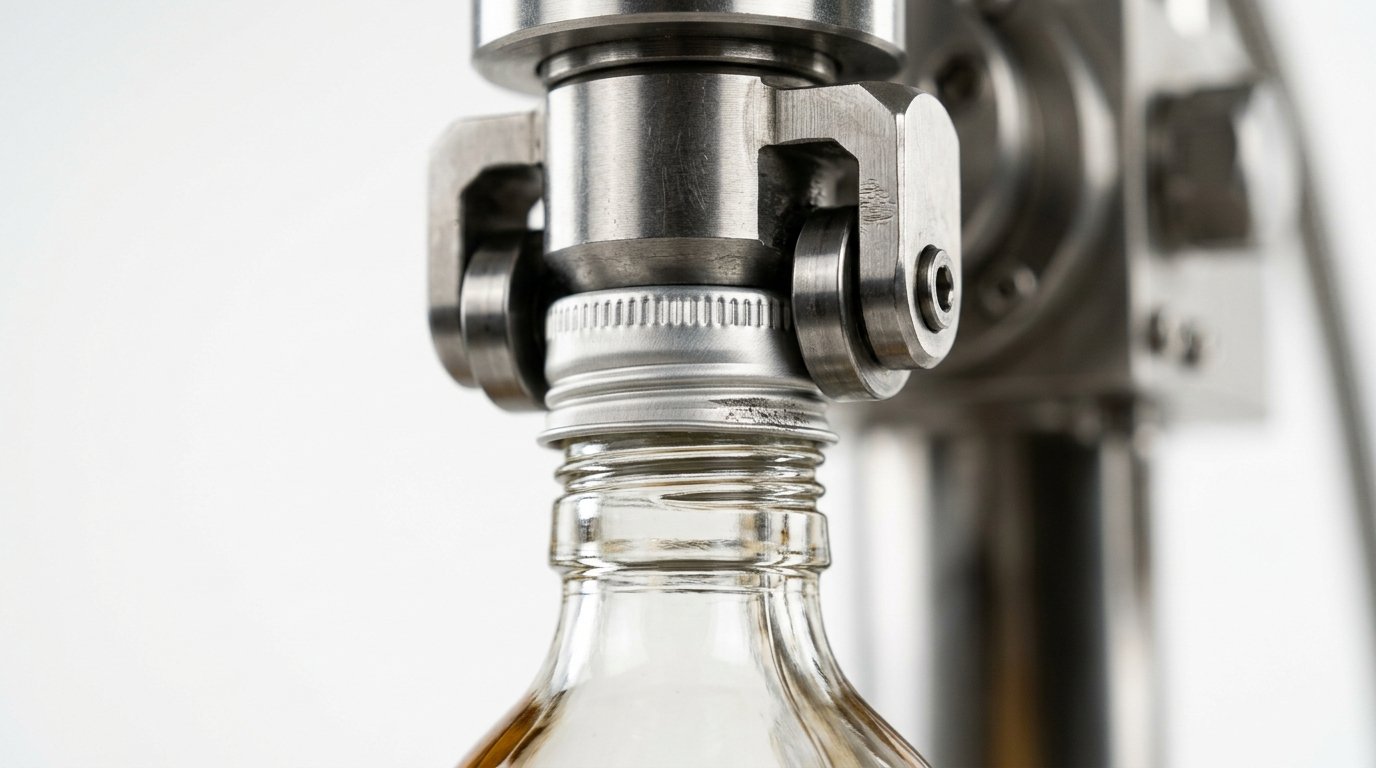
The ROPP capping process runs through six stations on a bottling line: the cap feed sorts and orients plain aluminium shells, the chute places one on each bottle, the head applies top load to seal the liner, thread rollers form the thread on the neck, pilfer rollers tuck the tamper band under the locking ring, and inspection rejects any bottle that fails. Each station has its own way of going wrong, and most leaks and loose caps trace back to one of the first four.
What ROPP capping is, and how it differs from a pre-threaded cap, is explained in what is ROPP capping. The machine itself, its types and settings, is in the ROPP capping machine guide. This page follows one bottle down the line.
The line at a glance
| Station | What it does | What it gets wrong when it is off |
|---|---|---|
| 1. Cap feed and orientation | Sorts shells from the hopper and turns each open end down | Upside-down or jammed caps, gaps in the feed |
| 2. Placement | Sets one shell on each bottle mouth | Missing, cocked or double caps |
| 3. Top load | Presses the shell down so the liner seals on the rim | Weak seal, or a crushed shell and cracked finish |
| 4. Thread rolling | Rolls the aluminium into the neck thread | Shallow or torn thread, loose cap |
| 5. Pilfer rolling | Tucks the band under the locking ring | Band that spins, rides up or breaks on the line |
| 6. Inspection and rejects | Checks each bottle and removes failures | Bad bottles shipped, or good bottles rejected |
Station 1: cap feed and orientation
Caps arrive at the line in cartons and are tipped into a hopper. A sorter, usually a vibratory bowl or a rotating disc, turns each shell open end down and sends it into a single-file chute. At this point the cap is a plain aluminium shell with a liner in the crown and no thread.
What goes wrong:
| Symptom | Usual cause |
|---|---|
| Caps reaching the chute upside down | Sorter set for a different shell height, or worn tooling |
| Caps jamming in the chute | Bent or out-of-round shells, chute width set wrong |
| Gaps in the feed at speed | Hopper running low, sorter speed set below the line speed |
| Liners found loose in the hopper | Liners not seated in the shell at the cap maker; reject the batch and report it |
Store cartons as the cap maker specifies before they reach the hopper. R Vision Closures’ caps are packed in PE bags inside corrugated cartons and stored between 5 and 30 °C; handling is in packing, carton counts and storage for aluminium closures.
Station 2: placement
As each bottle passes under the chute, it picks a shell off the end, or a pick-and-place arm sets one on. The shell must sit square and centred on the bottle mouth, because every later station works from where it lands.
What goes wrong:
| Symptom | Usual cause |
|---|---|
| Bottles leaving with no cap | Feed gap, or bottle spacing wrong at the chute |
| Cap sitting tilted | Bottle not held upright, chute height or angle set wrong |
| Cap off-centre on the mouth | Neck-guide or star-wheel worn, or bottle diameter outside the machine’s range |
A tilted cap is formed tilted at the next three stations and cannot be corrected later.
Station 3: top load
The head descends and its pressure block presses down on the flat top of the shell with a set force. This compresses the liner against the rim of the bottle. This is the moment the bottle is sealed: before any thread exists, the seal is made by the liner alone.
The liner is what does the work here. R Vision Closures’ Aqua Cap and Bev Cap both use a TPE (thermoplastic elastomer) liner, PVC-free on Bev Cap; how liners differ is in what is a cap liner and bottle cap liner materials.
What goes wrong:
| Symptom | Usual cause |
|---|---|
| Bottles that leak or lose carbonation | Top load set too low, so the liner is not compressed enough |
| Crushed cap tops, cracked glass finishes, PET necks that buckle | Top load set too high |
| Some bottles sealed, some not, on the same setting | Bottles of uneven height, or caps of uneven height |
Station 4: thread rolling
While top load is held, the head spins and the thread rollers move in against the cap skirt. They press the soft aluminium into the thread on the bottle neck, so the cap takes the exact profile of the glass or PET beneath it. This is the “roll-on” in roll-on pilfer-proof.
What goes wrong:
| Symptom | Usual cause |
|---|---|
| Shallow thread, cap turns too easily | Roller pressure too low, or roller set too high on the neck |
| Torn or cut aluminium at the thread | Roller pressure too high, or a worn roller with a sharp edge |
| Thread uneven around the cap | Cap tilted at placement, or head spindle out of true |
| Cap will not come off, or strips | Thread formed too deep against the neck |
Station 5: pilfer rolling
Lower on the skirt, the pilfer rollers curl the bottom edge of the shell under the bottle’s locking ring. This forms the tamper-evident band. On Aqua Cap it is a three-part break-system ring that parts on first opening; on Bev Cap the ring stays attached after opening so the bottle reseals, which resealable tamper-evident caps explains.
What goes wrong:
| Symptom | Usual cause |
|---|---|
| Band spins freely or rides up the neck | Pilfer roller set too high or too light, so the band is not tucked under the ring |
| Band breaks on the line, before any consumer opens it | Pilfer roller pressure too high |
| Band intact but cap opens without breaking it | Band not formed under the locking ring at all |
When the rollers retract and the head lifts, the bottle leaves with a sealed liner, a formed thread and a locked band, all made in one head cycle.
Station 6: inspection and rejects
After the capper, bottles pass checks that catch what the stations above got wrong. Which checks a line runs depends on its speed and product, but the common ones are these.
| Check | What it catches | How it is usually done |
|---|---|---|
| Cap present | Bottles with no cap | Sensor after the capper |
| Cap height and tilt | High or cocked caps | Sensor or camera |
| Band formed | Bands not tucked under the ring | Camera, or a sample checked by hand |
| Seal | Leaking bottles | Squeeze or pressure check on a sample, or in-line leak detection |
| Removal torque | Caps too loose or too tight | Torque tester on a sample every shift |
A reject should leave the line automatically and be kept, not thrown away, so someone can look at the cap and bottle together. The tests and how to read them are in testing a ROPP closure, and the defect-to-cause list is in capping defects.
What a good capped bottle looks like
- The cap sits straight, with no tilt against the bottle shoulder.
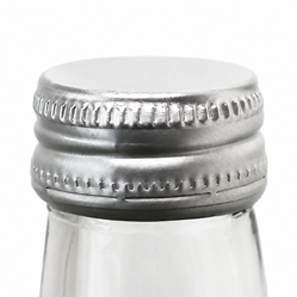
- The thread impression is even all the way round, with no flat or skipped sections.
- The band is tucked under the locking ring and does not spin.
- The bottle holds pressure and does not weep at the finish, which matters most on carbonated fills.
- The cap comes off firmly, breaking the band, without stripping.
R Vision Closures’ closures are rated to withstand pressures up to 8 bar, so on a correctly set line the seal holds under carbonation; see what is 8 bar pressure rating. Which machine class suits a given output is covered in semi-automatic vs automatic capping machines.
The caps this process runs on
| Aqua Cap | Bev Cap | |
|---|---|---|
| Size | 28/15 mm | 28/15 mm |
| Liner | TPE | TPE, PVC-free |
| Tamper band | Three-part break-system ring | Ring stays attached; Round Ring, Two Slit, Five Slit |
| Pressure rating | Up to 8 bar | Up to 8 bar |
| Machinery | Standard roll-on application machinery | Standard roll-on application machinery |
Frequently asked questions
What are the steps of the ROPP capping process?
Cap feed and orientation, placement on the bottle, top load to seal the liner, thread rolling, pilfer rolling to form the tamper band, then inspection and rejection of any bottle that fails.
At which step is the bottle actually sealed?
At top load. The pressure block compresses the liner against the bottle rim before any thread exists, so the seal is made by the liner. The thread and band are formed afterwards to hold the cap and show tampering.
Why do ROPP capped bottles leak?
Most often because top load is too low to compress the liner, the cap was placed tilted, or the bottle finish is out of specification. A thread formed too shallow lets the cap back off and the seal open.
Why does the tamper band spin on the bottle?
The pilfer roller did not tuck the band under the locking ring, usually because it is set too high or too light. The band then rides on the neck instead of locking under the ring.
What is checked after ROPP capping?
Commonly cap presence, cap height and tilt, whether the band is formed, the seal on a sample or in line, and removal torque on a sample every shift. Rejects are kept so the cap and bottle can be examined together.
Browse the rest of the closure guides on Learn, or contact R Vision Closures about caps for your line.