
 Sankalp
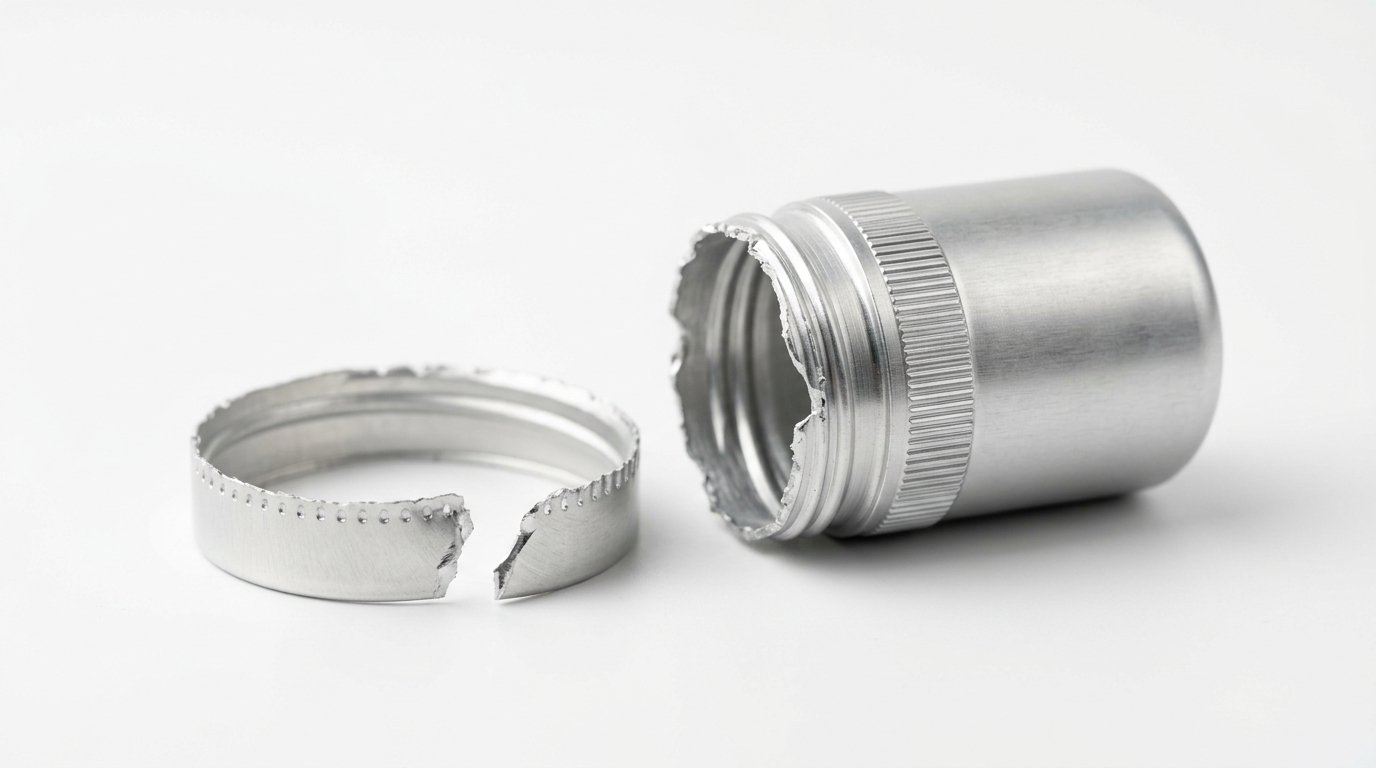
A tamper-evident cap is a bottle closure that leaves visible, permanent proof the first time the bottle is opened. On an aluminium ROPP cap that proof is a ring at the foot of the skirt, joined to the cap by small bridges that break on the first turn and cannot be joined again. R Vision’s Aqua Cap, a 28/15 mm closure for packaged drinking water, spreads that break across a three-part ring, and the four stages it goes through are set out below. A tamper-evident cap reveals an opening. It does not prevent one.
The three-part break system, stage by stage
A three-part break ring passes through four states: sealed as capped, loaded on the first turn, broken, and spent. Once it has reached the third state, nothing returns it to the first, and that one-way movement is the entire value of the feature.
At capping, the closure goes onto the filled bottle and the ring is seated under the bead that runs round the neck below the thread. When a consumer turns the cap for the first time, the cap body starts to climb the thread while the bead holds the ring down. The connections holding the ring together take the strain, then give way, and the ring splits or drops visibly. From then on the cap can be screwed back on to keep the water in, but the ring stays broken.
| Stage | What happens to the closure | What the ring looks like | What a buyer can tell |
|---|---|---|---|
| 1. As capped | Thread formed on the neck, liner pressed on the rim, ring seated under the neck bead | Continuous and snug under the bead, all three sections joined | The bottle is factory-sealed |
| 2. First turn | Cap body rises along the thread while the bead holds the ring in place | Still joined, under load | Nothing yet; the seal is being broken |
| 3. Break | The connections between the sections give way | Split or dropped, with visible gaps round the neck | The bottle has been opened |
| 4. Re-closed | The cap screws back on and holds the contents | Stays broken, cannot be pushed back into a continuous ring | The bottle was opened at least once |
Why three sections rather than one continuous band: a band that parts at a single point can leave a ring that still looks whole from the front of a shelf. A ring that gives way across three sections shows the break at more than one point round the neck, which is harder to disguise. The design is explained in full in the three-part tamper break system.
A ring can also fail the other way. It can part in the carton before anyone opens the bottle, or it can ride up with the cap and never break at all. Both are traced to either the cap as made or the capping head, and the diagnosis is in why tamper bands fail.
How the band is joined to the cap
The pilfer band, also called the pilfer-proof ring or tamper-evident band, is the lowest part of the closure. During capping it is tucked under a locking ring, the bead of glass or plastic just below the threads on the bottle neck. Once tucked, it cannot ride back up over that bead.
On a conventional aluminium ROPP cap, the band is part of the aluminium shell, cut free from the skirt by a row of short slits that leave thin bridges between them. R Vision’s two closures pair an aluminium shell with a PE (polyethylene) ring. Either way, the band stays behind when the cap lifts and the bridges are what break. After the break the band either drops loose against the bottle shoulder or, in resealable ring-retention designs, stays with the bottle below the cap. Where the band sits relative to the shell, liner and knurls is labelled in the parts of a ROPP cap.
Tamper-evidence methods and what each proves
A break ring is one of several ways a pack can show interference, and each proves something slightly different. The useful question for any method is what a shopper can check without opening the pack.
| Method | Where it is used | What it proves | What it does not prove |
|---|---|---|---|
| Break ring on an aluminium ROPP cap | Packaged drinking water, spirits, beverages on glass and PET | The cap has been turned off at least once since capping | That the closure is the original, if the whole cap has been replaced with a matching one |
| Break-off band on a moulded plastic cap | PET water and soft drinks | The same, for a plastic screw cap | The same limit; a generic plain cap is easy to match |
| Retained ring, as on Bev Cap | Beverages drunk over more than one sitting | First opening, with the broken ring kept on the bottle so the cap reseals | Anything about openings after the first |
| Induction seal (foil wad bonded to the rim) | Edible oils, pharma liquids, sauces | The mouth has not been opened past the membrane | It sits under the cap, so a shopper cannot check it on the shelf |
| Shrink band or neck sleeve | Liquor, some premium water, sauces | The cap has not been turned with the sleeve in place | A sleeve can be replaced by anyone holding matching sleeve stock |
| Vacuum button on a lug cap | Jams, pickles, other vacuum-packed food | The vacuum has held since sealing | Works only on vacuum-packed products |
The weak point in the first two rows is the closure being swapped for another. A cap with a printed or embossed top is harder to replace with a plain one bought in the market, which is one reason water and spirits brands decorate the closure; the options are set out in custom printed and embossed bottle caps. The wider set of methods used across Indian packaging is covered in tamper-evident packaging in India.
What the regulation asks for in India
No Indian rule names a single tamper-evident method for water or beverages. What applies is a set of instruments that expect a food-grade, securely sealed pack, and a closure that shows first opening is how bottlers meet that in practice.
| Instrument | What it covers | What it means for the closure |
|---|---|---|
| IS 14543, from BIS | Packaged drinking water: source, treatment, quality limits, packing and sealing | The standard the water is judged against, whether or not the brand holds a BIS licence |
| BIS certification (the ISI mark) | Voluntary since FSSAI notified the omission of the clauses that required it, on 17 October 2024 | Optional; the ISI mark on a pack signals voluntary certification against IS 14543 |
| FSSAI licence | Mandatory for any food business; packaged drinking water was reclassified as a high-risk food category on 29 November 2024 | The closure is part of the finished pack the licence and the annual third-party audit cover |
| Food Safety and Standards (Packaging) Regulations, 2018 | Materials in contact with food | The liner and any part touching the water must be food-grade |
| Legal Metrology (Packaged Commodities) Rules, 2011 | Declarations printed on the pack | A labelling requirement, separate from the seal |
The route to the ISI mark for a water brand, and what stays mandatory in 2026, is laid out in BIS certification for a water brand.
Tamper evident is not tamper proof
A tamper-evident cap shows interference, while a tamper-resistant pack makes interference harder and a “tamper-proof” pack does not exist. The three terms, and what a supplier using each can be held to, are defined in tamper evident vs tamper resistant vs tamper proof.
Where tamper-evident caps are used
Beyond water and carbonated drinks, tamper-evident closures are standard on juices, edible oils, liquor and pharmaceutical syrups, wherever the buyer needs to know that a sealed pack is genuinely unopened. The aluminium ROPP (Roll-On Pilfer-Proof) cap is common because the metal is inert and takes print, and the break ring is readable by anyone.
R Vision makes two: Aqua Cap with the three-part break ring for packaged drinking water, and Bev Cap, whose ring stays attached after opening so a beverage bottle reseals. Both are 28/15 mm with a TPE liner and are rated to 8 bar. For water brands buying in volume, water bottle caps wholesale sets out what a wholesale order involves and the specification to send with an enquiry.
Frequently asked questions
What is the difference between a tamper-evident cap and an ordinary cap?
An ordinary cap only closes the bottle. A tamper-evident cap adds a ring that breaks the first time the cap is turned, so anyone can see whether the seal is still intact. The sealing job is the same; what the tamper-evident cap adds is visible proof of first opening.
How does a three-part break ring work?
At capping the ring is seated under the bead on the bottle neck. On the first turn the cap climbs the thread while the bead holds the ring, the connections between its three sections give way, and the ring splits or drops visibly. The cap can be screwed back on, but the ring cannot be rejoined, so the bottle shows it was opened.
Can a tamper-evident cap be resealed after opening?
The cap can be screwed back on to protect what is left in the bottle, and some designs keep the broken ring attached at the neck. The tamper evidence is spent once the ring breaks, though. A retightened cap still stores the product, and the broken ring still shows that the bottle was opened.
Are tamper-evident caps required for bottled water in India?
No Indian rule names one tamper-evident method. Packaged drinking water is judged against IS 14543 and needs an FSSAI licence, and both expect a clean, food-grade, securely sealed pack. A closure that visibly breaks on first opening is how bottlers meet that expectation, and it shows a buyer the water has not been opened or refilled.
What is the pilfer band made of?
On a conventional aluminium ROPP cap the band is part of the aluminium shell, joined to the skirt by thin bridges left between short slits. R Vision’s Aqua Cap and Bev Cap pair an aluminium shell with a PE, or polyethylene, ring. In both designs the connections holding the ring are what break on first opening.
Sources
- Bureau of Indian Standards, for IS 14543 and the certification scheme for packaged drinking water.
- Food Safety and Standards Authority of India, for licensing, the Packaging Regulations, 2018, and the orders of 17 October 2024 and 29 November 2024.
R Vision Pvt. Ltd manufactures aluminium tamper-evident ROPP closures for water and beverages at MIDC Malegaon, Sinnar, Nashik, Maharashtra. For the water application, see closures for packaged drinking water and the Aqua Cap product page. The rest of the closure guides are collected on Learn.