
 Sankalp
A PVC-free liner matters for beverage brands because it removes the plasticisers a PVC liner needs, and with them the question of what migrates from the closure into the drink over shelf life. The liner is the only part of the cap that touches the product, so its material is a food-safety decision as well as a sealing one. R Vision Pvt. Ltd, an aluminium ROPP closure manufacturer in Sinnar, Nashik, lines both of its 28/15 mm closures with TPE (thermoplastic elastomer), and the Bev Cap liner is specified PVC-free. There is no PVC-lined option in the range. Both closures are rated to 8 bar.
What a cap liner does
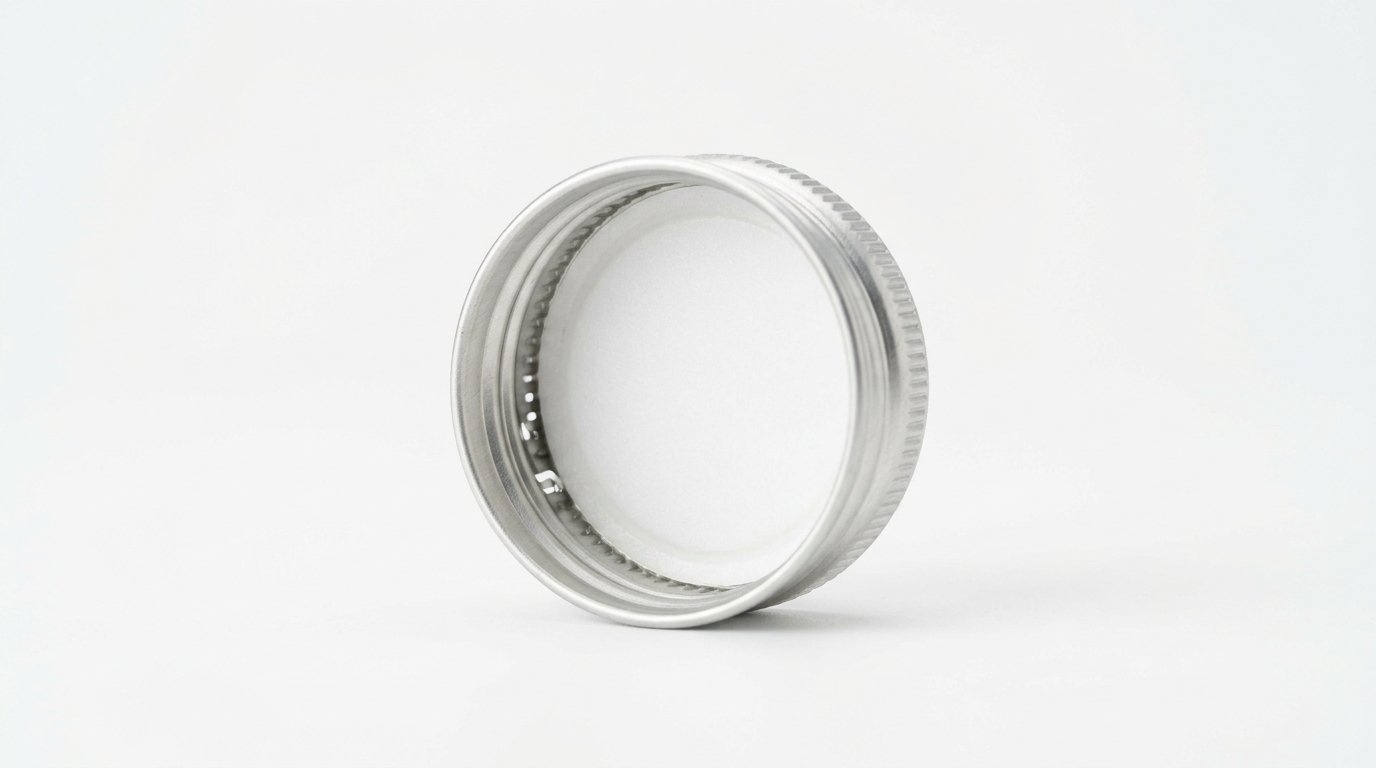
Inside a bottle closure sits a soft liner, sometimes called a wad, that presses against the bottle rim to form the actual seal. It is the only part of the cap in direct contact with the beverage. Because of that contact, the liner material governs two things at once: how well the bottle seals, and what, if anything, can transfer from the liner into the drink. What a cap liner is covers the component in full, and the families in use are set out in bottle cap liner materials.
PVC became the industry default for good reasons. It compresses well, tolerates a wide range of fill temperatures and forgives small variations in the bottle neck, and it is cheap. For decades that was the entire specification a bottler needed. How it compares with foam, solid PE and pulp liners is in EPE, PE, PVC and pulp liners compared.
The problem with PVC liners
PVC (polyvinyl chloride) on its own is rigid. To make it soft enough to seal, manufacturers blend in plasticisers, and those additives are not chemically bound into the polymer. That is the concern:
- Chemical migration. Plasticisers can migrate from the liner into the product, especially with fatty, acidic or long-shelf-life contents and at warm storage temperatures. For a beverage a consumer drinks directly, any migration into the liquid is unwelcome.
- Regulatory pressure. Food-contact rules in major markets set migration limits and restrict which substances may be used in food-contact plastics, and brands selling across borders prefer materials that meet the strictest of those rules.
- Brand risk. For a beverage brand, a food-safety question about the closure liner is a reputational risk that is easy to avoid by specifying a different material.
Switching to a PVC-free liner removes the plasticiser question at its source rather than managing it. PVC vs PVC-free cap liners sets the two materials side by side.
The regulatory background
Food-contact law does not ban PVC liners in India or the EU. It judges a material by what moves out of it, and asks the supplier to evidence that.
| Framework | What it requires of a liner | What it means for PVC |
|---|---|---|
| FSSAI Food Safety and Standards (Packaging) Regulations, 2018 | Material in direct or likely contact with food must be food-grade. Plastics must meet an overall migration limit tested by the method in IS 9845, with no visible colour migration | Permitted if it passes; the plasticiser system is what the test has to clear |
| European Commission Regulation (EC) No 1935/2004 | Food-contact materials must not transfer constituents in quantities that endanger health or change the food, and must carry a declaration of compliance where a specific measure applies | Permitted within the rules; migration evidence is the supplier’s burden |
| European Commission Regulation (EU) No 10/2011 | Authorised substance list and migration testing rules for plastics, with a declaration of compliance | Each plasticiser has to be authorised and within its limits |
So the question a PVC liner leaves open is not whether it is lawful. It is how much migration headroom it has on your product, at your storage temperature, over your shelf life. The detail of the Indian limits and the documents to ask for is in food-grade aluminium and liner standards.
Our position on PVC
Every closure R Vision makes uses a TPE liner. There is no PVC version of Aqua Cap or Bev Cap, and no cheaper PVC-lined option behind the price list. The decision was taken once, for the whole range. R Vision’s company profile sets out the range and the business behind it.
Our objection is narrower than “PVC is dangerous”, and we are not going to say that here. It is that a PVC liner leaves the bottler managing a migration budget on a component costing a fraction of a rupee, for the whole shelf life, in storage conditions nobody controls once the truck leaves the plant. Removing the plasticiser system removes the question instead.
What we are not claiming:
- We are not saying PVC-lined caps are unsafe or unlawful. They are widely used and regulated.
- PVC-free is a statement about the liner, not about recyclability. TPE is still a polymer, and the recycling story for an aluminium closure belongs to the shell.
- Our closures adhere to USFDA and EU standards. That is adherence, not a third-party certificate, and we do not describe it as certification.
- We do not charge for PVC-free as a premium feature. It is simply the only liner we supply.
What TPE does instead
TPE is elastic as supplied. It does not need a plasticiser package to behave like a seal, which is the whole point: there is no mobile additive to migrate. In R Vision’s closures it seals against internal pressure up to 8 bar, holds across hot fill, cold fill and carbonated products, and asks nothing unusual of the capping head.
Liner specification
| Specification | Aqua Cap | Bev Cap |
|---|---|---|
| Liner | TPE (thermoplastic elastomer) | TPE (thermoplastic elastomer), PVC-free |
| PVC-lined option | None | None |
| Closure type | Aluminium ROPP, PE ring | Aluminium ROPP, PE ring |
| Size | 28/15 mm | 28/15 mm |
| Pressure rating | Up to 8 bar | Up to 8 bar |
| Fill types | Hot fill, cold fill, carbonated | Hot fill, cold fill, carbonated |
| Tamper system | Three-part break-system ring | Ring stays attached after opening, so the bottle reseals. Round Ring, Two Slit and Five Slit variants |
| Standards position | Adhering to USFDA and EU standards | Adhering to USFDA and EU standards |
| Closure shelf life | Two years from manufacture, stored 5 to 30 °C | Two years from manufacture, stored 5 to 30 °C |
| Machinery | Standard roll-on application machinery | Standard roll-on application machinery |
On Bev Cap, the PVC-free liner works with the rest of the closure: the aluminium shell seals to 8 bar for carbonated and non-carbonated drinks, and the ring stays attached so the bottle can be resealed while tamper evidence remains visible. Full specifications sit on the Bev Cap product page, the questions beverage buyers ask most are answered in the Bev Cap FAQ, and closures for carbonated soft drinks covers the wider CSD brief.
What changes on your line
Switching liner material is a specification change, not a plant project. Here is what moves and what does not.
| What | Does it change |
|---|---|
| Seal performance | No. Formed the same way, against the same bottle finish |
| Pressure holding | No. Rated to 8 bar with the TPE liner, which covers carbonated fills |
| Capping machinery | No. Both products run on standard roll-on machinery |
| Capping settings | Possibly. Retune head load and roller pressure on the trial run, as with any new closure |
| Fill temperature range | No. Hot fill and cold fill both covered |
| Shelf life of the closure | No. Two years from manufacture, stored 5 to 30 °C |
| Your compliance file | Yes, in your favour. One less migration question for an export buyer |
| Artwork and decoration | No. Printing, embossing and foiling are unaffected |
The one thing to do properly is the trial run. Any change of closure deserves a supervised run with removal torque checks and a leak test, and a liner change is no exception. A PVC-free liner still has to hold gas as well as liquid, and how closures prevent carbonation loss covers what that takes.
Frequently asked questions
What is a PVC-free liner?
It is a bottle cap sealing liner made without polyvinyl chloride, usually from a thermoplastic elastomer (TPE). Because it is elastic as supplied, it does not rely on the plasticisers PVC needs to stay soft, which removes the question of those additives migrating into the product over shelf life.
Why do beverage brands want PVC-free liners?
Because the liner touches the drink directly. A PVC liner has to be softened with plasticisers that are not bound into the polymer, so a brand has to show migration stays within limits for its product and storage conditions. A PVC-free liner removes that question, which is simpler to explain to an export buyer or a quality auditor.
What liner do R Vision’s closures use?
Both R Vision closures, Aqua Cap and Bev Cap, use a TPE (thermoplastic elastomer) liner, and the Bev Cap liner is specified PVC-free. There is no PVC-lined version of either product. Both are 28/15 mm aluminium ROPP closures rated to 8 bar, suitable for hot fill, cold fill and carbonated products.
Does a PVC-free liner seal as well as PVC?
Yes. A TPE liner forms the seal against the same bottle finish in the same way, and R Vision’s closures are rated to 8 bar with it, which covers carbonated soft drinks as well as hot fill and cold fill products. As with any new closure, confirm it with a trial run on your own line.
Do I need new capping machinery to use a PVC-free cap?
No. Both R Vision closures run on standard roll-on application machinery. As with any new closure, run a supervised trial with removal torque checks and a leak test, and expect to retune head load and roller pressure slightly.
Is R Vision certified as PVC-free?
R Vision states that its closures adhere to USFDA and EU standards and that the liner across the range is TPE. That is a statement of specification and adherence rather than a third-party certification, so buyers who need documentary evidence for a compliance file should ask for a liner material declaration before ordering.
Sources
- European Commission, food contact materials, for Regulation (EC) No 1935/2004 and Regulation (EU) No 10/2011.
- FSSAI, Food Safety and Standards (Packaging) Regulations, 2018.
- IS 9845, overall migration from plastics in contact with foodstuffs, BIS.
More closure guides are collected in the learn library. To request samples for a trial run, contact R Vision or call +91 72620 02754.