
 Sankalp
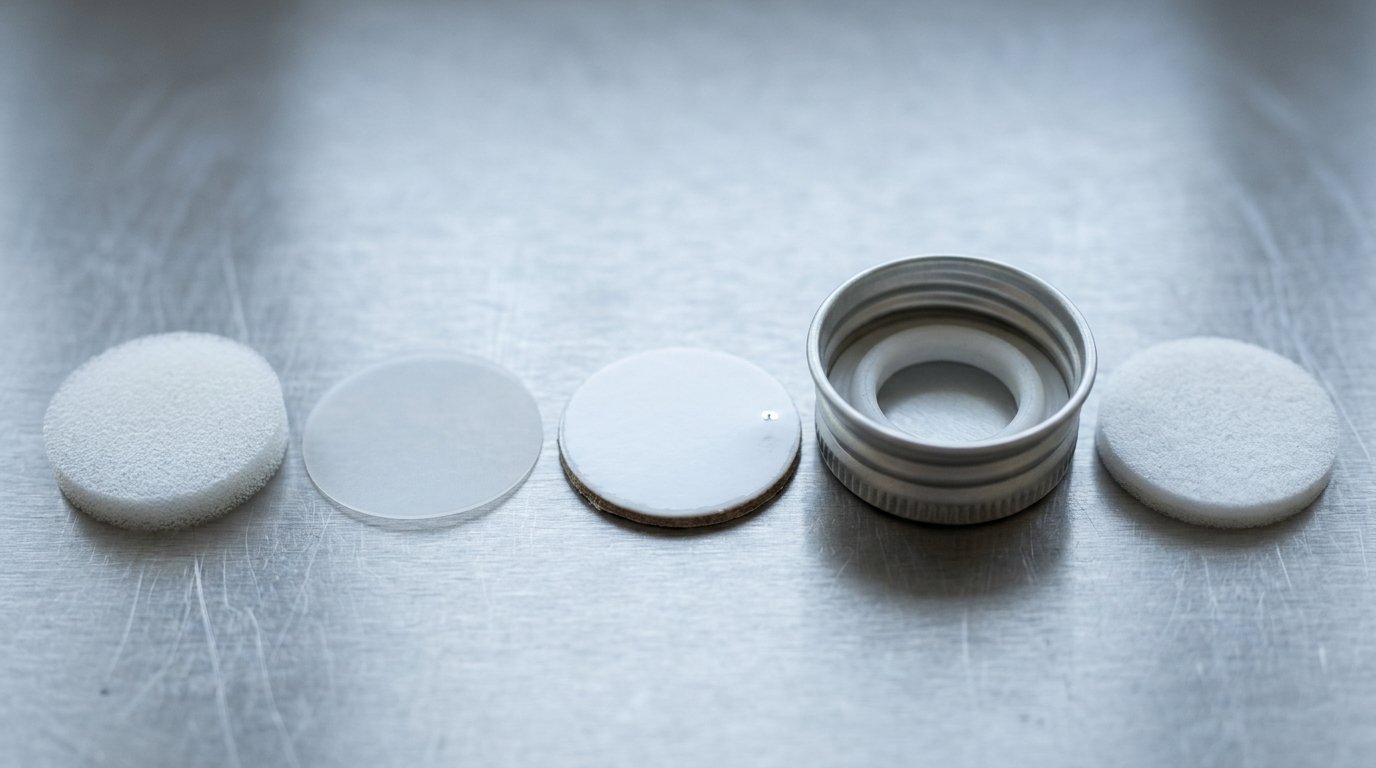
EPE is expanded (foamed) polyethylene: a compressible cell structure that takes up small rim defects under light closing force. A solid PE liner is the same polymer without the foam, so it is denser, a better moisture barrier, and less forgiving of an uneven rim. PVC liners are plasticised compound, flowed into a metal closure or faced onto a board, and they tolerate heat. Pulp and poly is a paper board backing with a thin plastic face, the cheapest of the four, for dry goods and mild liquids and never for pressure. For carbonated or hot-filled drinks under an aluminium closure, the choice narrows to a moulded compound liner, PVC or a PVC-free TPE.
What a cap liner is covers the component itself. This page is the material decision.
The materials side by side
Thicknesses are typical industry ranges, not a specification; the figure to order against is on the liner supplier’s data sheet for your cap size.
| Material | Composition | Typical form and thickness | Temperature position | Seals well | Food-contact position | Rough cost order |
|---|---|---|---|---|---|---|
| EPE (foam PE) | Closed-cell polyethylene foam, often with thin solid PE skins either side | Cut disc, commonly sold between about 0.5 mm and 1.5 mm | Cold fill. Supplier guidance keeps foam PE off hot fills, with the limit usually put around 70 °C | Still liquids, water-based products, rims that are not perfectly flat | Polyethylene is an established food-contact polymer, with a BIS standard for its use in contact with food and drinking water | Low |
| Solid PE | Unfoamed low-density polyethylene disc, film or cone | Thin disc or film, or a moulded cone that wedges into the bore | As foam PE | Moisture barrier, evaporation-prone liquids (cone form), flat and smooth rims | As above | Low |
| PVC | Plasticised PVC, flowed in as a compound or used as a facing | Compound is specified by weight and profile rather than a sheet thickness | Tolerates hot fill and heat treatment | Metal closures, hot fill, vacuum and pressure packs | Permitted within migration limits; plasticiser migration is the known concern | Low to medium |
| Pulp and poly | Compressed paper pulp board with a thin plastic facing, polyethylene or vinyl depending on the maker | Board-backed disc, thicker than film liners | Cold fill only | Dry goods, powders, some mild liquids | The facing is the contact surface, so ask what it is | Lowest |
| TPE compound (PVC-free) | Thermoplastic elastomer moulded into the shell | Moulded ring or disc, specified by the closure maker | Hot fill, cold fill and carbonated in closures rated for it | Pressure, carbonation, glass and PET rims | Seals without a plasticiser package, so the PVC migration question does not arise | Above PVC compound |
Cost order is relative for a like-for-like cap size, and it moves with volume and supplier. What drives ROPP cap cost sets the liner against the other lines in a closure quote.
EPE or PE: what the difference actually is
The difference is the foam. An EPE liner is polyethylene blown into small closed cells, so it squashes under the cap and springs back, filling a slightly chipped glass rim or a PET finish with a mould seam. A solid PE liner is dense: a better barrier to moisture and vapour, but it needs a flatter sealing surface and more closing force to make continuous contact.
On a quotation the two are often confused, because many suppliers write “PE liner” when they mean PE foam. Ask which is being offered, and whether the foam is a single layer or laminated between solid PE skins, which gives a cleaner, less porous face against the product. Neither is a liner for carbonated drinks or hot fill: foam loses its recovery when hot, and neither form is made to hold internal pressure under a thin aluminium shell. Hot fill needs a compound liner, and closures for juices and RTD beverages explains what the cooling pack then does to the seal.
Pulp and poly liners
A pulp and poly liner is a disc of compressed paper board that cushions the seal, with a thin plastic film facing the product. Some makers use polyethylene for the facing and some a vinyl film, so “poly” on a quote does not settle which.
They suit dry products, powders and cold-filled mild liquids. The weakness is moisture: if the facing is cut or lifts at the edge, the board takes up liquid, swells and loses its seal. That rules them out for water and beverages on a long shelf life, and for anything under pressure.
PVC compound and the PVC-free alternative
PVC in closures mostly means a compound: a plasticised paste flowed into a metal cap and fused into a sealing ring. It seals well, handles heat and is cheap. The concern is the plasticisers that make it soft, which are not bound into the polymer and can migrate into the product over shelf life. PVC vs PVC-free cap liners sets the two side by side, and food-grade aluminium and liner standards covers the migration limits in India. A TPE compound does the same job without a plasticiser package, which is why it has become the default for new water and beverage closures; PVC-free liners for beverages explains what that means for a drinks brand.
Linerless closures
A linerless closure has no separate liner. Its seal is moulded into the plastic cap, usually as a plug that enters the bottle mouth, a ring that presses on the outside of the finish, or both. Most plastic closures on PET water and soft drink bottles work this way.
Linerless caps are also common on chemical containers. With no liner there is nothing for an aggressive product to swell, soften or dislodge, so compatibility becomes a question about the closure resin alone. The trade-off is that the seal depends on the neck finish being moulded to tolerance, with no soft layer to take up variation.
An aluminium ROPP shell cannot be linerless. The metal has no sealing features of its own, and its thread is formed on the neck at capping, so every aluminium roll-on closure carries a liner.
Which liner R Vision uses, and why
Both R Vision closures use a TPE liner. Aqua Cap is the tamper-evident aluminium ROPP closure for packaged drinking water, and Bev Cap is the beverage closure with a PVC-free TPE liner and a ring that stays attached after opening. Both are 28/15 mm, rated to 8 bar, and suit hot fill, cold fill and carbonated products.
The reason is the job. A closure for water and soft drinks has to seal under pressure and through hot fill, on glass and PET. Foam and pulp liners are not made for that, and a PVC compound brings the plasticiser question. If a PVC-free claim will go on your pack, ask for a written liner material declaration, one of the documents in quality certificates to ask your cap supplier for.
Frequently asked questions
What is the difference between an EPE liner and a PE liner?
EPE is expanded polyethylene, a foam with small closed cells that compresses and recovers, so it seals against rims that are not perfectly flat. A solid PE liner is unfoamed polyethylene: denser, a better moisture barrier, but less forgiving of an uneven rim and in need of more closing force. Suppliers often write PE when they mean PE foam, so ask which is being quoted.
What is a pulp and poly liner?
A two-layer liner: a compressed paper board backing that cushions the seal, with a thin plastic facing against the product, polyethylene or vinyl depending on the maker. It suits dry goods and cold-filled mild liquids. It is not suited to pressure, hot fill or long wet contact, because the board swells if the facing is breached.
Which cap liner is best for carbonated drinks?
A moulded compound liner in a closure rated for pressure. Foam, solid PE and pulp liners are not designed to hold internal pressure. For carbonated soft drinks and sparkling water, the usual routes are a TPE or PVC compound liner in an aluminium roll-on closure rated to around 8 bar, or a linerless plastic closure on a carbonated PET finish.
What is a linerless cap?
A plastic closure whose seal is moulded into the cap as a plug, an outer ring or both, with no separate liner fitted. It is common on PET water and soft drink bottles and on chemical containers. The seal relies on the bottle neck being moulded accurately. Aluminium roll-on closures always need a liner.
Sources
- Bureau of Indian Standards, for IS 10146 (polyethylene for safe use in contact with foodstuffs, pharmaceuticals and drinking water) and IS 10151 (polyvinyl chloride and its copolymers for the same use).
- FSSAI, Food Safety and Standards (Packaging) Regulations, 2018.
- IS 9845, overall migration from plastics in contact with foodstuffs, BIS.
- European Commission, food contact materials.
- CETIE general data sheets, including DT31.00 on the main types of sealing on glass containers.
To match a liner to your fill and bottle, contact R Vision.