
 Sankalp
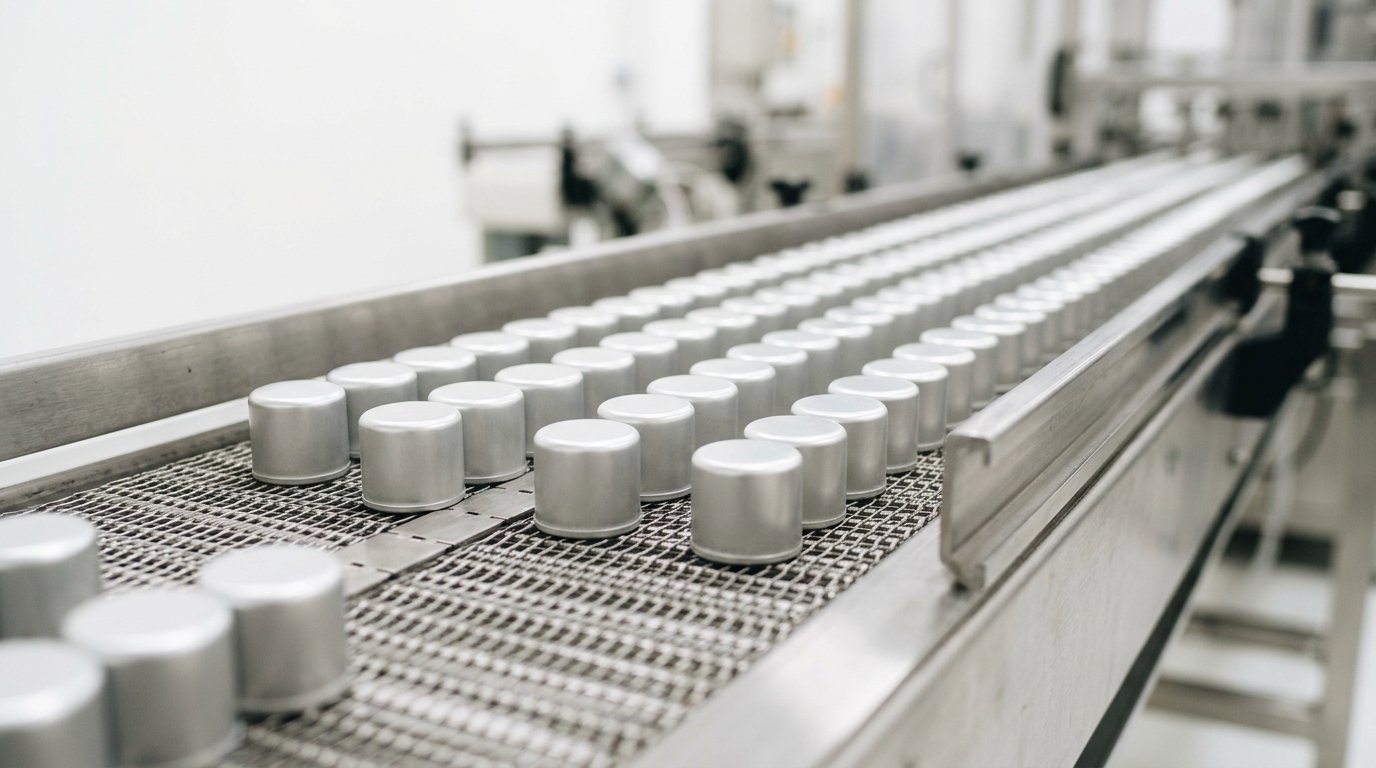
ROPP caps are made in two distinct stages. In the factory, an aluminium coil is cut and drawn into a plain, threadless shell, coated, printed, lined, and scored to create the pilfer band. The threads and final seal are formed later, on the bottling line, when rollers press the shell onto the specific bottle neck. What a ROPP cap is describes the finished closure this process produces.
Stage 1: making the aluminium shell
The starting material is a coil of aluminium sheet, chosen for the size of cap being produced. For a 28 mm cap the sheet is fed into a press that blanks out flat discs and then draws each disc into a shallow cup, the basic shell. This shell already has the diameter and skirt height of the finished cap, but no threads.
At this point the cap is a smooth aluminium cup with an open bottom edge. Everything that gives it identity and function is added in the steps that follow.
Stage 2: coating and printing
The bare shell is coated inside and out. The internal coating protects the aluminium from the product and protects the product from the metal, which matters for water, carbonated drinks, and edible liquids. The external coating provides the base colour and a surface that holds print.
Decoration is applied next. Plain silver shells skip printing; coloured shells receive a lacquer coat; branded shells go through litho printing for logos and text. These three routes are why plain silver, plain colours, and litho printing carry different minimum order quantities.
Stage 3: inserting the liner
A liner is placed inside the top of the shell. The liner is the soft disc that actually forms the seal against the bottle mouth once the cap is applied. Liner material is chosen for the product: a TPE liner suits water and can handle hot, cold, and carbonated fills, and a PVC-free TPE liner is used for beverages. What a cap liner is explains why this disc, not the shell, does the sealing.
| Step | What happens | Result |
|---|---|---|
| Blanking and drawing | Coil is cut and pressed into a cup | Plain aluminium shell |
| Coating | Inside and outside coats applied | Protected, colour-ready shell |
| Printing | Silver, colour, or litho decoration | Finished appearance |
| Lining | Sealing disc inserted at the top | Sealing surface ready |
| Scoring and knurling | Pilfer band scored, top knurled | Tamper band formed |
To understand what each of these components does, see parts of a ROPP cap.
Stage 4: scoring the pilfer band
The lower skirt is scored with a line of perforations that leave thin bridges of metal in place. This scored ring is the pilfer band. It stays connected to the cap body until the bottle is first opened, at which point the bridges break and the band separates or stays on the neck bead. That is the mechanism behind a pilfer-proof cap. The finished shell leaves the factory here: threadless, but ready to become tamper-evident.
Stage 5: applying the cap at capping
The final shell is not screwed on like a moulded cap. It is placed over the filled bottle neck and shaped onto it by rolling. On the capping line, one set of rollers presses the aluminium into the bottle’s thread profile to form matching threads, and another set tucks the pilfer band under the neck bead. This on-bottle forming is what “roll-on” in ROPP means. For the applying step in detail, see what is ROPP capping, the ROPP capping machine guide for the head that does the work, and semi-automatic vs automatic cappers for how that job scales with volume.
The key distinction: the factory makes the cap, but the bottler forms the threads and seal. A ROPP cap does not carry usable threads until it has been rolled onto a bottle.
Frequently asked questions
How are bottle caps made?
Aluminium ROPP caps start as a coil of aluminium that is cut into discs and pressed into shallow shells. Each shell is coated, printed, fitted with a sealing liner, and scored to create the pilfer band. The threads and final seal are not made in the factory; they are formed on the bottle at the capping line.
Do ROPP caps come with threads already made?
No. A ROPP cap leaves the factory as a threadless aluminium shell with a liner and a scored pilfer band. The threads are formed only when the cap is rolled onto a specific bottle neck during capping. This is why the same blank cap can fit a range of matching neck profiles.
What is the difference between making a cap and applying it?
Making the cap happens in the factory: drawing the shell, coating, printing, lining, and scoring the band. Applying the cap happens on the bottling line, where rollers press the shell onto the filled bottle to form threads and seal it. Two different places and two different machines are involved.
What material are ROPP caps made from?
ROPP caps are made from an aluminium shell with an internal sealing liner. R Vision uses aluminium shells in the 28/15 mm size with a TPE liner for water and a PVC-free TPE liner for beverages. The aluminium is coated so it does not react with the product inside.
See how the finished caps perform on the Aqua Cap and Bev Cap pages, or contact us for a production discussion. Further reading is gathered in the R Vision closure guides.