
 Sankalp
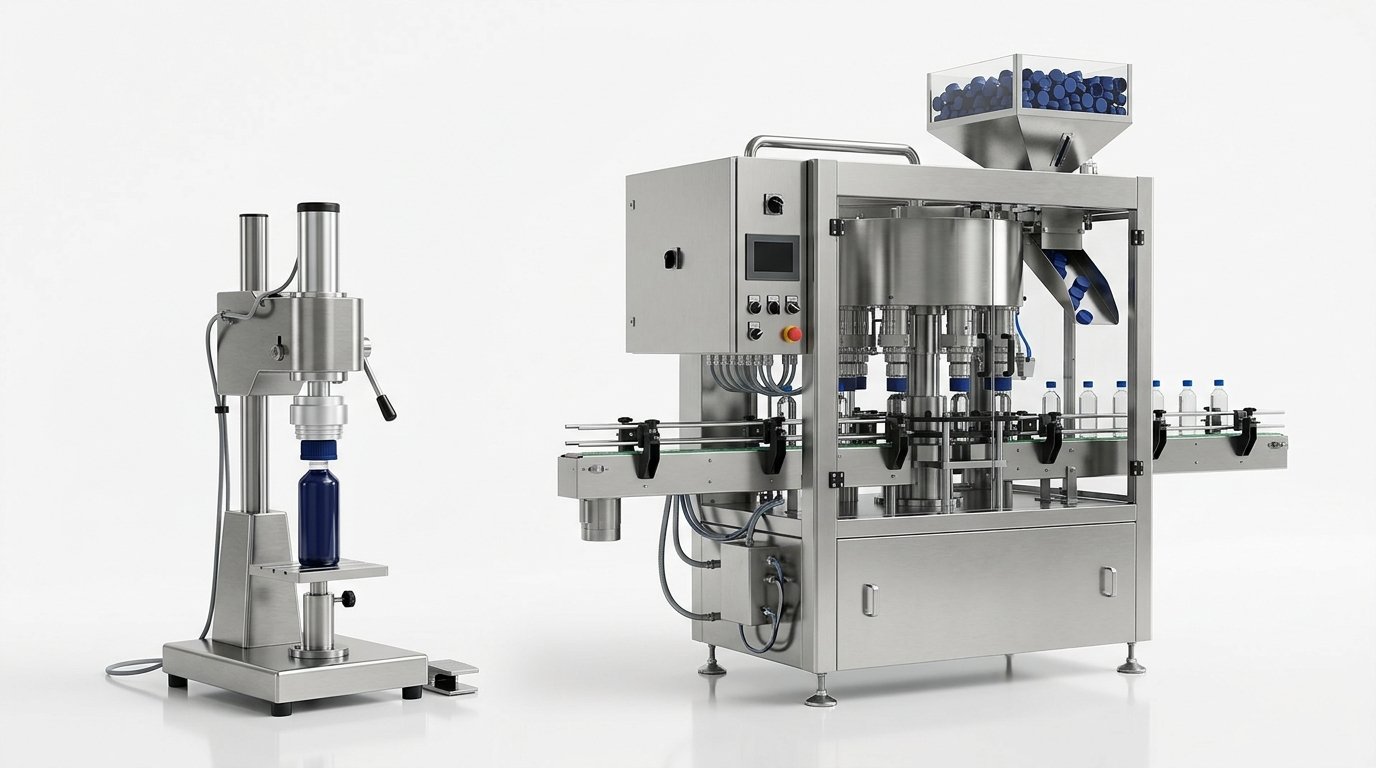
A semi-automatic capping machine needs an operator to load and position each bottle, and suits low volumes and early-stage brands. An automatic capper feeds, positions, caps, and discharges bottles on its own, suits higher and steadier volumes, and cuts per-bottle labour. For most small Indian water and beverage brands, semi-auto is the right start and automatic is the growth step.
The core difference
The split is about who moves the bottle. On a semi-automatic capper the operator places each bottle under the head and triggers the cycle, so throughput is paced by a person. On an automatic line the conveyor, star wheel, and cap sorter handle everything, so the machine runs continuously and the operator only monitors and refills caps.
Both form the closure the same way. The roll-on forming principle and the step-by-step process are identical whether the head is semi-auto or automatic. What changes is the volume, the labour, and the capital.
Comparison at a glance
| Factor | Semi-automatic | Automatic |
|---|---|---|
| Throughput | Lower, operator-paced | Higher, continuous |
| Upfront cost | Lower | Higher |
| Labour per bottle | Higher, hands-on each cap | Lower, monitor only |
| Consistency | Depends on operator | More uniform |
| Best-fit volume | Small / variable runs | Steady mid to high volume |
| Floor and utilities | Modest | More space and power |
Speeds are given as ranges because they vary by bottle, cap, and setup; treat vendor figures as a starting point and confirm on your own bottles and caps.
When semi-automatic is the right call
A semi-automatic capper fits when:
- Your volumes are low or seasonal and a fast line would sit idle.
- Capital is tight and you would rather prove demand before a larger spend.
- You run varied bottle formats and value flexibility over raw speed.
- Labour is available and per-bottle labour cost is not yet your bottleneck.
Many new packaged drinking water and beverage brands in India start here, capping R Vision’s 28/15 mm Aqua Cap or Bev Cap on a single semi-auto head while building distribution.
When to move to automatic
The signals to step up are practical:
- You are running the semi-auto machine at or near its ceiling for long stretches and still cannot keep up with orders.
- Labour cost per bottle is climbing and hands-on capping is a real line of your unit economics.
- Consistency is slipping because operator fatigue across long shifts is producing more cocked caps or variable seals.
- Demand is steady, not spiky, so a faster machine will actually stay busy and earn back its cost.
If demand is still lumpy, an automatic line can sit underused and hurt your economics more than it helps. The move works best when volume is both high and predictable.
What does not change: the cap
Whichever machine you run, cap consistency governs how clean the result is. A dimensionally consistent 28/15 mm shell with a well-seated liner lets you set the head once and hold it, which matters even more on an automatic line where you are not touching each bottle to catch a bad one. R Vision supplies the caps, not the machine: the Aqua Cap for packaged drinking water (three-part break-system tamper ring, TPE liner) and the Bev Cap for beverages (PVC-free TPE liner, resealable pilfer ring). Both are rated to 8 bar. For why shell consistency matters on faster lines, see Aqua Cap vs ordinary ROPP caps and the defects guide.
For a wider buyer view across machine types and Indian service and spares, read choosing a bottle capping machine in India. Machine capital is only half the budget: what drives ROPP cap prices in India covers the consumable side of the same sum. Every guide in this set is indexed on the Learn hub.
Frequently asked questions
What is the main difference between semi-automatic and automatic cappers?
On a semi-automatic capper an operator loads and positions each bottle by hand, so throughput is paced by a person. An automatic capper feeds, positions, caps, and discharges bottles on its own, giving higher continuous output and lower labour per bottle.
Which should a new water brand start with?
Most new Indian water and beverage brands start with a semi-automatic capper. It costs less upfront and suits low or variable volumes, which lets a brand prove demand before committing capital to a faster automatic line.
When is it time to switch to automatic?
Switch when your semi-auto machine runs near its ceiling for long stretches, labour cost per bottle becomes significant, or consistency slips over long shifts, and when demand is steady rather than spiky so the faster machine stays busy.
Does the cap change between the two machine types?
No. R Vision’s Aqua Cap and Bev Cap are the same 28/15 mm aluminium shells rated to 8 bar on either machine. Cap consistency actually matters more on an automatic line, where nobody is handling each bottle to catch a bad seal.
Does R Vision sell either machine?
No. R Vision manufactures the aluminium ROPP closures, not the capping machinery. You buy the semi-auto or automatic machine from a machine builder and run R Vision caps on it.
Talk through the right closure for your line: Aqua Cap, Bev Cap, or contact R Vision.