
 Sankalp
The main types of water bottle caps are aluminium ROPP (roll-on pilfer-proof) caps, plastic screw caps, sports and dispensing caps, and jar caps for 5 litre cans and 20 litre dispensers, with heat-sealed film lids on water cups. Aluminium ROPP caps suit premium still and sparkling water in glass or PET; plastic screw caps suit high-volume PET lines; sports caps suit on-the-go bottles; jar caps suit bulk water. The type of cap tells you something about the pack. The colour of the cap does not follow any Indian standard.
Water is a trust product. The closure has to seal reliably, show clearly if the bottle has been opened, and fit the way the water is sold. This guide covers each cap type used on Indian water packaging and where it fits, and it sits under the wider overview of closures for packaged drinking water.
Every water cap format in one table
| Cap type | Material | Bottle and volume | Still or sparkling | Tamper evidence | Neck it fits |
|---|---|---|---|---|---|
| Aluminium ROPP | Aluminium shell, plastic ring, sealing liner | Glass or PET, 200 ml to 2 litres | Both, when pressure rated | Pilfer-proof band that breaks on first opening | ROPP finish, commonly 28 mm |
| Plastic screw cap | PP or HDPE | PET, 250 ml to 2 litres | Still; sparkling on a carbonated PET finish | Break band that stays on the neck | Moulded PET thread finish |
| Sports or dispensing cap | PP with a push-pull or valve nozzle | PET, commonly 500 to 750 ml | Still or flavoured | Only with an added seal or shrink band | PET thread finish |
| Jar cap, 5 litre | Moulded PP or HDPE | Can, 5 litres | Still | Tear-off band or shrink seal | Wide jar neck, around 38 mm |
| Jar cap, 20 litre | Moulded PP or HDPE, press-on or screw | Returnable dispenser jar, 20 litres | Still | Tear-off band or shrink seal | Wide jar neck, around 55 mm |
| Film lid | Heat-sealed film | Cup, 200 to 300 ml | Still | The seal itself; a torn lid shows | No neck; sealed to the cup rim |
Sizes are the formats in circulation, not an order specification; water bottle cap sizes used in India sets them out from cup to jar, and neck formats on Indian packaged water bottles decodes the PET finish references.
What the cap types mean
The type of cap is the signal worth reading. A metal roll-on cap usually means a premium or glass-bottled water and a closure that shows opening clearly. A plastic screw cap means a standard retail PET bottle. A sports cap means a bottle designed to be drunk from on the move, and a wide jar cap means bulk or dispenser water.
Cap colour is different: no BIS or FSSAI rule assigns a meaning to it, so it reflects only what each brand decided. The colour-by-colour picture is in what water bottle cap colours mean.
Aluminium ROPP caps
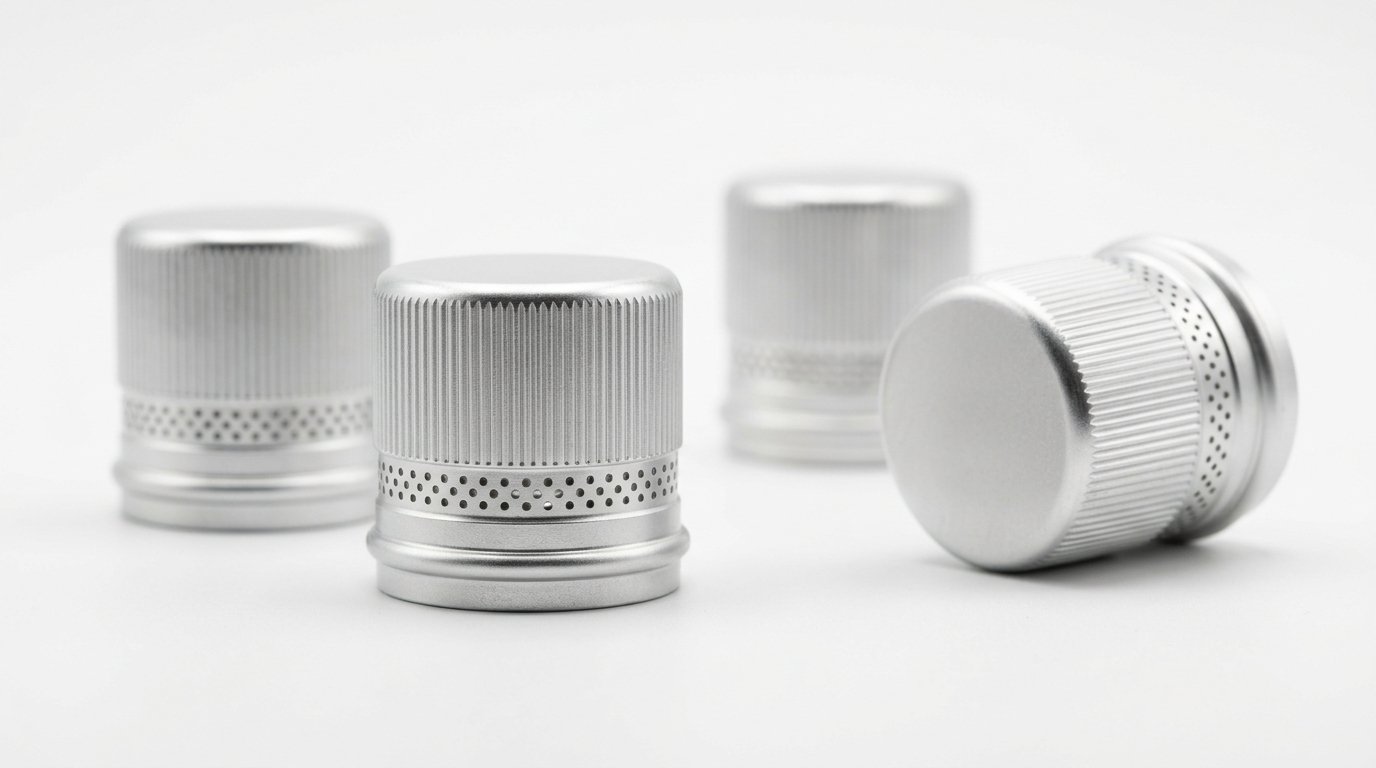
A ROPP cap is a plain aluminium shell whose threads are formed onto the bottle neck during capping, with a pilfer-proof band that breaks on first opening. The metal finish and the visible break band make it the premium closure for packaged drinking water and for glass or PET bottles that sell on quality.
- Material: aluminium, with an inner liner that forms the seal
- Suits: premium still and sparkling water, glass bottles, niche and hospitality brands
- Tamper evidence: yes, a break-away pilfer-proof band (see what makes a cap tamper-evident)
- Sizes: commonly 28/15 mm for water necks; see the ROPP cap size chart
- Decoration: plain silver, a brand colour or litho printing, covered in custom printed and embossed bottle caps
R Vision’s Aqua Cap is an aluminium ROPP closure built for packaged drinking water. It uses a tamper-evident three-part break-system ring and a TPE liner, is made in 28/15 mm, and is rated to 8 bar, so it covers hot fill, cold fill and carbonated water on one closure.
Plastic screw caps
Plastic screw caps are pre-moulded and thread onto a moulded PET bottle neck. They carry a tamper band that stays on the neck ring after the first opening, and they are the standard closure for high-volume PET water lines because they are light and fast to apply.
- Material: polypropylene (PP) or high-density polyethylene (HDPE)
- Suits: mass-market PET water bottles, value and mid-segment lines
- Tamper evidence: yes, a break-away lower band
- Neck finishes: published PET finishes, with separate families for still water and carbonated drinks
Most are linerless: the seal is moulded into the cap rather than carried on a separate disc.
Sports and dispensing caps
Sports caps let a person drink without fully removing the cap, using a pull or push nozzle. They are aimed at on-the-go and fitness formats rather than sealed retail packs, and they usually need an added seal to be tamper-evident.
- Material: PP plastic, often with a silicone or plastic valve
- Suits: sports and flavoured water, reusable and single-serve active bottles
- Tamper evidence: only when paired with an inner foil or shrink band
- Note: the nozzle mechanism adds cost and is not needed for standard retail water
Jar caps for large containers
Large-format water, especially the 20 litre dispenser jars used in homes and offices, uses its own closures. These are typically a moulded cap or a snap-and-seal closure with a tear-off tamper band, sized for the wide jar neck rather than a standard bottle neck. The 5 litre can uses a smaller moulded jar cap.
- Material: PP or HDPE plastic
- Suits: 20 litre returnable dispenser jars, 5 litre cans, bulk water supply
- Tamper evidence: yes, through a tear-off band or shrink seal
- Note: sized and designed differently from retail bottle caps, and made to survive inversion and returns
Film lids on water cups
The 200 ml and 300 ml water cup has no cap. A film is placed over the cup rim and heat sealed on the filling machine, and a torn or lifted lid is the evidence of interference. The specification is a film and a sealing temperature rather than a diameter and a thread.
Frequently asked questions
Which cap is best for packaged drinking water in India?
For premium still and sparkling water, aluminium ROPP caps are the usual choice because of their metal finish and clear pilfer-proof band. For high-volume, price-sensitive PET lines, plastic screw caps are the practical standard. The best fit depends on your bottle material and price segment, not on the colour of the cap, which carries no regulatory meaning in India.
What size cap does a water bottle use?
Retail water bottles from 250 ml to 2 litres commonly sit on a 28 mm neck, and a 28/15 mm ROPP closure fits the matching roll-on finish, where 28 mm is the diameter and 15 mm is the height. Five litre cans take a jar cap of around 38 mm and 20 litre dispenser jars around 55 mm. Confirm against your bottle’s neck finish drawing.
What do the different types of water bottle caps mean?
The type tells you about the pack: a metal roll-on cap usually marks a premium or glass-bottled water, a plastic screw cap a standard PET bottle, a sports cap an on-the-go bottle, and a wide jar cap bulk or dispenser water. The colour of the cap does not carry a standard meaning in India and varies from brand to brand.
Are aluminium ROPP caps only for glass water bottles?
No. Aluminium ROPP caps work on both glass and PET water bottles as long as the neck finish matches. They are popular on glass because the metal finish suits premium packaging, but they are widely used on PET as well.
Do sports caps count as tamper-evident?
Not on their own. A sports cap’s nozzle mechanism does not show whether the bottle has been opened, so it needs an added inner foil seal or a shrink band to be tamper-evident for retail sale.
Can one cap handle both still and sparkling water?
Yes, if it is pressure-rated. A closure rated to 8 bar, like the Aqua Cap, holds carbonation pressure, so a brand can run still and sparkling water on the same closure instead of qualifying a second cap for the sparkling line.
For a broader look at closures beyond water, including crown, snap-on and child-resistant caps, see the full types of bottle caps guide. To match a closure to your water line, see the Aqua Cap product page, or work through which water bottle cap is best and the five decisions behind choosing caps for a water brand. The full closure library is on Learn.