
 Sankalp
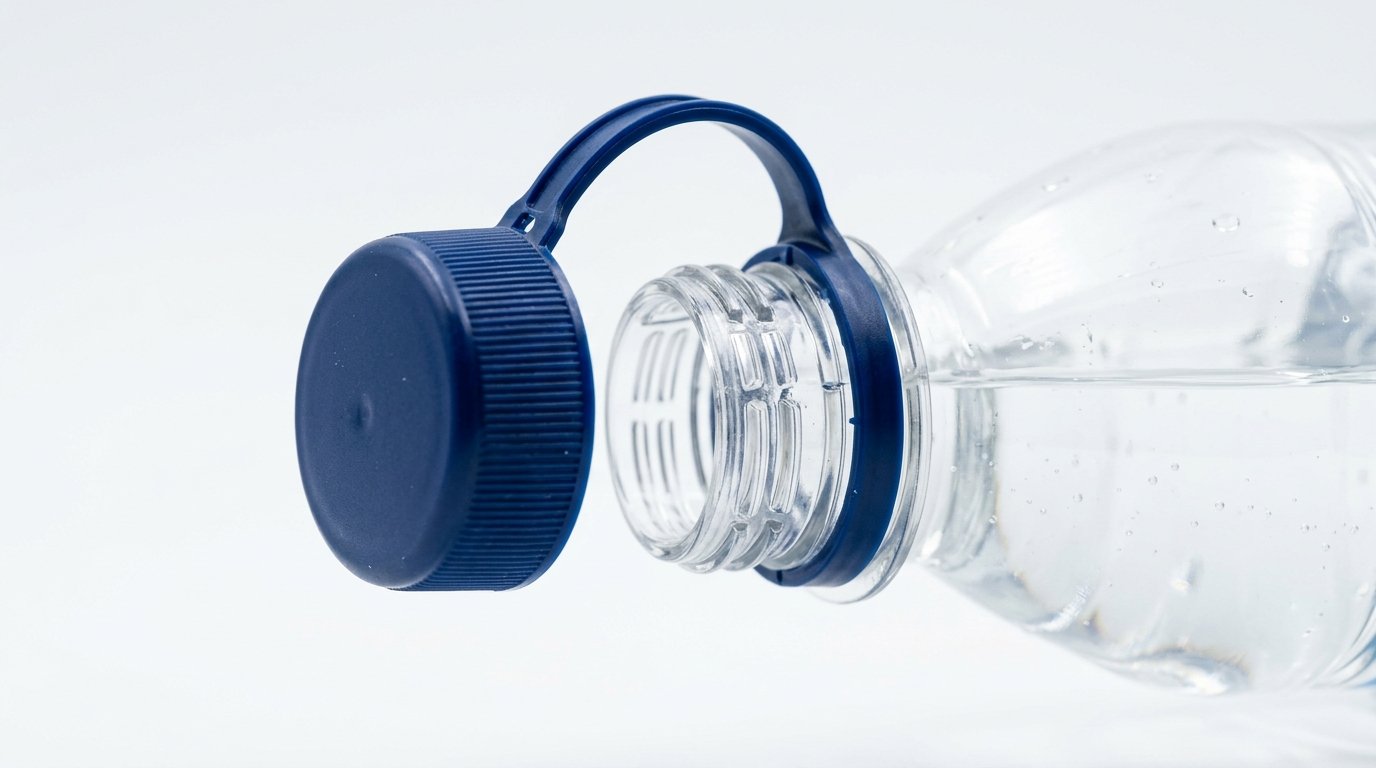
Tethered caps are closures that stay physically attached to the bottle after opening, so the cap does not detach and become loose litter. The European Union now requires them on most single-use plastic drink bottles under its single-use plastics rule. India has no equivalent mandate today, so any move in that direction is speculative for now. This article explains the EU rule and what a shift could mean for closure design.
What a Tethered Cap Is
A tethered cap uses a small hinge, band, or bridge that keeps the cap connected to the neck or ring of the bottle even when it is opened. You unscrew or flip it, drink, and reclose it, but the cap never fully separates. The goal is litter reduction: a cap that stays attached cannot be dropped, blown away, or lost separately from the bottle.
Tethering is a design idea applied to the closure. It is related to, but distinct from, tamper evidence and resealability, which are covered in resealable tamper-evident caps.
The EU Rule That Started It
The driver is the EU’s Single-Use Plastics Directive. Among its provisions, it requires that caps and lids on single-use plastic beverage containers remain attached to the container during use. Bottlers selling into the EU redesigned their caps and necks to comply.
The reasoning is litter data: loose caps are among the most commonly found small plastic items in the environment, and keeping them attached is a direct way to cut that count. This is an EU rule. It applies to products placed on the EU market and does not, by itself, apply in India.
| Point | Status |
|---|---|
| EU tethered-cap requirement | In force for single-use plastic drink bottles on the EU market |
| Scope | Applies to products sold into the EU |
| India equivalent | No mandate today; speculative and worth watching |
| Trigger for Indian relevance | Exports to the EU, or a future domestic rule |
Could India Follow?
This is the honest, watch-this-space part. India has moved on single-use plastics before, including restrictions on certain single-use plastic items, so the policy direction on plastic litter is real. But there is no announced tethered-cap mandate for India, and it would be wrong to claim one exists.
Two channels could still make tethering relevant to Indian brands sooner than any domestic rule:
- Exports. Any Indian bottler selling drinks into the EU already has to meet the tethered-cap requirement for those products.
- Voluntary adoption. Brands that position on sustainability may adopt tethered designs ahead of regulation.
So the practical stance is: no Indian mandate today, a genuine possibility over time, and an immediate requirement only if you export to the EU.
What It Would Mean for Closure Design
Tethering is primarily a design change to the plastic cap-and-neck system on single-use plastic bottles. It affects the hinge or bridge geometry, the neck finish, and the capping line setup.
It is worth being precise about scope. The EU rule targets single-use plastic bottles and their plastic caps. Aluminium ROPP closures, like those R Vision makes for water and beverages, are a different closure family: a metal shell with a tamper band that seals a threaded neck. R Vision’s closures already provide tamper evidence, and the Bev Cap keeps its pilfer-proof ring attached after opening for resealing. Whether metal closure formats would ever fall under a future tethering-style requirement is not something to assert; it is exactly the kind of development to watch.
For background on the closure types involved, see what is a ROPP cap and types of bottle caps. On the recycling side of the same argument, are aluminium caps recyclable covers India’s collection and scrap picture, and the industry shift to PVC-free closures tracks the material change already under way here.
The Practical Takeaway
If you sell only in India, there is nothing to comply with on tethering today, but it is a sensible trend to track. If you export to the EU, tethered caps are already a requirement for those products. Either way, building on closures that already deliver strong tamper evidence and, where relevant, resealability puts a brand in a good position if expectations tighten.
Frequently asked questions
What is a tethered cap?
A tethered cap is a closure that stays attached to the bottle after it is opened, using a small hinge, band, or bridge. It is designed so the cap cannot be dropped or lost separately, which reduces loose-cap litter.
Are tethered caps mandatory in India?
No. There is no tethered-cap mandate in India today. The requirement is an EU rule under its Single-Use Plastics Directive, and it applies to single-use plastic drink bottles sold into the EU, not to the Indian market.
Why did the EU require tethered caps?
The EU introduced the requirement because loose caps are among the most common small plastic litter items found in the environment. Keeping the cap attached to the bottle is a direct way to reduce that litter, so the rule targets single-use plastic beverage containers.
Do tethered rules apply to aluminium ROPP caps?
The EU tethered-cap rule targets single-use plastic bottles and their plastic caps. Aluminium ROPP closures are a different closure family, a metal shell with a tamper band, so they are not the direct subject of that rule. Any future extension is speculative and worth watching.
Should Indian brands prepare for tethered caps?
Brands selling only in India have nothing to comply with on tethering today, but it is a reasonable trend to track. Brands that export to the EU already need tethered caps for those products, so preparation depends on where you sell.
R Vision’s beverage closure already uses a PVC-free liner and a ring that stays with the bottle after opening: see the Bev Cap page, browse the guides on Learn, or contact R Vision to discuss tamper-evident and resealable closures for your bottles.