
 Sankalp
Aluminium bottle caps look more premium, recycle endlessly without loss of quality, and hold a tight pressure seal, but they cost more per unit than plastic. Plastic caps are cheaper and run on simple torque cappers, yet they read as a commodity closure and recycle less cleanly. For water and beverage brands weighing shelf appeal, sustainability, and seal integrity, the trade-off usually comes down to positioning and budget.
Premium look
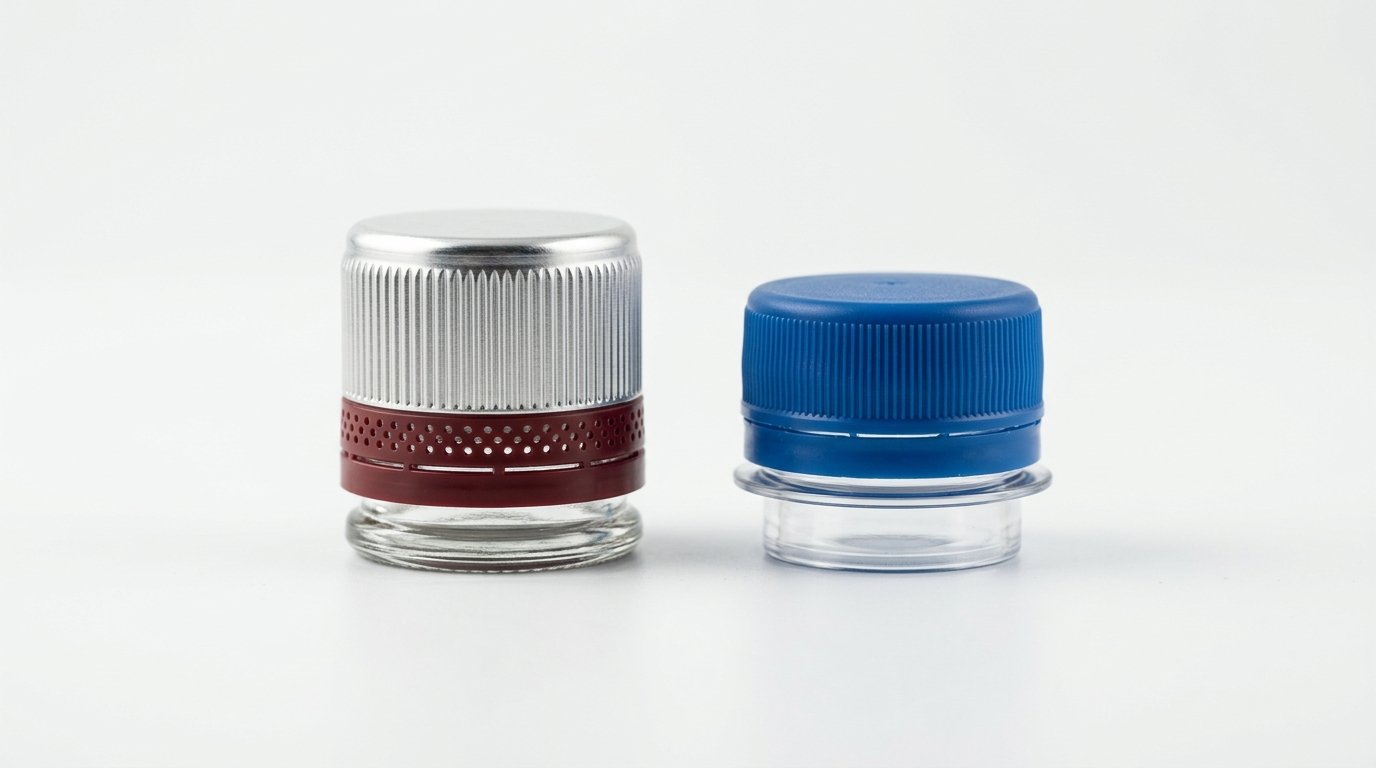
Aluminium closures have a metallic shell that can be anodised, coloured, embossed, and litho printed. On a shelf, that finish signals a premium product, which is why niche water and beverage brands lean on it. Plastic caps are moulded in a single colour and, while they can be tinted, they rarely match the perceived quality of a printed metal cap. If the pack has to look premium, aluminium wins. Types of bottle caps sets out the full range of formats behind that choice.
Recyclability
Aluminium is infinitely recyclable and keeps its quality through every cycle, and it is one of the most widely recovered materials in India’s scrap stream. Are aluminium caps recyclable? goes into how that recovery works in practice here. A plastic cap is recyclable in principle, but caps are small, often a different polymer from the bottle, and frequently lost in sorting. That loose-cap problem is what the EU tethered-cap rule targets, and whether it reaches India is weighed in tethered caps: will India follow the EU? For a brand building a sustainability story, aluminium is the easier claim to stand behind. It is also taint-free, so it does not carry odour or flavour into the product.
Seal
An aluminium ROPP cap has its threads rolled onto the bottle during capping, so the thread is formed to that exact neck and the top block presses the liner into a tight seal. ROPP cap vs screw cap takes the thread comparison further. That makes it strong under pressure: R Vision’s Aqua Cap and Bev Cap are rated to 8 bar, covering hot fill, cold fill, and carbonated products. A plastic screw cap seals through a moulded bead or liner and a matching thread, which works well for still products but leans on tolerance matching rather than a formed fit.
Cost
Plastic is the cheaper closure per unit and needs only a standard torque capper, so the barrier to entry is low. Aluminium costs more per cap and needs a roll-on capping head. Where you buy from moves that number more than most bottlers expect, as imported vs Indian ROPP caps shows. What drives ROPP cap prices in India breaks the aluminium number into its parts. The gap narrows once you factor in the premium positioning, the recyclability story, and the ability to run still and carbonated lines on one closure family, but on raw unit price, plastic is lower.
Side-by-side comparison
| Factor | Aluminium cap | Plastic cap |
|---|---|---|
| Look | Premium metallic, printable | Moulded, commodity |
| Recyclability | Infinitely recyclable, high recovery | Recyclable in theory, often lost |
| Taint | Taint-free | Can carry slight odour or flavour |
| Seal under pressure | Strong; formed thread; R Vision rated to 8 bar | Good for still; tolerance dependent |
| Tamper evidence | Integral pilfer band (ROPP) | Separate band, where fitted |
| Unit cost | Higher | Lower |
| Machinery | Roll-on capping head | Standard torque capper |
Which to choose
Choose aluminium when you want a premium shelf presence, a clean recyclability story, taint-free packaging, or the headroom to run carbonated lines. Choose plastic when the product is a value-segment still fill and unit cost is the deciding factor. Many Indian water and beverage brands start on plastic and move to aluminium ROPP closures as they premiumise. To see the closure families up close, browse R Vision’s products.
Frequently asked questions
Are aluminium bottle caps recyclable?
Yes. Aluminium is infinitely recyclable without losing quality and is widely recovered in India, which makes it a strong choice for brands with a sustainability story.
Do aluminium caps seal better than plastic?
Aluminium ROPP caps form their threads onto the bottle during capping and press the liner into a tight seal, which handles pressure well. R Vision’s closures are rated to 8 bar. Plastic caps seal adequately for still products but depend on tolerance matching.
Are plastic caps cheaper than aluminium?
Yes, plastic caps generally have a lower unit cost and run on simpler capping machinery, which is why they are common in value segments.
Which cap looks more premium?
Aluminium. Its metallic shell can be coloured, embossed, and litho printed, giving a premium finish that plastic moulding rarely matches.
More comparison guides are collected in the learn library. To match a closure to your brand and budget, see the Aqua Cap and Bev Cap pages or contact R Vision.