
 Sankalp
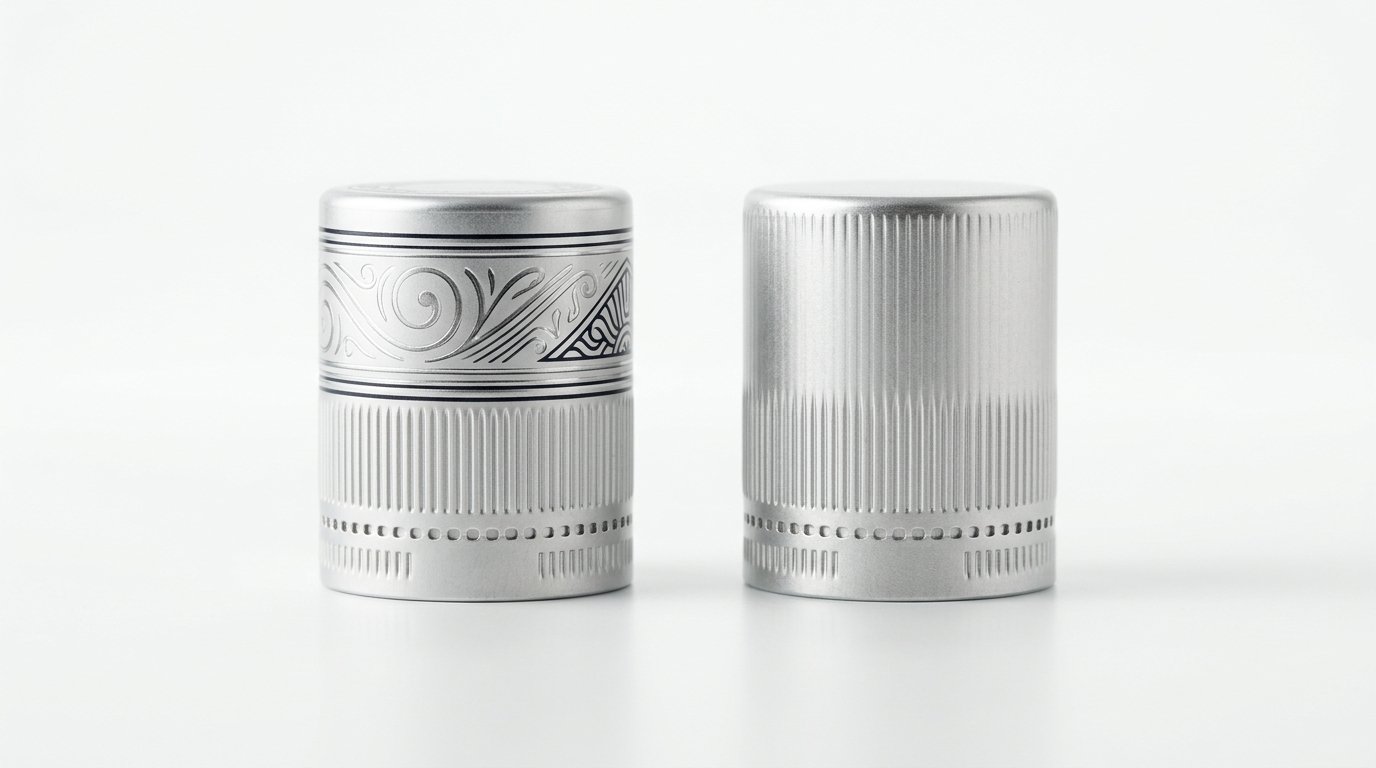
Aqua Cap is R Vision’s premium take on the standard ROPP water cap. Both do the same basic job: seal a water bottle with visible tamper evidence. The difference is in the tamper-evidence design, the pressure rating, and how much of the closure a brand can customise. This guide sets the two side by side so a water brand can decide what its bottle needs. For the wider closure landscape, see types of bottle caps.
The basics both share
Any ROPP water cap is an aluminium shell that gets its threads rolled onto the bottle neck during capping, with a pilfer-proof band that breaks on first opening. That mechanism is covered in What is a ROPP cap? The shared baseline:
- Aluminium construction: light, corrosion-resistant, recyclable, taint-free, weighed against moulded closures in aluminium vs plastic bottle caps
- Tamper evidence built into the cap itself
- A liner that forms the actual seal against the bottle rim
- Application on standard roll-on capping machinery
Where Aqua Cap differs
| Factor | Ordinary ROPP water cap | Aqua Cap |
|---|---|---|
| Tamper evidence | Plain pilfer band with bridge points | Aluminium cap paired with a distinct break-system ring, made to show breakage clearly |
| Pressure rating | Matched to still water | Up to 8 bar, covering sparkling and carbonated products |
| Liner | Varies by supplier | TPE (thermoplastic elastomer) |
| Decoration | Often plain or single colour | Custom colours, litho printing, embossing on the top; litho on the side |
| Finishes | Standard | MCA I/II/III, MCA 7.5 R, MCA 7.5 RF, PET BPF |
| Positioning | Commodity closure | Designed for premium and niche brands that want shelf presence |
Why the tamper-evidence design matters
For packaged water, the cap is the trust signal. An ordinary pilfer band works, but its breakage can be subtle. Aqua Cap’s ring is engineered to break visibly, so a consumer picking the bottle off a shelf can verify the seal without looking closely. For brands selling on purity and safety, that visible assurance carries the brand promise.
Why the 8 bar rating matters for a water cap
Still water does not pressurise the bottle, so an ordinary water cap does not need a high rating. But brands increasingly run sparkling lines alongside still water. A closure rated to 8 bar lets one cap, one capping setup, and one supplier cover both, instead of qualifying a second closure when the sparkling SKU launches. What an 8 bar pressure rating means explains the figure.
When an ordinary cap is enough
If the product is a value-segment still water where the cap only needs to seal and show tampering, a commodity ROPP cap does the job at commodity cost. Where that cap is made matters too, as imported vs Indian ROPP caps sets out. The case for Aqua Cap is strongest when:
- The brand is premium or niche and the pack has to look it
- Custom colour or printed decoration is part of the label design
- A sparkling variant is on the roadmap
- Visible, unmistakable tamper evidence is a brand requirement, not just a compliance box
Sourcing
Where shell consistency shows up in practice is on the capping line, and common ROPP capping defects separates the faults a machine setting causes from the ones an out-of-spec cap causes. Aqua Cap is made by R Vision Pvt. Ltd in Sinnar, Nashik, and ships in 4 to 6 weeks with MOQs from 50,000 caps. More comparison guides are collected in the learn library. Specs are on the Aqua Cap product page; for samples, contact R Vision.