
 Sankalp
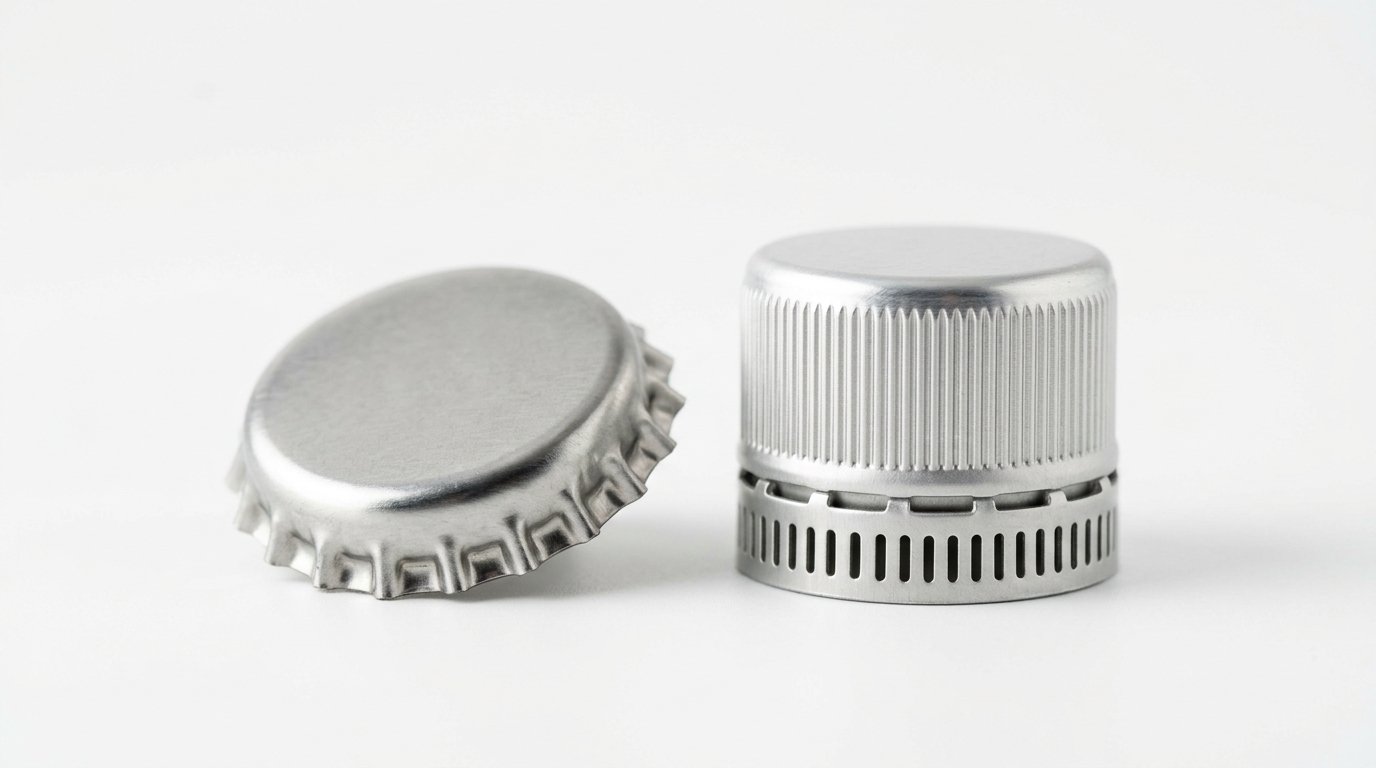
A crown cap is a steel cap about 32 mm across with 21 crimped flutes, pressed onto a 26 mm crown finish on a glass bottle and prised off with an opener. It holds carbonation well and costs less per piece, but it cannot reseal. A ROPP cap is an aluminium shell, 28/15 mm on most Indian water and soft drink bottles, whose thread is rolled onto the neck at capping, so it opens by hand, screws back on and shows first opening with a break ring. Choose the crown for single-serve glass that is finished in one sitting, and the ROPP cap for any bottle the drinker is expected to close again.
The decision in one table
The two closures split on resealing more than on anything else. Pressure, speed and cost narrow the choice; resealing usually makes it.
| Factor | Crown cap | ROPP cap (aluminium) |
|---|---|---|
| Pressure | Holds beer and carbonated soft drink pressure on glass, including returnable glass | Holds carbonated fills on a pressure-rated finish; R Vision’s closures are rated to 8 bar |
| Resealable | No; once levered off, the bottle stays open | Yes; screws back on by hand |
| Opening | Needs a bottle opener | Twist by hand |
| Line speed | A single crimping stroke per bottle, which is why crowners run on the fastest glass beer and soft drink lines | Each head forms a thread and tucks a ring with rollers, so there is more to set and maintain per head |
| Unit cost | Lower per piece: a stamped steel disc with a flowed-in liner | Higher per piece: aluminium, a liner, and often decoration |
| Tamper evidence | A removed or bent crown | A ring that breaks visibly on first opening |
| Container | Glass only, on a crown finish | Glass or PET, on a ROPP finish |
| Typical use | Beer, returnable glass soft drinks, soda water in glass | Packaged drinking water, juices, carbonated drinks, spirits |
| Decoration | Printed top | Printed or embossed top, printed side, colours matched to a brand |
What moves a ROPP cap’s price, from aluminium to decoration to order volume, is set out in what drives ROPP cap cost.
What a crown cap is
The crown cap is the fluted metal cap on a beer bottle. It is stamped from tinplate or tin-free steel, a liner compound is flowed into the underside, and a crowning head presses the skirt down round the bead of the bottle’s crown finish so the flutes close and lock under it. The seal is tight and holds carbonation, which is why the crown has stayed the standard for beer and returnable glass soft drinks. The metals are compared in aluminium vs steel bottle caps. Once levered off, a crown is bent and cannot be refitted.
What a ROPP cap is
ROPP stands for roll-on pilfer-proof. The cap arrives as a plain aluminium shell with no thread. On the line, the capping head presses the shell down onto the bottle, rollers form the thread into the aluminium using the neck finish as the pattern, and a second roller tucks the ring under the bead below the thread. On the first turn that ring breaks and stays broken. The mechanism is covered in what is a ROPP cap?, and the rest of the closure range in types of bottle caps.
Crown cap dimensions against ROPP cap dimensions
Both closures are sized to the bottle finish, not the other way round, and the numbers mean different things. A “26 mm” crown takes its name from the crown finish on the bottle, while a 28/15 ROPP size is a shell diameter and a cap height.
| Dimension | Crown cap, 26 mm crown finish (industry reference) | ROPP cap, 28/15 mm |
|---|---|---|
| What the size refers to | The 26 mm crown finish on the glass bottle | A 28 mm neck diameter and a 15 mm cap height |
| Outside diameter as supplied | About 32 mm across the flutes | 28 mm shell |
| Height | About 6 to 7 mm | 15 mm |
| Skirt | 21 flutes, crimped closed under the bead | Plain skirt; the thread and ring are formed on the bottle |
| Bottle finish | 26 H 126 or 26 H 180 crown finish, published by ISO | A 28 mm roll-on finish such as the MCA family published by CETIE, or PET BPF |
| Material | Tinplate or tin-free steel | Aluminium, with a PE ring on R Vision’s closures |
| Liner | A PVC or PVC-free compound flowed into the crown | A TPE liner on R Vision’s closures |
The crown figures are typical industry values and vary between makers; the bottle’s crown finish drawing is the controlling document. The 15 in 28/15 is the skirt length, which follows the depth of the neck finish, as explained in long skirt vs short skirt ROPP caps. Aluminium gauge and cap weight have their own page, ROPP cap weight and gauge, and the tolerances agreed against each dimension, with how incoming lots are sampled, are in cap dimension tolerances and QC sampling. The glass finishes a ROPP cap runs on, with their CETIE sheet numbers, are listed in glass bottle neck finishes for ROPP caps.
Which closure for your drink
Pick a crown cap when the product is a single-serve carbonated drink in glass, meant to be finished in one sitting, and when the crimped crown is part of how the category looks, as with beer and returnable glass soft drinks. It gives a strong pressure seal at a low unit cost on very fast lines, and nobody expects to reseal it.
Pick a ROPP cap when drinkers open the bottle, drink some and close it again, which is the norm for packaged water and most PET and glass beverage bottles in India. You get resealing, a clear tamper-evident ring and a metal finish that takes print. ROPP cap vs screw cap covers the other threaded option if plastic is on the table.
Which R Vision supplies, and which it does not
R Vision makes aluminium ROPP closures in 28/15 mm and does not make crown caps or capping machines.
| Closure | Supplied by R Vision? | Detail |
|---|---|---|
| Bev Cap | Yes | 28/15 mm aluminium ROPP beverage closure; ring stays attached after opening so the bottle reseals; Round Ring, Two Slit and Five Slit variants; PVC-free TPE liner; rated to 8 bar |
| Aqua Cap | Yes | 28/15 mm aluminium ROPP closure for packaged drinking water; three-part break-system ring; TPE liner; rated to 8 bar |
| Crown caps, any size | No | Buy from a crown cork maker |
| ROPP caps in other diameters | No | Industry reference only; R Vision manufactures 28/15 mm |
The India context
Crown caps still dominate beer and returnable glass soft drinks. Packaged drinking water, juices and most new beverage launches in India ship in PET or lightweight glass with a finish meant to be closed again, where an aluminium ROPP cap or a plastic screw cap is the closure. If the pack is meant to be resealed and carried, a crown is ruled out. Which ROPP closure then depends on the segment, and Aqua Cap vs ordinary ROPP caps compares a premium water cap with a commodity one.
Frequently asked questions
Can a crown cap be resealed?
No. A crown cap is crimped onto the bottle and prised off with an opener, which bends it, so it cannot be put back to reseal the bottle. If resealing matters, use a ROPP cap or another threaded closure.
Is a ROPP cap strong enough for carbonated drinks?
Yes, on a finish designed for pressure. Aluminium ROPP closures hold carbonated fills, and R Vision’s closures are rated to 8 bar, which covers carbonated and sparkling products through warm storage.
Are beer crown caps made of aluminium or tinplate?
Crown caps are steel, either tinplate or tin-free steel, with a liner compound flowed into the underside. Aluminium is used for roll-on closures such as ROPP caps, which are rolled onto the bottle rather than crimped.
What size is a standard crown cap?
A standard crown for a 26 mm crown finish is typically about 32 mm across before it is applied and about 6 to 7 mm tall, with 21 flutes that are crimped under the bead of the bottle. The exact figures vary by maker, so the bottle’s crown finish drawing is what to specify against.
Why do beer bottles use crown caps?
A crown gives a tight, low-cost pressure seal on a glass bottle and applies in a single fast crimp. Beer is a single-serve product that is not expected to be resealed, so the crown suits it.
Which looks more premium?
A ROPP cap has a smooth aluminium finish that can be coloured, litho printed and embossed, which reads as premium on a resealable bottle. Crown caps have their own classic look, tied to beer and glass soft drinks.
Both formats are used on fizzy drinks, and what the category asks of either one is set out in what is a CSD closure. More comparison guides are indexed on the learn page. To match a resealable closure to your beverage, see the Bev Cap and Aqua Cap pages or contact R Vision.