
 Sankalp
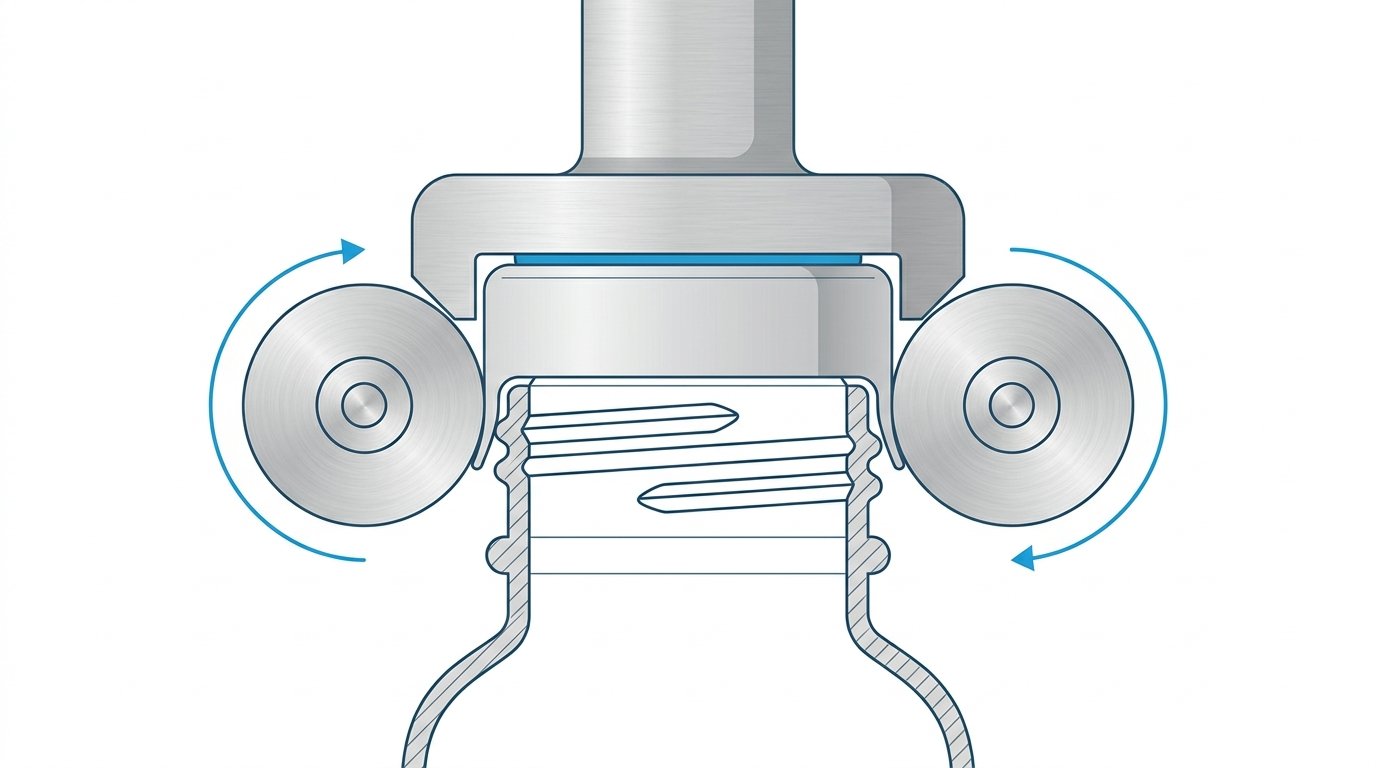
ROPP capping is the process of applying a plain aluminium shell over a bottle neck and using rollers to form the threads and the pilfer-proof band directly onto the bottle. The result is a sealed, tamper-evident closure whose threads match that specific bottle exactly.
How ROPP Differs From Pre-Threaded Caps
A conventional screw cap arrives already threaded and is simply spun onto a matching bottle finish. ROPP (Roll-On Pilfer-Proof) works the other way around. What a ROPP cap is covers the closure; this page covers the process that applies it. The cap starts as a smooth aluminium shell with no threads at all. During capping, machine rollers press the soft aluminium against the glass or plastic neck so the threads are formed on the spot. Because the threads are shaped against the actual bottle, the fit is precise and the seal is consistent. The lower skirt is then rolled under the locking ring to create the tamper-evident band. The two formats are weighed against each other in ROPP cap vs screw cap.
The Step-by-Step Process
ROPP capping happens in one continuous motion once the shell is placed. The shell reaches the line already drawn, coated, lined and scored, a factory sequence described in how ROPP caps are made. The core stages are below.
| Step | What Happens |
|---|---|
| 1. Cap placement | A plain aluminium shell is set over the bottle mouth. |
| 2. Thrust block presses down | A pressure block descends onto the top of the cap, compressing the liner against the bottle rim to form the seal. |
| 3. Thread rollers form threads | Rollers press the aluminium against the neck threads, shaping matching threads into the metal. |
| 4. Pilfer rollers tuck the band | Separate rollers roll the lower skirt under the bottle’s locking ring, forming the tamper-evident band. |
Steps 3 and 4 usually run together as the bottle rotates, forming the thread area and the pilfer band described in the parts of a ROPP cap. When the consumer first opens the bottle, the band separates or perforates, giving a clear visual signal that the seal was intact. The same five stages written out as a line-side sequence, with what each roller forms and what a good seal looks like, are in how ROPP capping works step by step.
The Equipment Involved
ROPP capping equipment scales with production volume. At the simplest end sit single-head hand or bench cappers, where an operator places each shell and the head forms one cap at a time. These suit laboratories, pilot lines, and small batches. As throughput rises, plants move to semi-automatic and then fully automatic multi-head rotary machines, where several heads work in sequence while bottles index through on a turntable. The forming principle is identical across all of them; only the speed and level of automation change. Whichever head you run, the shell diameter has to match the bottle, so start from the ROPP cap size chart. The machine side is covered end to end in the complete ROPP capping machine guide, and the choice between an operator-paced head and a continuous one in semi-automatic vs automatic cappers.
The Advantages
ROPP capping is popular in Indian bottling for a few practical reasons:
- Threads are formed against each bottle, so the fit matches exactly and reduces leaks.
- The compressed liner produces a hermetic seal that protects the contents, and what a cap liner is explains that sealing layer.
- The rolled lower band delivers built-in tamper evidence with no separate part to add.
- Aluminium shells are light, recyclable, and take print and colour well for branding.
Typical Applications in India
ROPP closures are used wherever a secure, tamper-evident metal seal matters. Packaged drinking water is the largest category, followed by carbonated soft drinks, where the closure must hold internal pressure. They are also standard on liquor and spirits bottles, and are widely used in pharmaceutical syrups and tonics that need a reliable, hygienic seal. R Vision’s Aqua Cap serves packaged drinking water with a three-part break tamper-evident ring, while the Bev Cap is built for beverages, keeping its ring attached for resealing, using a PVC-free liner, and rated to 8 bar carbonation pressure.
Related guides
Frequently Asked Questions
What does ROPP stand for?
ROPP stands for Roll-On Pilfer-Proof. The name describes how the closure is made: a plain aluminium shell is rolled on and threaded in place, and its lower band is formed to be pilfer-proof, meaning any tampering leaves a visible sign before the consumer opens the bottle.
Is a ROPP cap reusable after opening?
It depends on the design. Many ROPP caps can be screwed back on after the tamper band has broken, so the bottle can be resealed for later use. The tamper evidence is permanent, though: once the band separates, it stays separated, showing the bottle was opened.
What material are ROPP caps made from?
ROPP caps are made from aluminium, usually a thin, coated sheet supplied as plain shells before capping. Aluminium is chosen because it is soft enough to form threads under roller pressure, light to transport, corrosion resistant, and recyclable. An inner liner sits inside the shell to create the actual seal against the bottle rim.
Can ROPP caps hold carbonation pressure?
Yes, when the closure and liner are specified for it. Beverage-grade ROPP caps are built to retain internal pressure from carbonated drinks without leaking or lifting. The liner material and shell thickness are matched to the pressure rating, which is why carbonated products use closures designed for that duty rather than a standard water cap.
How is the tamper-evident band created?
During capping, pilfer rollers press the lower skirt of the aluminium shell inward and under the bottle’s locking ring. This tucked band cannot pass back over the ring without breaking or perforating. When the cap is unscrewed, the band separates from the upper part, leaving clear evidence that the seal has been broken.
R Vision, based in Nashik, manufactures the aluminium ROPP closures used in the process described above. Other guides in this series are indexed on the closures learning hub.