
 Sankalp
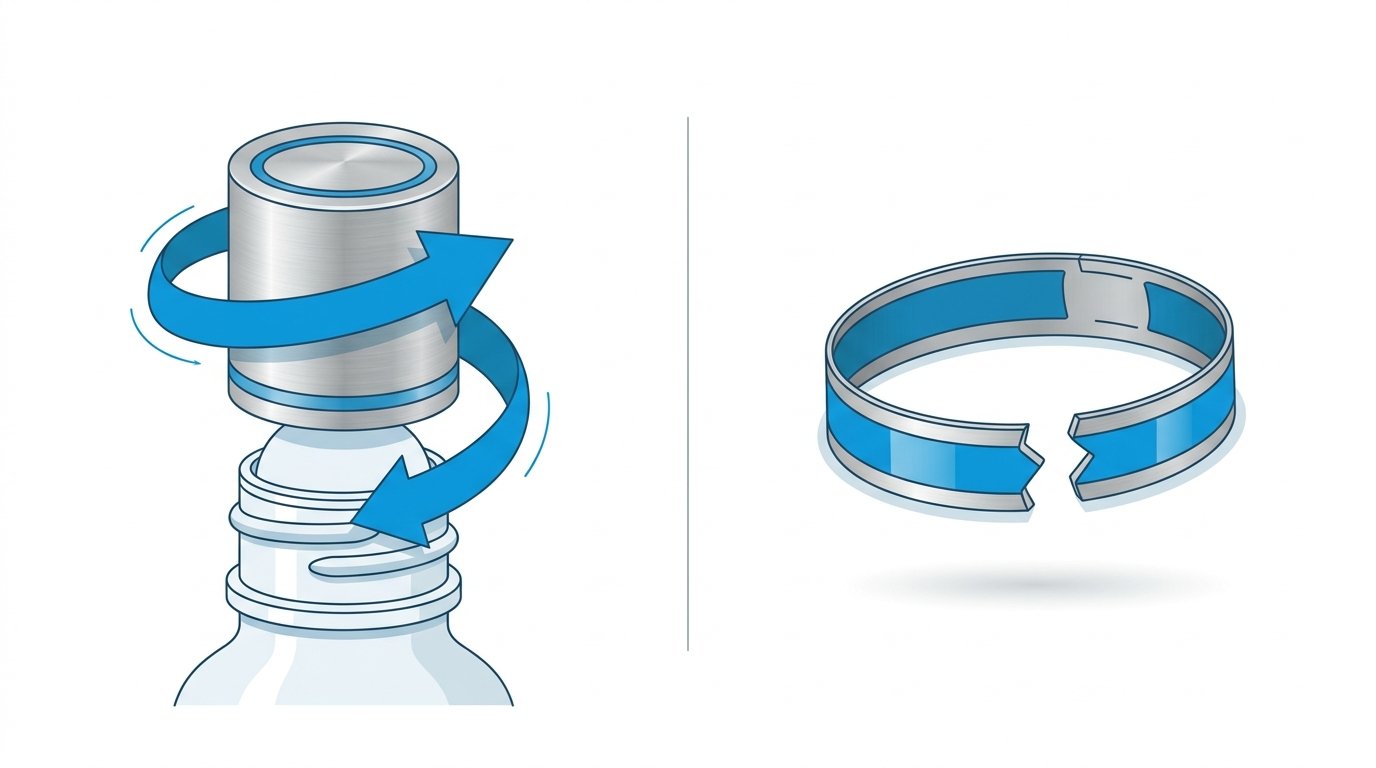
The full form of ROPP is Roll-On Pilfer-Proof. A ROPP cap is an aluminium closure whose thread is rolled onto the bottle neck during capping, with a lower band that breaks when the bottle is first opened. The expansion is the same in water, beverage, liquor and pharma packaging. For the closure itself, start with what a ROPP cap is.
Each word in ROPP explained
Each of the four letters describes either how the cap goes on or what it protects against.
| Letter | Word | What it means on the cap |
|---|---|---|
| R | Roll | The thread is rolled, or formed, into the aluminium by rollers on the capping head |
| O | On | The rolling happens on the bottle, at the filling line, not in the cap factory |
| P | Pilfer | Taking or tampering with the contents without it being noticed |
| P | Proof | The lower band breaks on first opening, so pilfering leaves a visible mark |
Read as two halves, “Roll-On” is the method of application and “Pilfer-Proof” is the promise to the buyer.
What “Roll-On” means
Roll-on means the cap has no thread until it is on the bottle. A ROPP cap starts as a plain aluminium shell. During filling, a capping head presses the shell onto the bottle and uses rollers to form the thread directly against the glass or PET neck finish. This is why the cap fits its container closely: the thread is created on the spot rather than moulded in advance. The rolling sequence on the filling line is described in what ROPP capping involves.
What “Pilfer-Proof” means
Pilfer-proof means the cap shows whether the bottle has been opened. The lower part of the cap is a band joined to the main body by thin bridges. When the closure is first unscrewed, those bridges break. The band either drops down or stays on the neck, so the seal cannot be reset to look untouched. The band, the bridges and the locking ring are labelled in the parts of a ROPP cap, and the wider format in what a pilfer-proof cap is.
“Proof” here is an older trade word. The cap does not stop a determined person opening the bottle; it makes the opening impossible to hide. That is why the broader term tamper-evident is now used for the same promise, and tamper evident vs tamper resistant vs tamper proof sets out what each term can honestly claim.
Why the name exists
The term names the two ideas that define the closure: how it is applied (rolled on) and what it protects against (pilfering, or tampering with the contents before purchase). Pilfer meaning in packaging unpacks that second word on its own. Early screw caps could be removed and refitted without a trace, which was a problem for spirits, pharmaceuticals and other products where tampering carries real risk. ROPP caps were adopted because they combine a close thread seal with a visible tamper record in one aluminium piece.
The terms a buyer meets alongside ROPP
Several words turn up in the same enquiry as ROPP, and some of them mean the same closure while others do not. The table sorts them.
| Term | What it means | Where you see it | Same closure as ROPP? |
|---|---|---|---|
| ROPP cap, ROPP closure | Roll-on pilfer-proof aluminium closure | Supplier catalogues, bottle drawings | Yes |
| Roll-on pilferproof (ROSPP) | The neck finish a ROPP cap is rolled onto | Indian Standard IS 7511 (Part 4) | It is the bottle side of the same joint |
| Roll-on closure | A rolled aluminium cap, with or without a pilfer band | IS 7511 (Part 3) covers the finish for the non-pilferproof version | Only if it carries a pilfer band |
| PP cap | Used two ways: pilfer-proof cap, or a polypropylene plastic cap | Pharma and liquor trade, plastic closure listings | Only in the pilfer-proof sense |
| Pilfer-proof cap | Any closure with a band that breaks on first opening | Water, liquor, pharma | ROPP is the most common type |
| Pilfer band, pilfer ring | The breakaway lower ring of the cap | Specifications, defect reports | A part of the ROPP cap |
| Wad | The liner inside the top panel | Trade usage, as in “ROPP cap with wad” | A part of the ROPP cap |
| Screw cap | A cap with its thread already formed | Plastic and pre-threaded metal closures | No |
The PP cap row causes the most confusion, because a buyer asking for PP caps can be quoted an aluminium closure by one supplier and a moulded plastic one by the next. PP cap, ROPP cap and screw cap settles which is meant where. The pre-threaded alternative is compared in ROPP cap vs screw cap, and the broader tamper category in what a tamper-evident cap is.
ROPP full form in pharma
The full form does not change in pharma: ROPP is still Roll-On Pilfer-Proof, used on syrup, tonic and liquid medicine bottles. What differs is the vocabulary around it, where “PP cap” is common shorthand, and the PP cap page linked above covers that usage.
Where the term is used
ROPP closures are common on liquor and spirits bottles, edible and pharmaceutical oils, syrups, packaged drinking water, and carbonated and still beverages. In India the format is used across food, beverage and pharma packaging. In Indian standards work the bottle side is called a roll-on threads pilferproof finish, specified in IS 7511 (Part 4), which neck finish standards on Indian glass bottles walks through. Diameters and skirt heights for the closures that fit those finishes are listed in the ROPP cap size chart.
A Hindi version of the ROPP guide is at ROPP cap kya hai.
Frequently asked questions
What is the full form of ROPP cap?
ROPP stands for Roll-On Pilfer-Proof. It is an aluminium closure whose thread is rolled onto the bottle neck during capping, and which has a lower band that breaks or shows damage after the first opening, signalling that the container has been opened.
What is the ROPP full form in pharma?
It is the same: Roll-On Pilfer-Proof. Pharma bottles for syrups and liquid medicines use the same aluminium roll-on pilfer-proof closures. The expansion does not change between pharma, liquor and beverage packaging.
Are ROPP caps reusable?
The threaded part can usually be closed again after opening. The lower pilfer band does not reset once its bridges break, so the cap can close the bottle again but the broken band still shows that the seal was opened at least once.
What is the difference between ROPP and a normal screw cap?
A normal screw cap comes with its thread already formed and simply twists on. A ROPP cap arrives as a plain shell, has its thread shaped onto the neck during capping, and includes a tamper-evident band. This gives a close fit and a built-in tamper record.
Where are ROPP caps used most?
ROPP closures are used most on spirits and liquor, edible and pharmaceutical oils, syrups, packaged drinking water and beverages. They suit products where a close seal and clear tamper evidence matter, which is why they are standard across much of the food, beverage and pharma sectors.
Sources
- Bureau of Indian Standards, IS 7511 (Part 4): 1986, Roll-on Threads Pilferproof, for the roll-on threads pilferproof (ROSPP) finish.
- Bureau of Indian Standards, IS 7511 (Part 1): 1992, Dimensions for Neck Finishes, for the series and the roll-on non-pilferproof part.
R Vision Pvt. Ltd manufactures aluminium ROPP closures in Nashik, Maharashtra: the Aqua Cap for packaged drinking water and the Bev Cap for beverages, both listed with specifications on ROPP caps. The rest of the closure explainers sit in the R Vision learn hub.